



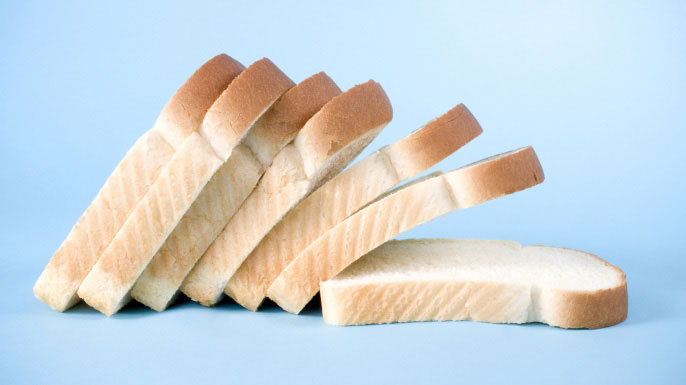
Inventions are the clever creations that make our lives easier, more enjoyable, and endlessly fascinating. They turn yesterday’s impossibilities into today’s necessities—things we can hardly imagine living without. From the humble paperclip to the mighty jet engine, each month we’ll uncover the stories behind the world’s most remarkable inventions and the brilliant minds who brought them to life. This month, we dive into the history behind one of the greatest innovations since…
SLICED BREAD
Before the pioneering invention of pre-sliced bread, the daily routine of preparing meals was markedly different. Bread of all kinds – whether a hearty loaf baked at home or a fresh loaf bought from the local bakery – was sold and kept whole, entirely unsliced. This meant that the consumer bore the personal responsibility of cutting off a slice for every sandwich or piece of toast. The resulting cuts were inevitably uneven, thick in one spot and thin in another, creating irregular slices that were notoriously difficult to manage. This constant necessity for manual slicing was time-consuming, especially for a busy household making several sandwiches. And it proved to be extremely difficult to achieve the uniform, thin slices preferred for toasting and attractive presentation.
The Rohwedder Bread Slicer
This culinary challenge began to change in the early 1900s, thanks to the ingenuity of Otto Frederick Rohwedder. Born in Des Moines, Iowa, he and his family moved to Davenport, Iowa when he was young. Rohwedder was a true inventor at heart, despite his primary professional background. A former ophthalmologist who later found success as the owner of three jewelry stores in the town of St. Joseph, Missouri, he was a keen tinkerer who applied his mechanical precision to solving a widespread domestic inconvenience. Rohwedder dedicated years to developing a design for a machine that could automatically slice and wrap baked loaves of bread. He sold his jewelry stores to fund the development effort and manufacture the machines.
His process was methodical. To gauge the ideal thickness for his future product, he conducted early market research by placing advertisements in local newspapers. These ads offered a questionnaire “for the purpose of determining a thickness of slice which would be most nearly universal in acceptance.” The overwhelming response he received – over 30,000 responses from American housewives – underscored the tremendous, if yet unrecognized, demand for a solution to the bread-slicing problem.
By 1912, Rohwedder successfully created a working model of his revolutionary machine. However, his initial prototypes were met with deep skepticism from professional bakers. Their primary concern was simple but critical: they were certain that pre-sliced bread would quickly go stale, thereby ruining the product and their reputation. In an early attempt to address this freshness problem, Rohwedder even experimented with using metal hatpins to keep the freshly cut pieces of the loaf together, hoping the structural integrity would preserve the bread. Unfortunately, the hatpins continually fell out, detracting from the product’s convenience and safety, proving the need for a better solution.
Tragedy, Resilience, and a Perfected Invention
Rohwedder’s decade-long quest for the perfect machine faced a devastating setback in 1917. A fire at a factory in Monmouth, Illinois, which had agreed to manufacture his device, resulted in catastrophic damage. The blaze not only destroyed the existing prototype but also consumed all of Rohwedder’s meticulously drafted bread-slicing blueprints. The loss set his commercial launch back by a full decade, forcing him to patiently recoup his losses and to recreate his designs.
As Rohwedder rebounded and tirelessly perfected his invention, the American kitchen landscape was evolving. Electric pop-up toasters were becoming more popular in homes across the country, which, in turn, fueled a rapidly increasing consumer demand for thin, evenly cut bread for perfect toasting. This new market need provided the final motivation and justification for Rohwedder’s perseverance.
In 1928, Rohwedder finally solved the fundamental challenge of keeping pre-sliced bread fresh. He added an ingenious feature to his updated Rohwedder Bread Slicer that automatically wrapped the sliced loaf in wax paper immediately after cutting. His perfected machine was a complex assembly of multiple blades that divided the loaf into uniform slices before it was tightly bound in its protective wax paper coating, finally ensuring its freshness and convenience for the consumer.
Instant Success and a Lasting Legacy
Despite the elegance of the new design, many bakeries remained hesitant to invest in the large, expensive device, still fearing the bread would spoil. It took a bold risk-taker to prove the concept would work. In July of 1928, the Chillicothe Baking Company of Chillicothe, Missouri, took the chance. They installed Rohwedder’s machine and placed their first sliced loaf on sale under the brand, Sliced Kleen Maid Bread.
The very first loaves of commercially pre-sliced bread appeared on store shelves on July 7, 1928. The product was an instant, overwhelming success. Within weeks, the Chillicothe Baking Company’s bread sales rocketed by an astonishing 2,000 percent! This meteoric rise immediately caught the attention of every baker in the nation, eager to capitalize on the new convenience. Just two years later, in 1930, the industrial giant Wonder Bread began to commercially produce pre-sliced loaves, rapidly popularizing the product and making sliced bread a household staple familiar to generations of American families.
Within five years of Rohwedder’s successful launch, the transformation was complete. The vast majority of bakeries across the United States had purchased and installed bread-slicing machines, and as much as eighty percent of all bread produced by companies in America was sold pre-sliced. The impact was so profound and immediate that it permanently altered the measure of successful innovation, giving rise to the now-famous epithet, “the best thing since sliced bread.” No one is sure who first coined the phrase, but American consumers certainly agreed with its sentiment, recognizing Otto Frederick Rohwedder’s persistent invention as a true milestone in modern convenience.
An Interesting Historical Footnote
The invention’s success was briefly – and controversially – interrupted during World War II. On January 18, 1943, the U.S. government imposed a short-lived ban on sliced bread. This measure, ordered by Food Administrator Claude R. Wickard, was intended to conserve resources, primarily the wax paper used for wrapping the sliced loaves, and potentially the steel used in the slicing machines. The public outcry was immediate and intense. Housewives and consumers, outraged at the loss of convenience, complained bitterly about the time wasted and the bread ruined by uneven hand-slicing. Recognizing the minimal actual savings and the massive disruption to home morale, the ban was quickly rescinded on March 8, 1943, just seven weeks later. The swift reversal only cemented the invention’s importance in American daily life.