



Ellen Geller Kamaras
“Poland is both a former Jewish paradise and a vast cemetery – overflowing with history, scholarship, creativity, and unbearable loss. We mourned children, scholars, and families erased from history. Visiting Poland, however, is an act of defiance and a testament to the resilience of the Jewish people.” – Ellen
Why, at 70, did I journey to Poland?
After participating in a Post-October 7 Mission to Israel, I felt I could no longer postpone visiting my parents’ birthplace and the sites of Nazi atrocities. My love for Israel was forged at a girls’ yeshiva in Brooklyn and from the ashes of the Holocaust. Bearing witness to the aftermath of October 7 crystallized something in me. I knew it was time to see the sites of mass destruction connected to my own family and to confront my parents’ history.
I needed to witness the barbarism of the Nazis. Only then I felt I could fully speak about the resilience, courage, and survival of our people during World War II and in Israel today. Only then could I grasp the meaning of the words Never Again Is Now.
Growing up, my parents shared their stories every Shabbat: forced labor camps, hiding in forests, hunger, and loss. My mother witnessed her father’s murder. After liberation, the family reached a displaced persons camp in Munich and eventually rebuilt their lives in America.
My Jewish identity was shaped by my parents’ experiences and by my Jewish education. Israel represented survival and renewal.
Off to Poland
Two large Jewish groups were on the same flight to Warsaw. One group of men had completed daf yomi and they were traveling to visit the graves of revered rabbis. The other group included unmarried young women on an Ohel Sarala mission, paired with childless couples through Bonei Olam. Ohel Sarala facilitates single women donating tzedaka to Bonei Olam, which assists couples struggling with infertility. The single women pray for children for their assigned couple, and the couple, in turn, prays for a match for their single.
Sitting on a Polish LOT flight surrounded by so many observant Jews felt surreal. We filled more than half the plane – a living contrast to the destruction we were about to confront.
Approximately 3 million Polish Jews were murdered during World War II, about 90 percent of the pre-war Jewish population.
Our tour guides emphasized both the rich thousand-year history of Polish Jewry and the Holocaust’s devastation. The trip balanced education with emotion.
Warsaw
Before World War II, Warsaw had the second-largest Jewish population in the world after New York City. Nearly 30 percent of its residents were Jewish.
We visited the Jewish Cemetery, where over 250,000 Jews are buried. It was bitter cold, evoking for me my mother’s accounts of frostbite and Elie Wiesel’s descriptions of freezing camps and deprivation. Seeing the beautiful Hebrew headstones deeply moved us.
The cemetery is a silent witness to both extraordinary cultural vitality and to catastrophic loss. We continued to Heroism Street near the former Umschlagplatz (in German: collection point or reloading point – meaning, the holding areas adjacent to railway stations in occupied Poland where Jews were gathered for deportation to Nazi death camps). Here between 254,000 and 265,000 Jews were deported to Treblinka in 1942. Nine out of every ten Jews in Warsaw were murdered. Nearby, the monument to the Warsaw Ghetto Uprising honored those who resisted, choosing fighting over submission.
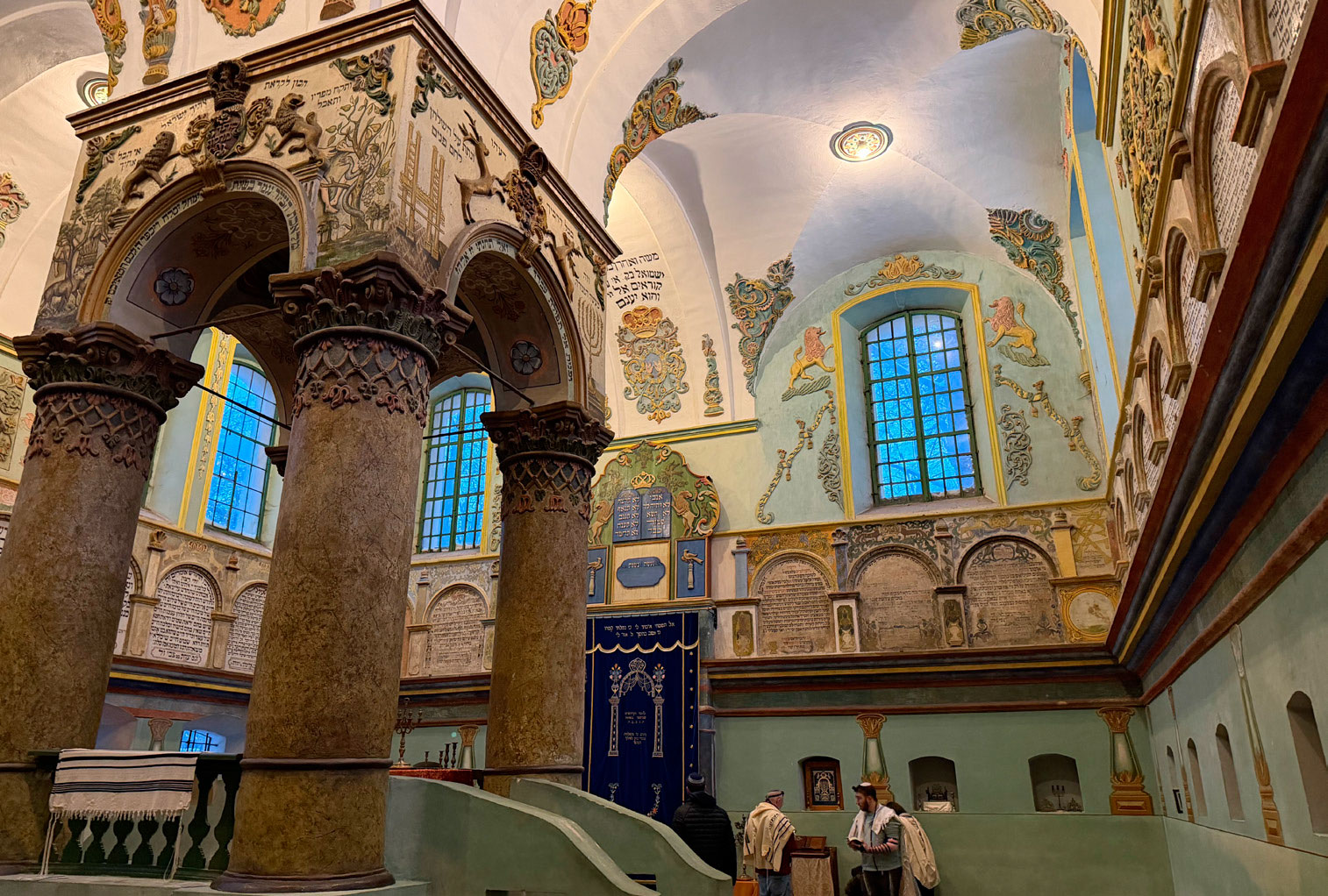
At the Polin Museum, we traced Jewish life in Poland from medieval times to the present. The Nozyk Synagogue, the only functioning prewar synagogue in Warsaw, reflected both loss and continuity. Before the war, there were more than 400 synagogues in the city..
Lublin and Majdanek
In Lublin, we stayed at the hotel in the former Chachmei Lublin Yeshiva, founded by Rabbi Meir Shapiro, the visionary who created daf yomi. Standing in the bet midrash, we felt the presence of generations of dedicated talmidim who once filled that space.
At the Grodzka Gate Center, Polish volunteers, some attempting to do penance for their family members, preserve Jewish memory with devotion and respect.
Majdanek was our first concentration camp. It shattered any emotional distance I still had. Once a POW camp, it became a major killing site. We learned about “choiceless choices.” This term was coined by Lawrence Langer in Versions of Survival: The Holocaust and the Human Spirit, to describe the no-win situations and impossible moral dilemmas faced by Jews during the Holocaust. Seeing the collection of over 56,000 shoes, 6,000 of them small children’s shoes, and the crematoria was overwhelming and revealed the systematic cruelty of the Nazi machine.
Tarnow and Krakow
Arriving in Tarnów, a Chassidic town in Galicia once home to 25,000 Jews, we encountered a landscape of devastation. Forty synagogues were destroyed, including the New Synagogue, often referred to as the Jubilee Synagogue or Franz Josef Synagogue, built in honor of Emperor Franz Josef. One surviving column stands as a memorial in the 15th-century Jewish cemetery. Philanthropist Ronald Lauder helped restore the original bimah, the remaining fragment of the destroyed Alta Shul. Today, one Jew lives in Tarnów, Adam Bartosz, an ethnologist who is the Director of the Regional Museum in Tarnow and is the President of the Committee for the Renovation of Jewish Monuments in Tarnow.
At Zbylitowska Góra, a village in the Tarnow District, we stood before mass graves. A Yiddish inscription reads: “Here lie eight hundred battered heads of children.” We recited Tehillim, struggling to comprehend the magnitude of the loss.
In Krakow’s Kazimierz district, we saw a glimmer of Jewish life slowly reviving. We visited synagogues, the JCC, and memorials. Auschwitz-Birkenau was the largest concentration and extermination complex. This site was the emotional climax of our journey. Some wore Israeli flags and walked through the gates, adorned by a replica of the original “arbeit macht frei” – work sets you free. We saw barracks, gas chambers, and rooms filled with victims’ belongings. Piles of shoes, tallitot, suitcases, and hair testified to mechanized murder and forced us into silence.
The industrial scale of murder defies comprehension. We prayed for our loved ones in both camps.
My niece and I found my grandfather’s name in the Book of Names at Auschwitz, connecting our personal family story to the collective tragedy of our people.
Reflections
This journey strengthened my belief that “Never Again” must be active, not symbolic. We must never be helpless again. The atrocities of the Shoah and of October 7 must never be repeated. We must fight Holocaust distortion and trivialization and preserve historical truth.
Just three years after the Holocaust ended, we miraculously reestablished Jewish sovereignty in our ancestral homeland. We are ambassadors of light, resilience, and hope.