



Victor Cohen
Besides for the rabbi, a synagogue’s hazzan is perhaps the single most influential factor in the strength of the congregation’s prayers. Proficient hazzanut can make the service an inspiring, uplifting experience, arousing people’s emotions and helping them deepen their connection to Gd.
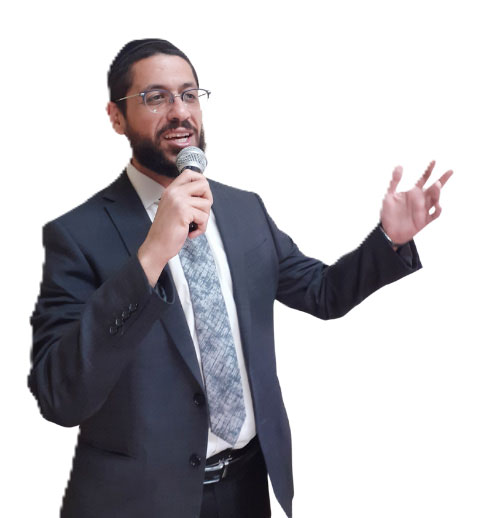
Being a great hazzan depends on more than just having a beautiful voice. The best hazzanim spend years training, honing the craft, and delving into the minutiae of the maqamim – the system of notes and melodies of the prayer service. I had the pleasure of speaking with one of these great hazzanim – Netanel Askari, an exceptionally talented and accomplished hazzan who grew up in our community and now lives in Israel.
Netanel recently made a significant contribution to the world of hazzanut. He created a website with nearly 300 songs, so that aspiring hazzanim can listen to them, learn them, and sing them in their own synagogues. In honor of this achievement, we spoke with Netanel about his journey in the field of hazzanut, his thoughts on how it has developed today, and what he hopes his website will accomplish.
The Emergence of a World-Class Hazzan
Netanel grew up in Brooklyn, and always had a love for music, beginning to learn hazzanut at a young age. He also learned to play violin.
He has a special affinity for Sephardic music. “It always touched my neshamah [soul],” Netanel says, adding that he was always drawn to this genre. He grew up hearing the tunes sung in Bene Yosef and Ateret Torah, and he soloed in the Camp Shivte choir, run by the then-young Mordechai Salem.
From before his Bar Mitzvah, Netanel loved listening to all-star Hazzan Moshe Habusha’s “heavy” songs, as well as Yechezkel Zion and the Tiferet Hamizrach choir. “My parents always had music on in the house and encouraged us to listen and learn.”
Netanel vividly remembers going as a youth to the Chodesh Nissan yearly Tawahits in the Ahaba Veahva synagogue with Rabbi Alouf, Moshe Habusha, along with the master violinist Rafi Shawat. “The excitement there was palpable!”
At age 16, Netanel studied under Rafael Yair Elnadav, the legendary Hazzan who served at Shaare Zion in the 1960s and 1970s. “He really encouraged me.”
At the age of 20, Netanel went to Israel to study in yeshiva. On Shabbat mornings, he would walk to the Sephardic synagogue in Jerusalem’s Bayit Vagan to hear Hazzan Rafi Naftali. He began to understand the differences between the styles and tunes that he grew up with and those which were more common in Israel. Later in life, Netanel returned to Israel, studying maqamim more deeply. He learned from Uri Amram, the author of the “blue book” – an in-depth book on songs and pizmonim– and Rabbi Yosef Nouri.
“Rabbi Nouri taught me so much,” Netanel added. “In Israel, you’re exposed to Sephardic music and hazzanut all over the place, in the weekly Friday night bakashots, in the parties, concerts and haflas, and with the abundance of qualified hazzanim and musicians.”
Today, Netanel lives with his wife and children in Beitar Ilit, a town just south of Jerusalem, where he serves as hazzan of the Mishkan Hakodesh synagogue. He returns to the U.S. each year for the High Holidays, spending time in Bnai Yosef in Brooklyn, and Cedar Avenue Synagogue in Deal. For the past several years, he has had the privilege of serving as hazzan on the High Holidays in Bene Yosef alongside Hacham Moshe Yedid.
“He [Hacham Moshe Yedid] really enriched me with his complex maqam transpositions, his exact knowledge of authentic Syrian tunes and traditions, and, above all, his humility and yirat Shamayim [fear of Gd] that’s befitting a sheliach tzibur [leader of the congregational service].”
In addition to his work in these synagogues, Netanel sings at weddings and other events, and has his own YouTube channel. He has been a part of a choir in Israel called Nehallela, which sings with all-star hazzanim such as Moshe Habusha, Moshe Dweck, and Netanel Cohen.
Netanel also taught Torah and hazzanut in Yeshivat Lev Aharon for five years, with several of his students hazzaning and playing musical instruments in the community today. Netanel’s children follow in his footsteps. “My son Mordechai ‘melts people’ with his sweetness of voice. Singing with my children every Shabbat is me’en Olam Haba.”
Sephardic Music & the “Quarter-Notes”
During our conversation, Netanel explained what maqamim are and how they work.
A maqam is a set of eight notes in a specific order. To understand exactly how it works, let us imagine a piano. Each key of a piano makes a specific sound. Besides the main, white keys, there are also black keys which produce a “sharp” or “flat” version of a specific note, what we might call a “half-note.” Using only the white keys, you could play basic forms of music. If you were to use the white keys and the black keys, using full notes and half-notes, you could play more complex pieces, like the scales used in familiar Western and Ashkenazic music.
But what if there was an additional layer of keys on top of the black keys, a level of “quarter-notes” to accentuate the half-notes? Certainly, this would allow you to produce music on a whole new level of beauty (and difficulty). This, simply put, is what the Sephardic maqam system is.
Sephardic maqamim is what you get when you introduce quarter-notes to hazzanut, adding an entirely new dimension to the music. It is more difficult, yet much richer-sounding, than the Western and Ashkenazic system. The main maqam categories are called Ajam, Nahawand, Bayat, Hijaz, Rast, Siga and Saba, and there are numerous subcategories. If you know how to properly maximize each scale, and also know how to mix in other maqam scales, you can uplift the congregation in ways that are otherwise unimaginable. A hazzan who understands maqam-scalecompositions is light years ahead of a hazzan who does not.
A professional hazzan, Netanel says, has an internal “roadmap” with precise directions for going in and out of the various maqams without losing the initial tone.
“He knows exactly when to give what so that the words penetrate the hearts and the feelings come out. It’s so exciting, so vibrant. It’s a world of its own and such holy work.”
Netanel has a fervent desire to help hazzanim enhance their skills. “I believe that if Hashem gave me a talent, then He gave it to me to give to others.”
“A Sublime Connection to Hashem”
Netanel’s ambition is reinforced by the positive feedback he receives. He frequently receives comments such as, “You literally made my Shabbat!,” “How did you mix Nahawand and Ajam so smoothly like that!” These reactions reinforce his conviction to do more to spread the tradition of Sephardic hazzanut – a conviction that has now given birth to his website – https://www.netanelaskari.com.
As mentioned, the site features 300 different tunes for Shabbat, holidays, and other special occasions, with Syrian, Israeli, and Yerushalmi tunes. They are all clearly organized according to maqams, alongside enriching comments. These include both old, traditional melodies, and more recent creations. During the first 20 years of Netanel’s life, he grew up with the core Syrian tunes of the “red book,” a traditional book of songs and pizmonim that have been sung in our community. In the second twenty years of his life, Netanel absorbed the Israeli tunes and variations. He took the best from both worlds and put it on his website.
Netanel says that this is just the start, as he is planning to add even more content. All the material on the website is available free of charge, to help aspiring hazzanim looking to learn the traditional tunes, and to help experienced hazzanim hone their craft and expand their horizons.
“My dream is that there should be well-trained hazzanim all over the world that are really helping people connect to Hashem,” he explained. “We are going to be praying three times a day for 120 years. It could be boring, or you could enjoy it. There’s a certain sublime connection to Hashem that only music can engender.”
Netanel concluded by citing the rabbinic tradition that in the heavens, just beneath the Shaar HaTorah, (the Gate of Torah), there is Shaar Hanegina (the Gate of Music).
Netanel’s passion for what he’s doing led him to create the “Maqam Academy” where he offers private lessons in hazzanut and maqamim, as well as workshops in Sephardic schools and synagogues. He’s also available for singing at events in Israel and abroad, together with his multi-talented, sweet-voiced son Mordechai.
“For the person with a passion for our beautiful Sephardic music who would like to take it to the next level and own it, I would love to help make it happen,” he says.
To learn more, you can find Netanel’s material at https://www.netanelaskari.com.