



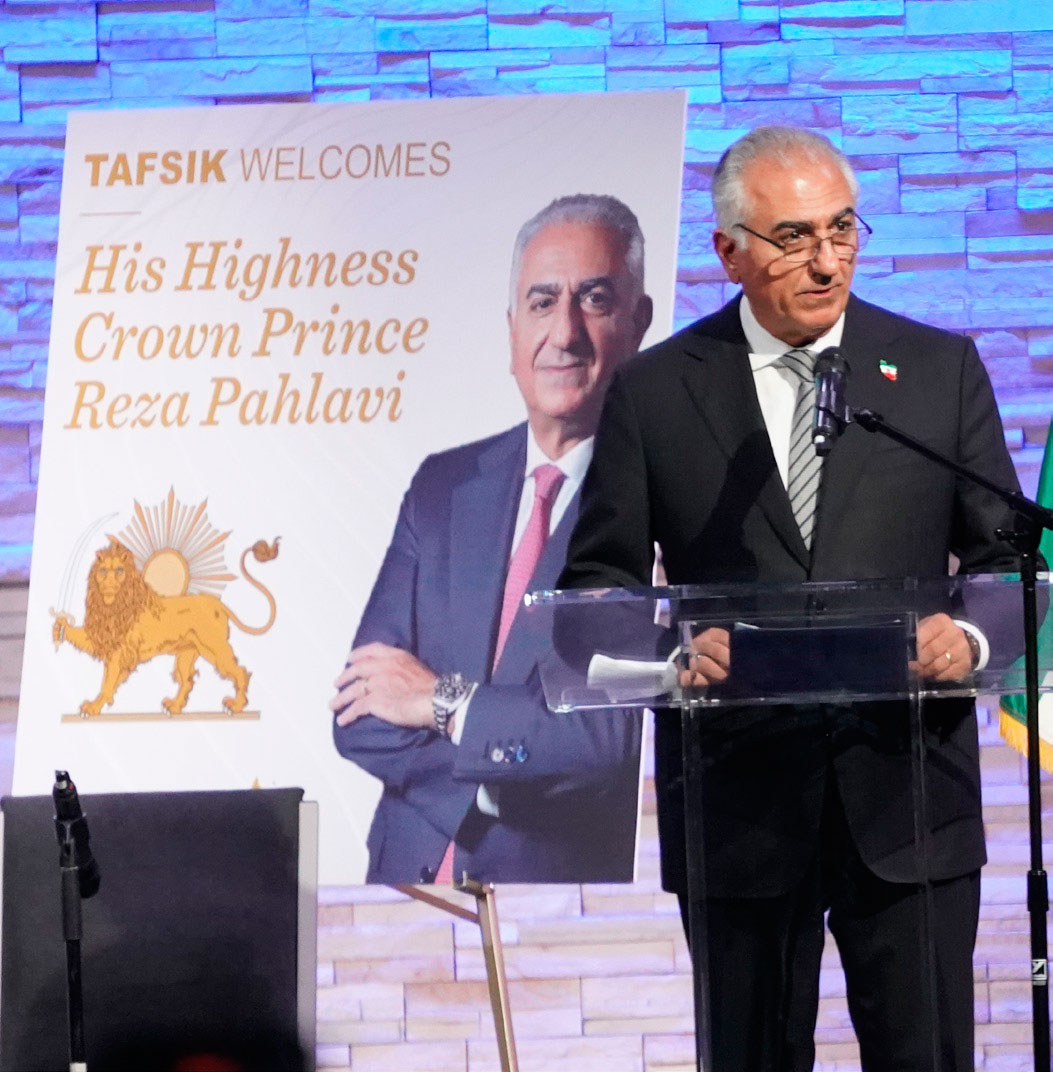
As Iran trembles, Reza Pahlavi Steps Forward as the Self-Declared Bridge
between Revolution and Democracy
Dave Gordon
Once a distant figure in exile, Crown Prince Reza Pahlavi has emerged as a rallying symbol for many Iranians demanding change. His name echoes through the streets during protests, reflecting a growing following inside and outside of Iran.
The son of the late shah fled to the United States after the 1979 Iranian Revolution and has leveraged his royal pedigree and a flurry of media appearances over the past year to raise his political profile.
Pahlavi’s Intended Role
“I think I’ve earned their [my followers’] trust and respect,” he said. “And, that puts me in a position to be impactful in that [leadership] role… I’m not shying away from that responsibility.”
Pahlavi aims to become a transitional leader should the current regime in Iran collapse.
“My role is to see to it that this process culminates in a temporary governance, while the Constitutional Assembly deliberates what exactly will be the rule of law of the land,” he said, touting both secular and democratic values.
U.S. Reactions
Washington remains cautious: As of Jan. 8, President Trump appeared reluctant to meet with Pahlavi. In mid-January, White House envoy Steve Witkoff met with Pahlavi – until now, the only high-level American government official to do so, the news website Axios reported. According to polls cited in the article, one-third of Iranians support Pahlavi, while another third do not.
“Crown Prince Reza Pahlavi has re-entered Iran’s political imagination,” wrote Ali Siadatan, an Iranian Canadian educator, in the National Post. “Today, his support extends beyond traditional royalist circles, reflecting not nostalgia for the past but a search for continuity amid collapse.”
From the outside, the Iranian government’s hold on power appears at its weakest point since the shah was overthrown in the 1979 revolution. With street protests and violent government crackdowns the U.S. is keeping a sharp eye on events. On Jan. 26, the USS Abraham Lincoln carrier strike group arrived in the Indian Ocean, putting it closer to assist in any possible U.S. operations targeting Iran. The USS Gerald Ford is on its way to join the USS Abraham Lincoln.
Iranian Expats Weighs In
Should there be a power vacuum, Pahlavi is “the only alternative,” said Salman Sima, a former Iranian political prisoner who fled Iran to Canada and has organized numerous protests supporting Israel against Hamas. “It is really obvious these days, [that Pahlavi is] the only name you can hear from inside Iran.”
Sima believes the crown prince is a unifying figure who has found support among progressives and conservatives. “He doesn’t take a side, he doesn’t say ‘I’m going to be the shah,’ or ‘I’m going to be the president,’ or ‘I’m going to be the prime minister.’ All he said was a free election must be determined by the people of Iran.”
Iranian expat Dr. Amir Hamidi is the Chairman of the Board of Telo-Revers Anti-Aging Medical Laboratory. He is an internationally recognized expert in global terrorism, cybersecurity, and law enforcement. Regarding Pahlavi he said, “This isn’t a personality contest. In a national liberation moment, the real question is who can unify people, lower the temperature between factions, and keep the transition focused on democracy and the rule of law. He has been consistent on the essentials: a secular state, equal citizenship, rejection of revenge politics, and a future decided only by the Iranian people through free elections.”
The former Justice Department special agent, who also served as country attaché in the United Arab Emirates, added that Pahlavi has recognition across generations and across the political spectrum inside and outside Iran.
Hamidi claims that Pahlavi supports “any figure who places Iran’s sovereignty in the hands of its people, not in the hands of armed factions, foreign powers, or one-party ideologues – and Crown Prince Reza Pahlavi has repeatedly said exactly that.”
Road Map
In July 2025, Pahlavi led a public whitepaper officially called the Emergency Phase Booklet. A whitepaper is an in-depth report to help readers understand a complex topic and present a problem-solving solution. The whitepaper included consultations from a wide array of experts. For starters, Pahlavi calls for Iranians “to be fully involved in the progress of our nation, as opposed to a very corrupt mafia that has been ruling our country all these years.
“I always believe that it’s important for people to have a road map to recovery, to understand what will happen post‑regime. What’s the alternative? How are we to re‑establish a process that will stabilize the country, bring about the opportunity for economic growth and investment?”
Under Pahlavi’s leadership, Hamidi said, “people will have a true opportunity for prosperity, and for that, we have a very comprehensive project of what is to be done short term, mid‑term and long term.” Hamidi sees great potential when the regime falls: “Imagine just the amount of talent that exists within the Iranian diaspora,” he said. “Iran is not just simply an oil‑rich or gas‑rich country – imagine tourism just as an industry, and everything that can open up.
“I’ve talked to industrialists, economists, entrepreneurs, Iranians, and non‑Iranians that are waiting for this opportunity, once Iran is open again as a last untapped frontier,” Hamidi stated. The concern, of course, is that the country have healthy circumstances in order to be reintegrated in the free world, so investors feel comfortable and secure about their assets.
Pro-Israel, Pro-Holocaust Recognition
Reza Pahlavi, like his father, is aligns with Israel and the Jewish people, framing that stance as both historical and moral. He argues that Iranians reject the Islamic Republic’s genocidal anti-Israel and anti-Semitic policies and says a future democratic Iran should restore friendly ties with Israel and its neighbors, which he has labeled potential “Cyrus Accords.” He frequently invokes the legacy of Cyrus the Great – who allowed Jews to return to Judea after the Babylonian Exile. He cites the biblical connection between Persians and Jews, describing their relations as a “Biblical relationship” stretching back 2,500 years. He acknowledges shared values of human rights and religious tolerance. Pahlavi has insisted that, because Tehran denies the Holocaust, he has a particular duty as an Iranian leader-in-exile to honor its victims and reject denialism. He portrays the Islamic Republic as a driver of global anti-Semitism and terrorism, and cast himself and his movement as allies of Jews.
In April 2023, Pahlavi traveled to Israel to carry a message of peace and friendship from the Iranian people, renew ancient bonds, and explore economic and technological cooperation, especially Israeli water technology that he argued could help remedy Iran’s severe water crisis. He attended the Yom HaShoah ceremony at Yad Vashem, declaring it his duty to honor Holocaust victims on behalf of Iranians, and stating that the current regime “doesn’t represent the Iranian people.”
During the trip he prayed at the Western Wall and met senior officials. For many Iranian Jews in Israel, his presence and rhetoric were a symbolic reconnection to an era when Jews felt protected under the Pahlavi monarchy, and as an affirmation that they remained participants of the Iranian story.
Iran and Nukes
After a recent White House meeting with Netanyahu in February, President Trump insisted that Iran nuclear talks must continue. Trump has not restored the JCPOA, the Joint Comprehensive Plan of Action or the “Iran nuclear deal.” Instead, he has initiated a new round of negotiations under a maximum‑pressure framework.
The Crown Prince responded that nuclear weapons are “not a real estate deal that he [Trump] can cut with a regime that is very corrupt.” Pahlavi bristled at the notion of military intervention, “We don’t need to have an army coming into Iran. We have the boots on the ground already – the Iranian people who are there.”
The actual war to fight, he insisted, is the ideological war, that has been the root of much of the unrest in the region for fifty years.
The Eye of the Octopus
“Radicals have always tried to recruit people out of desperation and ignorance, to brainwash them into one way of thinking,” Pahlavi said. “One of the key sources of this radicalization is the regime in Tehran. That’s where the eye of the octopus is. [The West has] been fighting the tentacles, but as long as the eye of the octopus is sitting there, you’re not going to eliminate the problem.” It starts with who bankrolls the terror sources: “Follow the money trail,” he said, “Follow the funding. Once they’re gone, all of that disappears. The funding disappears. The root of the ideology disappears.” That, he suggests, is how you get past the octopus, and back to the country beneath it: an Iran known less for sponsoring militias abroad than for the diversity and openness of its own society. “The beauty of Iran is the diversity of its culture,” Pahlavi said. “That’s the whole beauty of Iran, a nation state that for centuries had this mosaic of ethnic groups and different faiths living side by side.”