



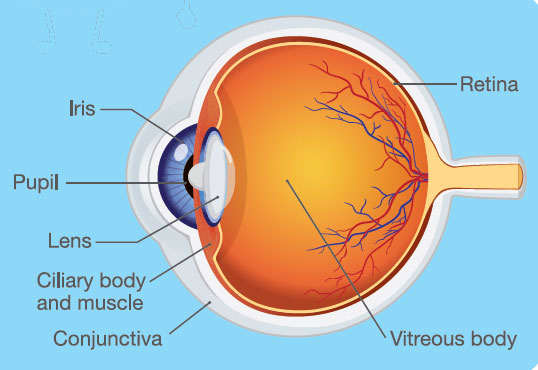
When you look at an object, light rays bounce off of the object and into your eyes. The light rays go through the small, black, circular hole in the center of each eye, called the pupil.
Behind the pupil, there is a lens. The light rays travel through this lens, and the lens bends the light and sends it on to the retina, which is a thin layer of tissue that lines the back of the eyeball. The retina then turns the light rays into signals, which it sends to the brain for visual recognition.
The colored part around your pupil, called the iris, is actually a muscle. Its job is to control how much light gets into your eye. When you are in a bright place, the iris contracts (shrinks) the pupil, so that it lets in less light. When you are in a darker place, the iris opens the pupil wide, so that it lets in more light. This helps you see better.
What Determines Eye Color
Just like the shape of your nose and the color of your hair, your eye color is determined by the genes you inherit from your parents. These genes determine how much melanin, or colored chemical matter, you have in your irises. The more melanin you have, the darker your eyes. Less melanin makes for lighter eyes.
Words of Wisdom
The word “eino – his eye” has a gematria of 136, which is the same as “mamon – money.” This teaches us that what a person sees and perceives is influenced by various factors, such as money and incentives.
Fact or Fiction??
Wearing glasses or contacts will weaken my eyesight, and my eyes will eventually become dependent on them.
This is false! Your eyes will not grow weaker as a result of wearing corrective lenses. However, your prescription may change over time simply due to aging or the presence of an ailment.
Amazing Anatomy
A fingerprint has forty unique characteristics, but an iris has 256 of them! For this reason, retina scans are often used for identification and security purposes.
The Eyes Have It!
Parshat Re’eh begins with Moshe Rabbeinu addressing the people and saying, “See, I have placed before you today a blessing and a curse…” (Devarim 11:26). It seems a bit odd that Moshe chose to begin this pasuk with the word “see” when giving the people the option of choosing between blessing and curse.
The power of the sense of sight is highlighted in many places in the Torah. In fact, as the Gemara tells us (Sotah 8a), the yetzer hara has no power except with respect to what the eyes see.
Of all the five senses, sight is the only one that does not have the inherent weakness of “forgetting.” For example, it is difficult to remember an actual smell after the source of the smell has been removed, or to remember a certain sound after the noise has stopped. Likewise, it is hard to remember the taste of something that has long left our mouths, or to remember how something feels once we stop touching it.
However, even a quick glance at something is enough to make us remember that sight for a long while. Sight is like taking a snapshot of something with our minds; even years later, we can still see the image on the “screens” of our minds and souls. As such, sight has a longer lasting influence on us, for better or for worse, than any of our other senses. Perhaps that is why Moshe Rabbeinu began his address with the word “see,” for embedded in that single word is the secret to how to we can cling to blessing and avoid curse: by being careful with what our eyes are exposed to.
What’s the Difference between Nearsightedness and Farsightedness?
Normal vision occurs when light is focused directly on the retina (the membrane that lines the back of the eyeball) rather than in front of it or behind it. A person with normal vision can see objects clearly whether they are near or far away. Nearsighted people, however, are only able to see objects clearly when they are near, while farsighted people can only see objects clearly when they are far.
Nearsightedness and farsightedness are two very common – but very different – kinds of vision conditions. Both are defects of the eye that affect its ability to focus light on the retina.
Nearsightedness, or myopia (my-O-pee-uh), occurs when light entering the eye falls short of the retina, usually because the eyeball has grown too long. As a result, distant objects appear blurry. This condition is corrected by wearing glasses or contacts that have concave lenses. These lenses spread out the light rays coming to the eye, so that when the light is focused on the eye, it reaches the retina properly. Farsightedness, or hyperopia (hy-per-O-pee-uh), is the opposite of nearsightedness. It usually is caused by an eyeball that’s too short, which causes light to come to a focus behind the retina instead of directly on it. As a result, close objects appear blurry. This condition is corrected by wearing glasses or contacts that have convex lenses, which cause light rays to come together as they approach the eye. In this way the light can be focused correctly on the retina.