



This month we explore the intriguing history behind the…
SELF-DRIVING CAR
For decades, a car that could drive itself existed mostly in science-fiction movies and futuristic drawings. The idea seemed impossible: a vehicle that could understand the road, avoid obstacles, follow traffic rules, and make decisions without a human behind the wheel.
Today, self-driving technology is no longer just a dream. While fully autonomous vehicles that can drive anywhere under all conditions do not yet exist, cars with advanced automated features are already on roads around the world. Behind this transformation is more than a century of research involving engineers, computer scientists, robotics experts, and artificial intelligence (AI) researchers.
The modern self-driving car was not invented by one person or one company. It was created through decades of discoveries that allowed vehicles to sense their surroundings, process information, and respond to changing situations.
The Early Search for Automated Vehicles
The idea of a driverless vehicle began long before modern computers existed. In 1926, a radio-controlled vehicle called the American Wonder traveled through New York City streets in a public demonstration. Although it appeared to drive itself, it was controlled remotely by a person in another vehicle. It was an important demonstration of automation, but it was not truly autonomous.
Interest in automated transportation continued throughout the twentieth century. At the 1939 New York World’s Fair, designer Norman Bel Geddes presented his famous Futurama exhibit, which imagined a future filled with advanced highways and automated traffic systems. Although the technology needed to create that vision did not yet exist, it encouraged engineers to explore new possibilities.
Real progress began when computers became powerful enough to help vehicles understand their environment. During the 1980s, researchers developed experimental autonomous vehicles using cameras, sensors, and computer programs. Carnegie Mellon University’s Navlab project and German engineer Ernst Dickmanns’ work on computer vision demonstrated that vehicles could begin recognizing roads, lanes, and other objects.
Another important milestone was the European PROMETHEUS Project, launched in 1987. This large research effort helped advance technologies such as computer vision, intelligent vehicle systems, and automated driving concepts.
However, early experiments revealed how difficult autonomous driving really was. A human driver makes thousands of decisions almost instantly, often without thinking. Teaching a computer to handle the same variety of situations required major advances in sensors, software, and artificial intelligence.
The Engineering Breakthroughs Behind Self-Driving Cars
Modern autonomous vehicles work because several technologies operate together.
Cameras provide visual information similar to human eyesight. They can recognize lane markings, traffic signs, pedestrians, cyclists, and other vehicles. However, cameras can struggle in conditions such as heavy rain, fog, or darkness.
Radar helps solve some of these problems by using radio waves to detect the distance and movement of objects. It is especially useful for measuring the speed of nearby vehicles and maintaining safe distances from them.
Many autonomous vehicles also use lidar, which stands for Light Detection and Ranging. Lidar uses laser pulses to create detailed three-dimensional maps of the environment around the vehicle. This allows the vehicle to understand the location and shape of objects nearby.
Location technology is another key part of autonomous driving. GPS helps determine where a vehicle is, but self-driving systems require much greater accuracy than ordinary navigation apps. Engineers combine GPS with high-definition maps, motion sensors, and other information to determine a vehicle’s position.
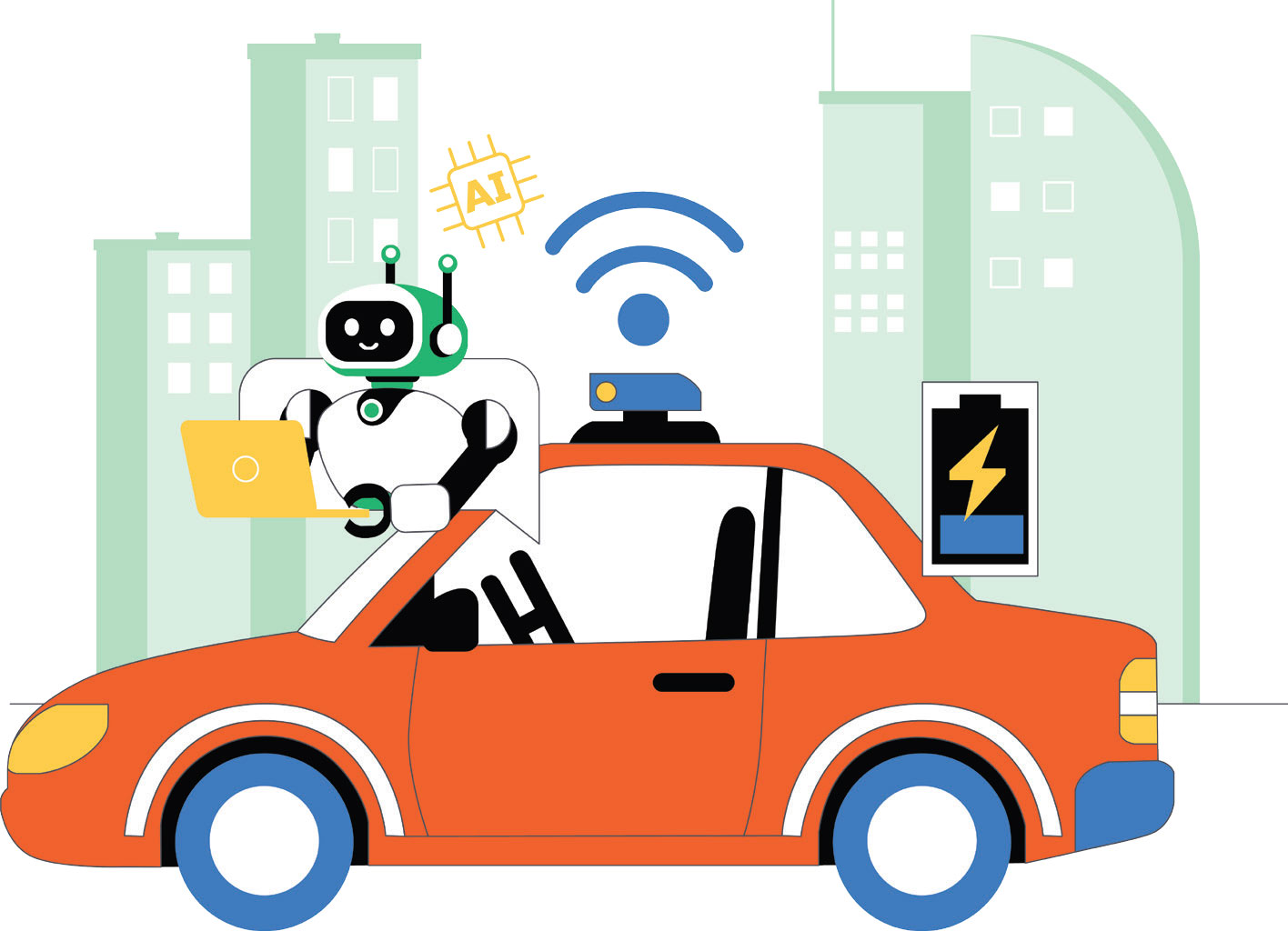
The most important technology may be the vehicle’s artificial intelligence system. AI software combines information from all the sensors, identifies objects, predicts how they may move, plans a safe route, and controls the vehicle’s steering, acceleration, and braking. These decisions must happen in fractions of a second.
The Competition That Accelerated Innovation
One of the biggest turning points in self-driving technology came from the DARPA Grand Challenge, organized by the U.S. Defense Advanced Research Projects Agency.
The first competition in 2004 challenged teams to build vehicles that could travel across a desert course without human control. None of the vehicles completed the route, showing how challenging autonomous driving was.
By 2005, progress had improved dramatically. Several teams completed the course, and Stanford University’s autonomous vehicle, Stanley, won the competition. The achievement proved that self-driving technology was advancing quickly.
In 2007, DARPA created the Urban Challenge, which required vehicles to handle more realistic driving situations, including intersections, traffic rules, and interactions with other vehicles. Many researchers involved in these competitions later helped develop autonomous technology at major technology companies and automobile manufacturers.
In 2009, Google launched its self-driving car project, bringing together experts in artificial intelligence, robotics, mapping, and engineering. The project later became Waymo, which became one of the leading companies developing autonomous vehicle technology.
How Self-Driving Technology Is Used Today
Although fully autonomous cars are not yet available everywhere, self-driving technology is already being used in several ways.
Some companies operate autonomous ride-hailing services in limited areas where vehicles have been carefully tested and approved. These vehicles use cameras, radar, lidar, maps, and AI systems to navigate without a human driver inside under specific conditions.
Most people encounter a simpler form of this technology through advanced driver-assistance systems (ADAS). Features such as adaptive cruise control, lane-keeping assistance, automatic emergency braking, and automated parking help drivers but do not replace them. Human drivers must remain responsible and ready to take control.
Autonomous technology is also used outside passenger cars. Mining companies use self-driving trucks in controlled environments, farmers use automated machinery for precision agriculture, and warehouses use robots to move products efficiently.
The Benefits and Challenges
Supporters of autonomous vehicles believe they could make transportation safer and more accessible. Human mistakes, including distraction, fatigue, and impaired driving, contribute to many crashes. Autonomous systems do not become tired or distracted, and engineers hope they can eventually reduce accidents caused by human error.
Self-driving vehicles could also provide greater independence for people who cannot drive, including some older adults and people with disabilities. They may improve access to jobs, education, healthcare, and daily activities.
However, major challenges remain. Autonomous vehicles must handle unpredictable situations such as construction zones, extreme weather, emergency vehicles, and unusual road conditions. Engineers must also protect vehicles from cybersecurity threats and create safety standards that build public trust.
Another challenge is that today’s autonomous systems operate only within specific limits. A vehicle that can drive itself in one location or situation may not be able to operate safely somewhere else.
The Future of Autonomous Driving
The future of self-driving cars will likely develop step by step rather than arrive suddenly. Engineers continue improving AI, sensors, computer power, and mapping technology.
Researchers are also exploring vehicle-to-vehicle and vehicle-to-infrastructure communication, which could allow cars and roads to share information about traffic, hazards, and changing conditions.
Autonomous trucks, robotaxis, and automated systems in agriculture and logistics may continue expanding. However, the goal of Level 5 autonomy – a vehicle capable of driving anywhere in any conditions without human involvement – remains a long-term challenge.
The invention of the modern self-driving car is a story of human creativity and engineering persistence. From early experiments with remote-controlled vehicles to today’s AI-powered systems, each breakthrough has brought transportation closer to a new era.
The self-driving car is still being invented. The engineers and innovators of the future will determine how far this technology can go – and how it will reshape the way people move around the world.