



Linda Argalgi Sadacka
On Tuesday, October 6th, the day before the third anniversary of the worst massacre of Jews since the Holocaust, I walked into United Nations headquarters in Manhattan. For many of us, that building has become a symbol of what followed October 7th: hostages pushed to the margins, diplomatic language that obscured responsibility, and an international community quicker to scrutinize Israel than to confront those who attacked it. This afternoon, Israel’s Permanent Mission had brought October 7th survivors into a chamber where governments would hear from them directly.
I attended with a close friend. Wherever advocacy takes me, I make a point of having my husband, a relative, or a trusted friend beside me. Our community understands that choice. The values that guide us at home travel with us into public life, whether we are on Ocean Parkway or inside the United Nations.
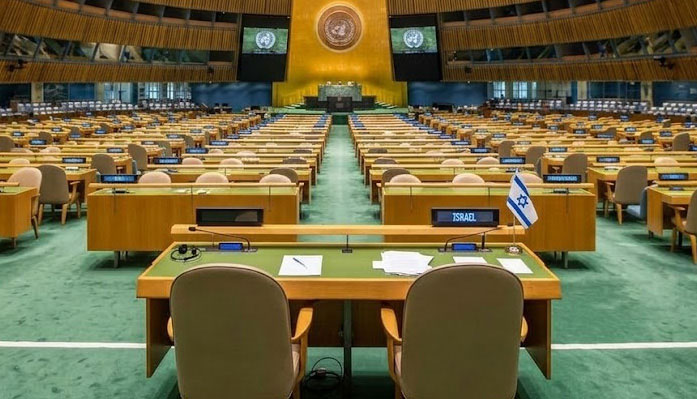
When we arrived, an usher led us down through the chamber. Once seated, I realized where we had been placed: on the lower level, among ambassadors and senior diplomats, just a few rows from the stage. In front of each seat, the small blue screen that normally identifies a country displayed three words: Rise. Rebuild. Recover. Before anyone spoke, those words established what Israel had come to show.
A Chamber Built to Listen
Organized by Israel’s Permanent Mission under Ambassador Danny Danon, the gathering brought together diplomats, public figures, and invited guests. Representatives of the United States, Australia, Germany, the United Kingdom, Argentina, Tanzania, and many other countries were present. An Israeli flag stood beside the stage. On the desks, next to the microphones, rested the earpieces used for simultaneous translation. Everything about the setting suggested an official meeting. Everything about the atmosphere suggested a memorial.
Among those present was my friend Ellie Cohanim, senior policy adviser to Ambassador Waltz at the U.S. Mission. Born in Tehran, she fled Iran with her family after the revolution. She is someone who understands Jewish displacement firsthand and is now helping shape America’s response to threats against our people.
Within our community, we rarely need to explain why the hostages’ names matter or why the losses remain so deeply felt today. Here, the people listening represented governments whose decisions carry consequences far beyond this room. Survivors were addressing an audience with the power to shape policy, influence public opinion, and decide what their countries would remember.
The program centered on Eliya Cohen and Ziv Abud, in conversation with television host and psychologist Dr. Phil McGraw. Ambassador Danon and U.S. Ambassador Mike Waltz delivered remarks. Staff Sergeant (Res.) Oriya Berlin, a surveillance soldier who survived the attack on the Re’im army base, shared her experience. Together, the speakers’ contributions moved the afternoon from the violence of October 7th to the difficult, deliberate work of living afterward.
The Couple at the Center
Eliya and Ziv went to the Nova music festival near Re’im on October 7, 2023. When rockets interrupted the music, they fled and sought refuge in a small roadside bomb shelter. Ziv told the audience that 29 people crowded inside. Terrorists threw grenades into the shelter and fired at those trapped there. Staff Sgt. Aner Shapira (22), an off-duty unarmed soldier in the IDF’s Nahal Brigade, caught grenades and threw them back outside until he was killed. Ziv’s nephew, Amit Ben Avida, was murdered. Hersh Goldberg-Polin was abducted from the same shelter.
Ziv described being wounded and losing consciousness. Eliya, also injured, covered her with the bodies of those who had been killed, hoping the terrorists would believe she was dead. She later regained consciousness beneath them. Eliya was taken into Gaza. They had entered the shelter together. When the attack ended, neither could reach the other.
Eliya spent 505 days in Hamas captivity. Ziv spent those months campaigning for Eliya’s release, speaking publicly and lobbying anyone who might be able to help bring him home. Their separation contained different forms of suffering: his imprisonment and deprivation, her fear and the pressing obligation to keep fighting. The uncertainty surrounding what had happened in that shelter remained part of their ordeal.
After Eliya was released in February 2025, the couple’s reunion became one of the images that allowed people to imagine a future beyond captivity. Eliya’s mother told Ziv that he had bought an engagement ring before the attack. Their plans were in place before Hamas entered their lives. Terror interrupted their plans, but had not been allowed to make the final decision.
At Eliya and Ziv’s wedding this past August, remembrance accompanied the couple and the ceremony. Aner Shapira’s father, Moshe, wrote their ketubah. Ziv’s nephew Amit’s tallit fluttered above the couple, as their chuppah. The people they had lost were present in the symbols surrounding the home they were beginning to build. Our community understands that language: grief carried into celebration, absence acknowledged without surrendering the obligation to live.
Onstage, Dr. Phil asked Eliya about the emotions he carried after captivity. Eliya’s answer resisted the expectation that suffering must leave a person defined by anger. He spoke about refusing to let bitterness determine his life. To his captors and to terrorists watching elsewhere, his message was direct. “I won.” Asked what he wanted to tell those who had prayed and rallied for him, he answered, “Stay proud to be Jewish. Stay proud to be Israeli.” The chamber responded with a standing ovation and resounding applause.
Ziv spoke about survivor’s guilt and the question that follows her: why she returned from Nova when others did not. She described fighting for those she loved while living with unbearable uncertainty. There was no suggestion that marriage had erased what happened, or that survival made the aftermath straightforward or painless. Then she said, “We are here, and we survive.” The force of those words came from everything she had already told us.
Dr. Phil acknowledged how difficult it was to comprehend her experience from the comfort of an air-conditioned chamber. I looked around at the padded chairs, the orderly desks, and the diplomats listening through translation devices. Ziv had brought the reality of that shelter into a setting designed for measured discussion. For anyone paying attention, abstractions about the conflict became harder to maintain.
A Soldier’s Responsibility
Oriya Berlin completed her IDF training as a visual intelligence observer on October 5th and arrived at the Re’im base when terrorists overran it on October 7th. That morning, she and four other women soldiers ran barefoot, unarmed into a small shelter. As nearly 60 terrorists attacked the base, the young women heard gunfire and the screams of fellow soldiers being murdered nearby. These women were soldiers whose work was to watch the border and warn of danger. Now they were trying to survive perilous danger themselves.
Oriya spoke about friends she had been chatting with only 48 hours earlier. Terrorists had murdered them while she sheltered nearby, unable to stop what was happening. Just two days separated an ordinary conversation from a loss she would carry for the rest of her life. As she described what happened, she began to cry. Many in the chamber struggled to hold back tears.
I had come to hear her story, but I had not anticipated how painful it would be to watch her tell it. Standing before ambassadors and diplomats, she was returning to the terror of that shelter and the memory of friends whose lives had barely begun.
Oriya went on to serve as a spokesperson for the IDF diplomacy office. Today, she shares her experience with visiting delegations and public figures, keeping the stories of her murdered and abducted friends before the world. Hearing her, I felt grateful that she was willing to speak, and heartbroken that she had this story to tell.
Bearing Witness
Ambassador Waltz spoke about Eliya’s refusal to cooperate with Hamas’s efforts to use him for propaganda. He described pressure to claim he was being treated well and attempts to turn his release into a staged display. Addressing Eliya directly, Ambassador Waltz emphasized the strength of one whose captors had failed to secure his submission. Hearing America’s representative recognize that resistance inside the United Nations held profound meaning.
Ambassador Danon stated the purpose of the commemoration plainly: “October 7th can never be erased, rewritten, or forgotten.” He described a country profoundly wounded by the attack, but still capable of recovering and choosing life. Eliya and Ziv, seated before the audience as a married couple, personified that claim.
For Israel’s representatives, speaking at the UN often means answering accusations or challenging distorted accounts. This gathering created another opportunity: to place the people at the center of the story before those who make decisions about it. The mission had used its diplomatic platform to make listening possible. Coverage by several news outlets carried that testimony beyond the chamber, extending its reach to people who had not attended. What the guests did with what they heard would be the next measure of its impact.
Conversations Beyond the Stage
After the program, guests gathered around the speakers and survivors.
Dr. Phil’s reach extends into American homes that many Jewish advocates never enter. Since October 7th, he has used that reach to speak about anti-Semitism and to share what he learned from Israelis, hostage families, and survivors.
During the program, he described growing up in Texas and Oklahoma without personal familiarity with Jews or Israel. He spoke about how October 7th divided Jewish and Israeli life into a before and an after. What had struck him in Israel was the capacity to carry immense loss while continuing to create meaningful, beautiful lives.
I thanked him for standing with our people and for speaking clearly when so many public figures retreated into ambiguity. I told him our community appreciated his willingness to distinguish right from wrong when that distinction became uncomfortable. Advocacy depends partly on reaching people beyond those already persuaded. His willingness to bring these stories to his audience gives them a chance to be heard in places we cannot easily reach ourselves.
Ambassador Danon’s work requires representing Israel in an environment where its suffering is too often qualified before it is acknowledged. This time, he had brought diplomats together around the testimony of people who lived through the attack and its aftermath. I told him how much that mattered to our community.
My conversations with Oriya, Eliya, and Ziv were brief. I told them that our community had prayed for the hostages and that our children knew their names. Meeting them brought a sadness different from watching them on a screen. These are young people entitled to private lives, ordinary plans, and happiness unburdened by public testimony. Yet, they continue telling their stories because forgetting has consequences.
What We Carry Forward
Leaving the building, I walked past the flags along First Avenue and thought about the responsibility of being there. Attendance does not change a government’s position by itself. A moving program cannot undo years of institutional failure. Although statistics can offer data, testimony creates a personal connection, and those connections matter when people with influence are willing to listen.
Our community knows the work of rebuilding. Families who left Aleppo and Damascus, Cairo and Beirut carried their traditions into unfamiliar places and established homes, schools, synagogues, and institutions for the generations after them. They understood that continuity requires action: raising children, protecting memory, and accepting responsibility for one another. Eliya, Ziv, and Oriya exhibited that same determination in a different generation.
There is also a responsibility in how we tell these stories. Eliya and Ziv deserve to be understood as people, with lives that began before the attack and will continue beyond it. Oriya deserves recognition for both her service and the burden of bearing witness. When we share their experiences, accuracy is part of our showing respect to those who shared their stories. Their testimony is powerful enough without embellishment. For parents, that means choosing language our children can understand while allowing room for questions. For those of us who write, organize, or speak publicly, it means keeping the people themselves at the center. The purpose of remembering is to preserve what happened and to understand what it asks of us, including how we support those still living with the consequences of what they went through in the years ahead.
These stories belong in our schools, our community programs, and the conversations through which we teach our children Jewish history. A people cannot protect its future without knowing its past. As the familiar warning teaches, those who cannot remember the past are condemned to repeat it. We should teach our children who Aner Shapira was and what he did for the people who sheltered beside him. We should tell them about Oriya’s service, Ziv’s persistence, and Eliya’s return. Give your children names and histories they can carry, so that remembrance becomes knowledge, and knowledge becomes tied with a sense of responsibility.
Eliya spoke about the phrase that sustained him: “Thank You, Father.” Those words ask us to consider what faith can preserve when almost everything else is taken away. They also give meaning to the words on the chamber’s screens: Rise. Rebuild. Recover. On October 6th, we heard what that requires from people doing it. Our task is to carry their stories forward and give them a lasting place in our community’s memory.
Imagine leaving a United Nations chamber without feeling the need for a factchecker. The truth had been spoken by the people who lived it.