



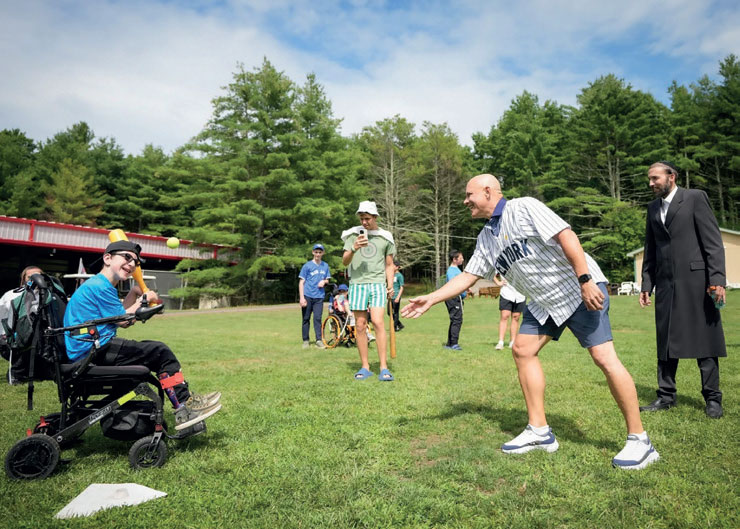
New York Yankees legend Jim Leyritz brought an afternoon of baseball, excitement, and inspiration to the children of Camp Simcha who are all battling serious illnesses. The visit was arranged by New York State Assemblyman Simcha Eichenstein.
Leyritz is best known for his unforgettable three-run home run in Game 4 of the 1996 World Series, a dramatic moment that helped turn the tide for the Yankees in that series and sparked the late 1990s Yankees dynasty, which won four championships in five years.
During his visit, Leyritz played baseball with the campers, shared tips and expertise, and encouraged them to keep fighting. He was deeply touched by the children he met and inspired by their courage.
Leyritz shared the story of his legendary home run and the determination it took to come through in a crucial moment. “I was down to my last strike, and I didn’t give up,” Leyritz told the campers. “Remember that! As long as you have one strike or one breath left, you can overcome just about anything.”
“It was an absolute honor to bring baseball legend Jim Leyritz to Camp Simcha,” said Assemblyman Simcha Eichenstein. “He brought big smiles, unforgettable stories, and tremendous joy to some of the bravest and most resilient kids you will ever meet. His visit was a tremendous inspiration to all the campers, who are facing challenges of their own with incredible strength and courage.”
The Courts Have Spoken: STOP THE BIKE LANES!
A temporary court order has halted New York City’s plans to install new bike lanes in parts of Midwood, Brooklyn, following a lawsuit filed by local residents and organizations. The ruling prevents the Department of Transportation (DOT) from moving forward with the project south of Avenue H while the legal challenge proceeds.
Residents opposing the bike lanes argue the city failed to provide the required public notice and meaningful community input before advancing the project. The lawsuit contends that local elected officials and Community Board 14 were not adequately consulted, despite requests for a public meeting to discuss the proposed street changes.
The legal challenge was filed by several residents and local organizations, including Mesivta Yeshiva Rabbi Chaim Berlin, Yellow Door, and Glatt Mart. It also received support from Councilmembers Simcha Felder and Inna Vernikov, along with Assemblymembers Simcha Eichenstein and Kalman Yeger. The lawmakers called the court order a victory for community involvement, accusing the city of advancing the project without meaningful public engagement. They also argued the proposed bike lanes could create traffic and safety concerns in the neighborhood.
The temporary restraining order is scheduled to remain in effect through Nov. 25th while the case moves forward. The court will ultimately determine whether the city can proceed with the planned bike lanes or must revisit its approval process.
Councilman Simcha Felder’s Fight Pays Off
After months of fighting city agencies to address the disruption caused by the Department of Environmental Protection (DEP) and the Department of Design and Construction (DDC) green infrastructure project in Boro Park, Councilman Simcha Felder secured a major victory for residents: DDC will relocate its long-term construction staging materials off residential streets, restoring parking spaces that were occupied for months. The change is expected to reduce the project’s staging footprint by as much as 70 percent, addressing one of the community’s biggest concerns.
“Every parking space we bring back to the community matters,” said Councilman Simcha Felder. “That’s why we asked senior city officials to leave their comfortable conference rooms and come out to see firsthand what Boro Park residents have been dealing with these many months.”
Felder is now writing legislation to require agencies to conduct an inter-agency “Community Impact Assessment” in consultation with local representatives and the Community Board, before any major project can be approved. The assessment would identify the people and communities most likely to be affected and their specific cultural or community needs. It would then identify the negative impacts of the project on communities such as temporary loss of parking, access to private properties and public services, or other community resources during construction – and require the agencies to plan how they will reduce those impacts and help residents navigate them for the duration of the project.