



Linda Sadacka
There is a difference between protesting a government (namely Israel’s) and intimidating a religious community.
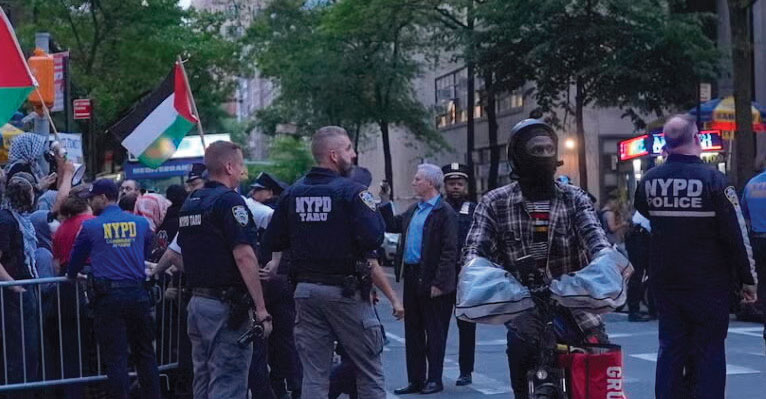
Across the country, anti-Israel activists have increasingly taken their political grievances beyond government buildings, universities, and public squares and brought them directly to synagogues. Jewish families arriving for prayer services, communal gatherings, and events have found themselves confronted by hostile crowds, aggressive chants, blocked entrances, and an atmosphere that can make walking through the doors of a house of worship feel like an act of defiance.
First Amendment Protections
The First Amendment protects the right to protest. It protects offensive speech, unpopular opinions, and political expression that many Americans may find reprehensible. That protection is not incidental to American liberty. It is one of its foundations.
But the Constitution protects something else as well: the free exercise of religion.
Those two freedoms should not be treated as though one must swallow the other.
Americans have every right to protest Israeli policy, condemn Zionism, or criticize the Israeli government in public spaces.
Targeting
But when a political movement deliberately chooses the entrance of a synagogue as the place where American Jews will be confronted over the actions of a foreign government, we should ask a question that has too often gone unasked:
Why the synagogue? A synagogue is not an embassy. It is not a legislature. It is not the Israeli government. It is where Jews pray.
And to Brooke Goldstein, a human-rights attorney, award-winning filmmaker, and Founder and Executive Director of The Lawfare Project, the choice of target is itself revealing.
“The target tells you everything about who these protesters are really targeting,” Goldstein said. “When protesters walk past consulates and embassies, the United Nations, and every government office in New York City and choose to stand outside a Jewish house of worship, they are clearly and unambiguously targeting Jews as Jews.”
Intimidation
Goldstein points to the November 19, 2025 protest outside Park East Synagogue, where, a demonstrator was captured on camera saying, “We need to make them scared.”
“A synagogue doesn’t make foreign policy and is not representative of any government,” Goldstein said. “The only ‘them’ to make scared are congregants.”
New York State Senator Sam Sutton put that distinction plainly.
“When a protest is deliberately positioned at the entrance of a synagogue, the message is no longer simply political. It’s usually an act of intimidation designed to make Jewish families afraid to walk through the doors of their own house of worship. We must protect the First Amendment, but the First Amendment does not give anyone the right to threaten, harass, or intimidate people exercising their own constitutional right to worship. That is exactly why the buffer zone was so important: no New Yorker should have to face a gauntlet of agitators simply to pray.”
No American should have to run a gauntlet of political agitators simply to pray.
Yet elected officials have often appeared more worried about being accused of restricting protest than about confronting conduct that crosses from expression into intimidation.
As Sutton put it, “Protecting free speech and protecting people from intimidation are not contradictory principles. We can and must do both.”
That is the heart of the issue.
Protecting Freedom of Religion
Religious liberty cannot exist only on paper. It must be possible to exercise it in practice. Americans should be able to walk into a synagogue, church, mosque, or other house of worship without having to calculate whether organized intimidation awaits at the entrance.
The bipartisan Right to Worship Act seeks to address this. The legislation would create a 100-foot protected area around houses of worship during services and communal gatherings, to provide greater protection against obstruction, harassment, and intimidation while preserving constitutionally protected expression.
A Jewish mother should not have to walk her children through a crowd screaming about a foreign conflict simply to attend a synagogue program.
This is not an argument for silencing protest. Holding a sign, criticizing Israel, and peacefully demonstrating are considered speech. Blocking synagogue entrances, threatening worshippers, or deliberately disrupting religious activity are considered conduct.
Any buffer-zone law must be carefully drawn so government cannot suppress lawful political expression. But protecting access to a house of worship is not the same thing as suppressing speech. The right to protest does not create an entitlement to threaten or harass worshippers. Protecting religious access does not require the suppression of political dissent.
More importantly, this cannot be understood merely as a Jewish issue. Sutton framed the larger principle in terms that should concern every American.
“No citizen should have to choose between exercising their constitutional rights and exposing themselves or their family to harassment and intimidation. Today that may be a Jewish family walking into a synagogue. Tomorrow it could be any religious or minority community.”
Adaption – Not Acceptance
Freedom of religion is not a special accommodation. It is a foundational American right. Perhaps the most troubling development is how rapidly the extraordinary has become ordinary for American Jews. Private security, guards, and locked doors have become familiar features of Jewish communal life. Jews have learned to adapt. But adaptation should never be mistaken for acceptance.
The burden must also fall on government to ensure that intimidation does not become the price of practicing one’s religion. And this is where outrage must become action.
The Orthodox Union Advocacy Center is urging constituents to contact their senators in support of the Right to Worship Act through its pre-written action alert. Synagogues, schools, rabbis and community organizations should circulate it.
There will always be fierce political disagreement in America. There should be room for demonstrations over Israel, American foreign policy, war, religion, and countless other subjects. But the existence of one constitutional liberty does not require the surrender of another.
We should not have to choose between an America in which people can protest and an America in which people can pray. A free society should be capable of defending both, especially when political anger directed at a foreign government is redirected toward American citizens walking into a house of worship.
That is no longer simply a debate about Israel. It is a test of whether Americans still understand what religious liberty requires and whether we are prepared to defend it before intimidation becomes an accepted feature of American religious life.
America has plenty of space for protest. Surely we can preserve 100 feet for worship.