



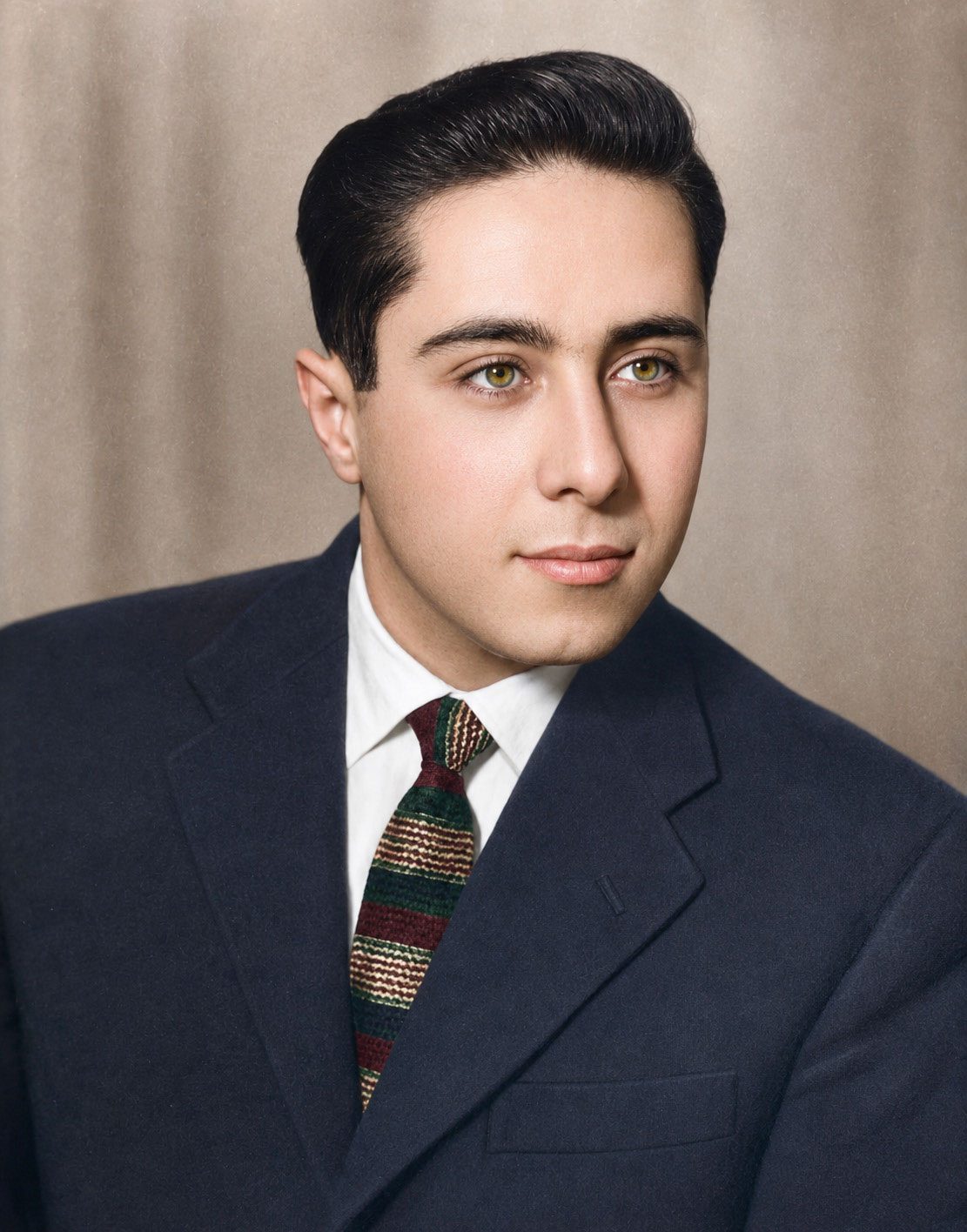
Linda Argalgi Sadacka
Readers may remember that my father, Shlomo Salim Argalgi, a”h, passed away while I was writing my three-part series, about stories of Syrian Jews’ escape to freedom, earlier this year. What I could not do within those pages was to tell you who my father was.
My father was born in Beirut in 1938. At thirteen, he was faced with a decision no child should be burdened with. His mother had been diagnosed with a brain tumor. The surgery that could potentially save her was dangerous. She turned to her eldest son and asked what he thought she should do.
My father told her to have the operation.
She never came home.
He knew he was not directly responsible for his mother’s death. Even so, emotion is not obedient to reason, and the decision he made haunted him for the rest of his life.
His mother’s death also taught my father what it meant to have no one firmly in your corner. Decisions about his education were made without a mother there to challenge them. Decades later, my father still remembered the injustice and had an instinct to seek out and help the person who was overlooked or was left without an advocate.
Montreal
When he arrived in Montreal in 1967, he had little materially, but he possessed intelligence, an extraordinary capacity for work, and a refusal to accept circumstances as destiny.
And then he met my mother, Gladys.
They were married for 57 years. My father adored my mother and, as his circumstances changed, he delighted in giving her beautiful things. He was a jeweler, after all.
But the diamonds came later.
First came the years when they could barely afford milk.
Buying Milk with a Prayer and Hishtadlut
My brother Morris was a baby when my mother called my father one day to tell him they had no money left to buy milk. My father had already spent the day going from jewelry store to jewelry store trying to sell his merchandise. Nobody was buying.
At that moment he turned to Hashem. He prayed that his wife and child should not suffer because he could not provide for them.
Then he tried one more store.
The owner bought everything.
It is tempting to tell that story as one about a miracle, and perhaps it was. But the part that has stayed with me is what my father did after he prayed. He picked up more merchandise and knocked on another door. Faith, for him, was never an excuse for passivity.
Success, Generosity, and Integrity
In time, the man who once could not afford milk built Importex and David Edouard into a substantial jewelry business, with an atelier [studio or workshop], more than twenty employees, and prominent clients. With limited formal education, my father taught himself English, French, and Chinese in addition to Arabic and Hebrew. And he loved history and politics.
Success gave my father the means to give. He helped open a Kollel in Montreal, donated several sifrei Torah, helped establish synagogues, and assisted people in need.
When finances were still precarious, a supplier mistakenly sent my father more pearls than he had purchased. My father returned them. Years later, a Muslim businessman accidentally left a valuable bag of gold in his office. That, too, was returned intact.
What belonged to someone else belonged to someone else.
While traveling for business, my father once helped a non-Jewish man who insisted on repaying him. My father refused.
“If one day a Jew needs your help, help him,” he told him.
The Centrality of Shul
Shul, too, was central to my father’s life. On a visit to Italy, he went to shul with a man who lived there but did not regularly attend shul. My father entered and began greeting people he knew.
The man was puzzled. How could a visitor know more people in the synagogue than someone who lived there?
“Because I go to shul,” my father replied.
To him, a synagogue was where community became visible. You learned who had a simha, who was struggling, and who needed help.
Yet, my father was anything but solemn. He danced, joked, and had a quick wit. A trip for chocolate in Montreal could become an adventure simply because he was enjoying it. He noticed beauty that the rest of us hurried past. He made ordinary life feel worth noticing.
A Devastating Stroke
Fourteen years before his death, a catastrophic stroke brought our family to a very different place. The prognosis left little room for optimism. My father was dying, and the doctors stated there was nothing left to be done. One physician was unwilling to perform the surgery that might give my father a chance.
My brother Morris refused to accept that.
When he discovered that the physician spoke Arabic, Morris began speaking to him in Arabic and pleaded with him to reconsider. Somehow, he convinced him.
The doctor operated.
It was in those earliest days, before my father was verbal and before there was any clear indication of what recovery, if any, would look like, that I asked him to strengthen his observance of Shabbat. He already prayed, put on tefillin, went to shul, and kept a kosher home, but I wanted him to take on Shabbat more fully. I wrote out a commitment for him.
He signed it.
The Impossible Takes Shape
Then, slowly, what we had been told would never happen began to happen.
My father swallowed again. He ate. He drank. He spoke. He walked.
And he lived another fourteen years. Twice seven.
I would never presume to know Hashem’s calculations. Still, in a Jewish life governed by the rhythm of seven, our family could hardly fail to notice it.
Those years gave us far more than time. My father saw grandchildren born and watched them grow. He was there for my brother Morris, for me, and my twin sisters, Caroline and Edna, through the ordinary and extraordinary chapters of our lives. There were semahot, conversations, and constant Torah. He listened to Rabbi Eli Mansour and Rabbi Uri Lati, including shiurim in Arabic.
Thankfully, we decided to record him. We now have on video stories of Beirut, business, people, lessons, and stories that might otherwise have disappeared with him. We did not understand that one day the sound of his voice itself would become part of the inheritance.
The Final Months
My father’s final eleven months were extraordinarily difficult. My mother remained at his side with remarkable devotion, while children and grandchildren made certain he was rarely alone.
During those months, Morris learned about a Jewish woman who had died and whose family lacked the resources for a Jewish burial. The family was considering cremation. My father made calls, secured the necessary help, and ensured that she was buried as a Jew.
My father lay in a hospital bed while one of his children was elsewhere doing precisely what he had spent a lifetime teaching us to do.
Toward the end, my father became terribly thin. His body was no longer properly absorbing nutrition, and for a period he was being sustained intravenously. His strength had almost disappeared.
But he wanted to go home.
The hospital staff placed him in a chair with bicycle pedals for rehabilitation. We told him that if he could regain enough strength, perhaps they would let him leave.
I have a video of what happened next.
Pushing the Pedals
This terribly frail man began pushing the pedals.
When I watch it today, I see the young man in Montreal who had spent an entire day failing to sell his jewelry and nevertheless tried one more door.
The body had changed. The instinct had not.
Several months before my father died, while he was still cognizant, I sat beside him and said what I could not risk leaving unsaid. I thanked him for his sacrifices, generosity, guidance and example, and apologized for the times I had taken him for granted.
Then I told him how deeply I loved him.
I looked into those extraordinary green eyes, flecked with gold and yellow.
He puckered his lips and kissed me.
Then he squeezed my hand.
I knew he understood.
Afterwards, whenever I left the hospital, I developed a personal ritual. I would walk far enough that my father could no longer see me and then turn around for one last look.
I would think: Is this the last time?
I was not terrified of the answer. By then, he had suffered enormously. I simply understood that eventually the answer would be yes.
Eventually, it was.
Zaken Kasher V’shalem
My father died surrounded by his family with a Torah class playing in his room.
At his funeral, a respected Jewish dayan explained that his position required care with words. He could not praise a man merely because the occasion demanded it.
He described my father as a zaken kasher v’shalem, an upright and complete elder.
My father lost his mother at thirteen and spent much of the rest of his life creating what that boy had lost: security, family, community, people who showed up. He built a business, but also shuls. He accumulated wealth, but also gave. He once had no advocate, so he noticed people who had none and took action for them.
Perhaps this is what remains when a life has been well lived. Not simply memories of the person, but his life lessons living inside other people.
Pray, and then knock on another door. If something is not yours, return it. Go to shul. Notice who is missing. Help the person nobody else has noticed. And when your strength is nearly gone, push the pedals once more.
My father spent his life teaching us how to live.
I am only now discovering how much we learned…