



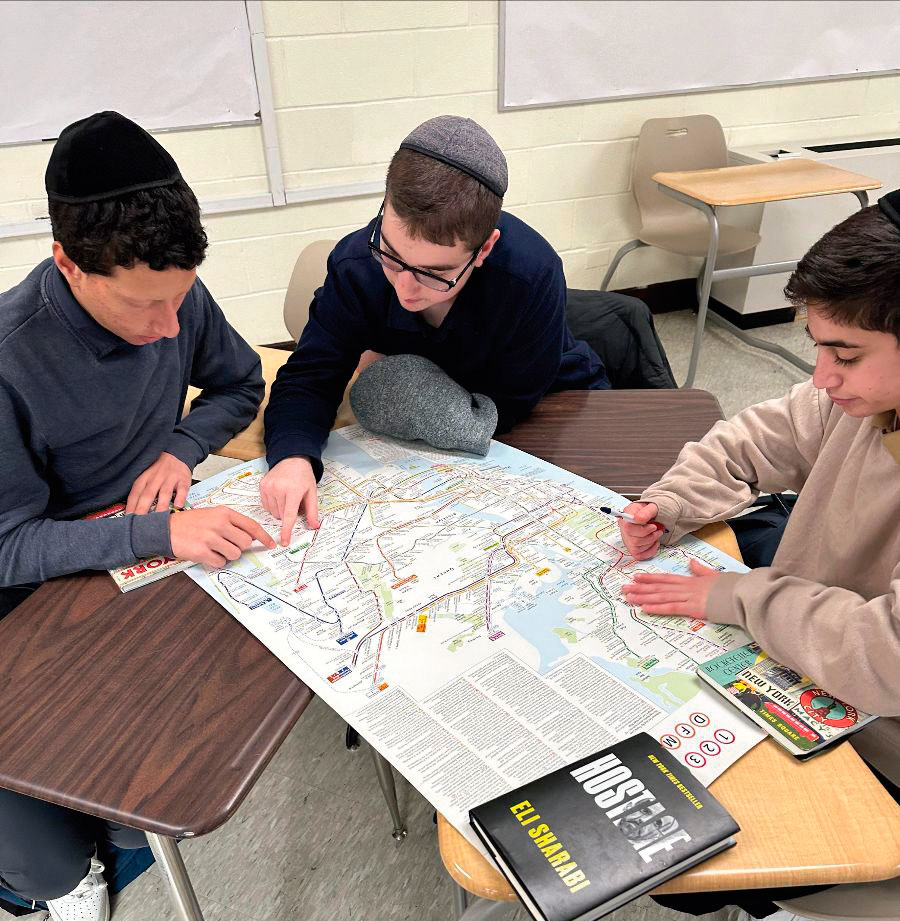
Tenth graders in the Jeff and Rachel Sutton Scholars Program at Magen David Yeshivah recently explored the fascinating history of the New York City subway system. Their study began with the first train that departed City Hall Station in 1904 – just five cents to ride – and traced the subway’s growth into the sprawling, complex network we know today. Students examined how it was built and expanded, how crime and neglect brought it to the brink of collapse in the 1970s, and how it has been depicted in literature, film, and popular culture. They also explored the business side of the system, designing their own subway advertising campaigns to understand how the underground serves as both transportation and a commercial platform.
The unit concluded with a lively, hands-on game. Each group received a full-size subway map and tackled a series of challenges to find the fastest routes across the city while minimizing transfers. Between rounds, teams answered subway trivia questions. Members of the winning team each went home with a mini subway car, complete with its own graffiti, celebrating both their knowledge and creativity.
Anti-Semitic Hate Crimes Surge 182 Percent in New York City During Mayor Mamdani’s First Month in Office
Jewish New Yorkers were the targets of 31 reported anti-Semitic hate crimes in January, according to the NYPD. The data reflected an average of roughly one anti-Semitic incident per day over the course of the month.
In total, police recorded 58 hate crimes citywide in January. Incidents targeting Jews accounted for approximately 54 percent of all reported bias crimes, making anti-Semitism the most prevalent form of hate crime during the period.
Compared with January of last year, the number of anti-Semitic incidents rose sharply. NYPD data showed a 182 percent year-over-year increase, a spike that coincided with new Mayor Zohran Mamdani’s first month in office. The figures have drawn early attention to anti-Semitism as a pressing public safety concern in the city.
Although the January total declined from 40 anti-Semitic incidents reported in December, Jewish residents continued to face more hate crimes than any other group.
Authorities emphasized that the figures remain preliminary, noting that investigators may later determine some incidents lacked a bias motive. Even when police substantiate hate crimes, convictions remain relatively rare, despite stricter penalties tied to the broader impact of such offenses.
The Values We Pass On
“Children learn more from what you are than from what you say.”
Last month, one transplant made those words feel especially real.
Yom Tov didn’t grow up with lectures about generosity. No one sat him down and told him what it means to give. He learned it by watching his parents live it.
Years ago, his mother quietly donated a kidney. She didn’t seek attention or praise. She just did what felt right. Later, his father made the same choice. Giving wasn’t discussed in their home as something extraordinary. It was simply part of who they were.
So when Yom Tov stepped forward this month to donate a kidney, it didn’t feel like a dramatic decision. It felt natural.
At 29 years old, Yom Tov is a husband and the father of three young children. He shared that his motivation came straight from the example his parents set. He saw firsthand what it means to put someone else first, and those lessons stayed with him. When the opportunity arose to help save a life, he didn’t need to search for the courage. It was already part of him.
For the recipient, this transplant means renewed health and a future filled with hope. For the rest of us, it offered something just as powerful – a reminder that the values we live by echo far beyond us. This wasn’t only about one young man giving a kidney. It was about a family that quietly built a legacy of kindness, one choice at a time.