



DAVE GORDON
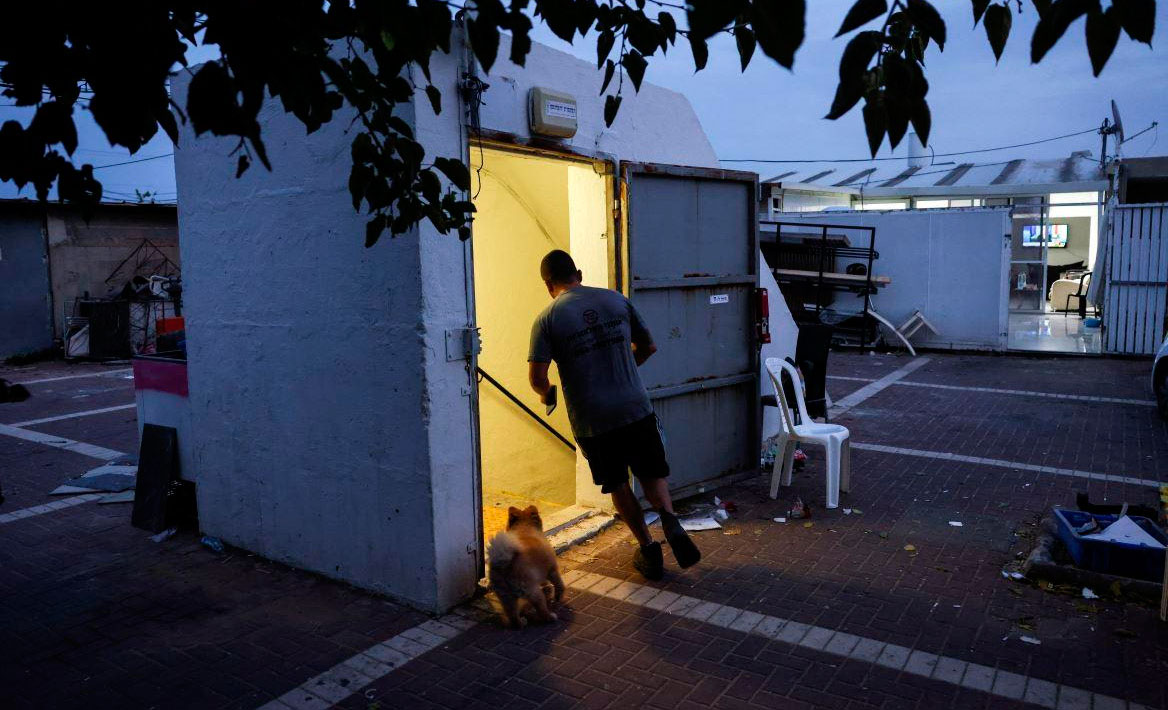
Sirens, school cancellations, and crowded bomb shelters have become the “new norm” of life in Israel. Yet, Israelis have responded with resilience, strength, and communal bonding.
Community Magazine interviewed a cross‑section of Israelis about their lives and their resilience during this period. Israelis are all navigating the backdrop of alerts of possible sirens, often followed by actual sirens, indicating a missile has been fired towards their area. Their reflections exhibit what has changed since Iran and its proxies attacked: the way communities unite to support each other, the sense of purpose, and pride. Yes, families need to stay close to shelters. Certainly, everyone lives with a level of tension and uncertainty. There has been a financial toll on individuals and families. And in this small country everyone feels the losses.
How are Israelis coping, supporting one another, making sense of their fears, and still accessing faith when the future has rarely felt more uncertain? Let’s hear from them.
Journalist Shanna Fuld, of Tel Aviv, originally from Queens, NY, whose apartment was destroyed last June by an Iranian missile
How has your daily routine changed since the war?
In Israel, time is measured between sirens and alerts. When I am going to do anything, I think about what would need to be done before the siren happens. I have evacuated my apartment in the evening for about a month, so that I could sleep in an apartment that has a mamad (reinforced safe room).
You only have so much energy because you’re not sleeping great, and you might be subconsciously worried about being killed in a missile attack. With work, a couple of my gigs are canceled so I’m not getting paid, because I can’t fly and I can’t go to stuff.
What do people outside of Israel not understand?
People don’t understand enough of the frustration of how this disrupts people’s lives… what it takes to rebuild after your apartment has been hit. I was so blessed that my friend posted my situation in a WhatsApp group, and a bunch of women from Tel Aviv, whom I did not know, pulled together bags of their clothing for me and brought it to me at my hotel [where evacuees were resettled].
One person put together a makeup bag, basic cosmetics, including a toothbrush, toothpaste, and face moisturizer. That was the best thing anybody gave me. Community plays an aspect.
I didn’t ask for it, but people from my synagogue sent me donations. And you know what? It was so needed because my compensation package from the government came to me more than three months after the attack, and I couldn’t work for a couple of months because I was spending my days in government offices.
I needed a security deposit for a new apartment, new furniture, and food.
Everybody’s very acutely aware that you probably won’t die from a Hamas missile. You can shelter in the stairwell. But you can’t shelter in the stairwell for an Iran missile, because those are more powerful.
Asif Izak, native Israeli, -is chairman of Or Ofir Foundation, which fosters leadership, strengthens community ties, and builds bridges between Israel and the Jewish world, he is also Head of the Hof Carmel Regional Council
What have these past few months been like for your family?
Two of my children enlisted in the IDF over the past year, and we also have a younger daughter at home. The concern is constant, but alongside it there is also a great deal of strength that comes from family and community. We live in Kibbutz Hahotrim, within a community that demonstrates every day that mutual responsibility is not a slogan – it is a lived reality. This is true within our home, and it is equally true across Hof HaCarmel and throughout Israel.
Have there been evacuations in your area?
In Hof HaCarmel, we were not required to evacuate, but very quickly we found ourselves absorbing around 3,000 evacuees – from both the North and the Gaza border region. This represented about a 10 percent increase in our population in a very short time. We opened our communities, established two new schools for them, and supported them over many months. This was a very tangible expression of mutual responsibility – not just as an idea, but in daily action.
What gives you hope?
I have seen, firsthand, a powerful resurgence of solidarity and mutual responsibility across the country. Out of hardship, people are coming closer together, supporting one another, and strengthening their sense of belonging. These events also remind us how essential the State of Israel is – a place where the Jewish people can live in security, and take responsibility for their own future.
Award-winning Israeli journalist Aviva Engel, originally from Montreal
How has your daily routine changed since the war began?
I live about 30 minutes from Haifa, in Zichron Yaakov – in northern Israel, though fortunately not far enough north to be directly affected by the unrelenting rocket fire from Lebanon. While Purim was marked in a subdued, almost Covid-like way due to restrictions on large gatherings, Passover was remarkably quiet, thanks to the ceasefire.
The beginning of the war was particularly trying, with frequent sirens that required us to stay close to shelters at all times. Simple activities, like long walks, hiking, going to the beach, or even playing outdoor sports, were no longer possible. Thankfully, I work from home and have access to a shelter.
As for daily life, malls, grocery stores, and restaurants equipped with shelters have remained open.
Have you or people close to you suffered personal losses?
Since October 7, a relative’s partner was killed while serving in the IDF, and a friend’s child lost both legs on an IDF mission. We are continually inspired by their courage and heroism, and carry their sacrifices with us in our daily lives.
What does “normal life” mean?
There is an expression in Hebrew, lizrom – to go with the flow. Life right now is anything but normal, and I try to embrace that mindset as much as possible, recognizing how quickly circumstances can change.
Every quiet moment with loved ones feels like a gift, as do the children playing in the nearby schoolyard.
Rabbi Raphael Shore, originally from Canada, author and executive chairman of OpenDor Media
How has this war affected your family?
Being at home more has created a kind of closeness that daily life doesn’t always allow. At the same time, something unexpected has happened in the neighborhoods. People are meeting each other in bomb shelters, sometimes neighbors they barely knew before, and those moments, ironically, have created real connection.
None of this takes away from the stress. People are tired. Sleep is disrupted. But alongside that, there is something strengthening that’s happening, both within families and across communities.
How has this affected your children?
I see it most clearly through my daughter and her family. They have five kids under the age of thirteen.
The kids have been out of school for about a month, and suddenly the full responsibility shifts to the parents. It’s like running a full-time camp. You have to constantly create activities, keep the kids engaged, and make sure they’re not sitting around getting anxious. Sometimes they come over to our house and we do arts and crafts, to give everyone a bit of relief.
It takes a lot of creativity and a lot of extra energy. But what stands out is that families are really stepping up. There’s a strong effort to keep things as normal and as positive as possible for the kids.
Have you or your family experienced any personal loss?
I have a nephew who spent much of the past two years in Gaza. He lost more than twenty soldiers under his command. These are not distant events. They are deeply personal, and very hard.
What helps people keep going is a strong sense of purpose, and the feeling that we are not alone in this. There is a deep sense of family, not just within our own homes, but across the country.
It doesn’t take away the pain, nothing does. But it does help people carry it.
Our son is just finishing his army service this summer, but he’s been in a state of war from the very beginning. Even now, when he’s on base near Tel Aviv, they’re hearing explosions overhead regularly. It’s a constant reminder of what’s going on, and it’s not easy.
How has this affected your faith and hope?
Faith here is very strong, even if it doesn’t always look the way people expect.
There’s a perception outside of Israel that it’s a largely secular society, and in terms of formal religious practice that may be true for many. But the level of emunah, of belief and deeper awareness, is much more widespread than people realize.
In a time like this, that becomes very visible. People feel that we are living through something beyond the ordinary. You see it in the stories that come up almost daily, situations that could have ended in far greater tragedy and didn’t. Just yesterday, for example, a missile struck a building with a massive explosive that, had it detonated fully, could have leveled an entire block. It didn’t. Moments like that leave a strong impression.
Entrepreneur and author of Hinenu (Here We Are), David Shlachter, made aliya from California and resides in Tel Aviv
What has life been like for you and family?
Before the war, our daily life in Tel Aviv felt almost unusually smooth. Our kids’ school is two blocks away. We don’t have a car, and they bike everywhere. When the war started, that disappeared immediately. School shut down, work essentially stopped, and movement shrank to a very small radius around our building. Even something simple like going for a run or out to eat comes with the expectation that you may need to drop everything and get to a bomb shelter within minutes.
What has it been like in the shelters?
Two other families moved into our apartment because they didn’t have adequate bomb shelters, so at times we’ve had 15 to 18 people living together, including nine kids. There’s very little privacy, and no real separation between day and night, work and rest. That creates friction, but it also creates a kind of shared resilience. Practically, we’ve had to be flexible – sharing space, coordinating meals, helping with each other’s kids. Emotionally, it’s about staying steady for the children and for each other. There’s something stabilizing about not going through it alone.
How has this affected the kids?
The kids feel the disruption immediately. It’s obvious that they should be in school, that they need structure and normal interaction, and that absence is hard to replace. At the same time, they adapt in ways that are surprising. They’ve created their own routines – games, activities, and ways of passing time. Even the bomb shelter sometimes becomes a place where they play. What stands out is how quickly they normalize the situation.
Our nanny was called up to reserve duty in a search-and-rescue unit, and that shift was immediate. She went from being part of our daily life to being on the front lines responding to missile strikes. The emotional experience is a mix of concern and gratitude – knowing people close to you are in harm’s way, but recognizing that they’re the reason the rest of us have some degree of safety.
David Lange, originally from Australia, editor of news site IsraellyCool, whose stepson fell in battle in Lebanon
Since the Iran war began, how has your daily routine changed?
There was no change to my work routine, because I work from home.
But there were definitely changes to my travel routines. When we get a missile alert, we have one and a half minutes from siren to shelter. You don’t want to be caught in the middle of driving somewhere, because you might end up on the side of the road just ducking down.
Once I got stuck outside, I was near a shopping center so I pulled into the car park, ran out, and went into their shelter.
These days I don’t go for long shopping trips, because, obviously, I didn’t want to be stuck.
What kind of community support did you receive after your stepson was killed?
That’s one of the shining lights. When people found out, there were multiple communities in our city that were ready to do everything we needed. People provided meals and cleaned the house. Right before Pesach, there was no official shiva. But my wife and her ex-husband had an open house, similar to shiva where people come and pay their respects and talk, which I think is a very cathartic experience.
Hundreds of people came, including Israeli President Isaac Herzog, and a sheikh from a Druze village. It really showed the unity of Israeli society. And it was just so comforting.
Has this affected your faith or hope? It doesn’t make us lose hope or faith. In fact, having the hope and faith helps us cope with the conflict, and anti-Semitism, which we’re seeing around the world.
Resilience in Israel is not a slogan or a moment of triumph – it is a daily practice, quiet and cumulative. It lives in the split-second decisions made between sirens, in the crowded shelters where strangers become neighbors, in the parents who steady their voices for their children, and in the communities that refuse to let anyone face loss alone. Resilience does not erase fear or grief. It strengthens people. In a country where uncertainty hums beneath the surface of ordinary life, resilience is found not in the absence of danger, but in the insistence on living fully despite it – holding fast to one another, to purpose, and to a deeper faith that even in the darkest moments, they are not alone, and that something larger is carrying them forward.