



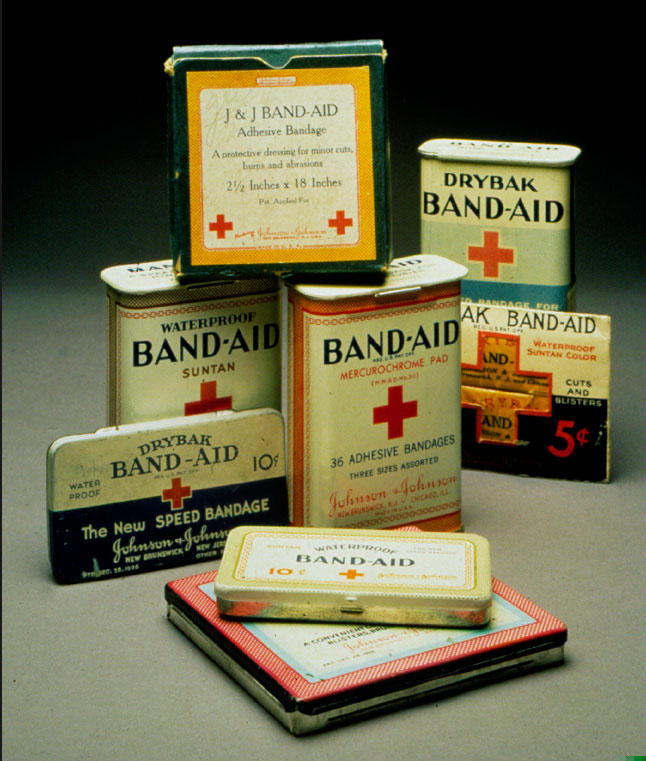
Band-Aids in World War II
Although early sales of Band-Aids were slow, the product’s popularity took a big leap during World War II. As Johnson & Johnson expanded its first-aid supplies, it included Band-Aids in kits sent overseas to U.S. servicemen and allies, where they were widely used for minor cuts, blisters, and scrapes in training and combat situations. This exposure helped millions of soldiers become familiar with the product and brought Band-Aids into common usage when many veterans returned home after the war. The wartime distribution played an important role in transforming Band-Aids from a niche household item into a trusted staple in American first-aid care.
How the Boy Scouts Helped Spread the Brand
One of Band-Aid’s early marketing breakthroughs came through an unexpected partner: the Boy Scouts of America. In the 1920s, Johnson & Johnson included Band-Aids in first-aid kits for Boy Scouts, and later distributed free supplies to Scout troops. Scouts frequently encountered the kinds of scrapes and minor injuries that Band-Aids were designed to treat, making them ideal users of the product. This grassroots exposure helped familiarize entire families with Band-Aids and contributed significantly to growing demand nationwide. The Boy Scouts partnership is an early example of targeted product sampling that helped make Band-Aids a household name long before mass advertising.
Trademark vs. Everyday Language
The name Band-Aid has become much more than a product – it’s a well-known example of a brand name entering everyday language. While Johnson & Johnson still holds the trademark and officially refers to its products as “BAND-AID® Brand Adhesive Bandages” to protect that trademark, many people use the term generically to mean any adhesive bandage. This process, known as “genericization,” occurs when a brand name becomes synonymous in common speech with the category itself. Other examples include “Kleenex” for tissues and “Xerox” for photocopies. Even though Band-Aid remains a protected trademark, its widespread use in language reflects its deep cultural impact.
Inventions are the ingenious gadgets and machines that have made our lives a little more fun, interesting, and useful. Real inventions are the things that we did not think were possible yesterday, and yet, it would be difficult to live without today. From the tiny paperclip to the massive jet engine, every month we will explore the history behind our world’s most famous inventions and learn about the innovators who designed them.
This month we explore the history behind an invention that is an absolute staple of any home’s First Aid Kit…
The
BAND-AID
Earle Dickson was employed as a cotton buyer for large medical and healthcare firm, Johnson & Johnson in New Brunswick, New Jersey. In 1917, Dickson married Josephine Francis Knight. His wife routinely suffered minor injuries in the kitchen while preparing food. By 1920, Dickson became used to the routine of bandaging the occasional cut, burn, or graze on his wife’s fingers and hands. Available bandages at the time were often big and bulky. It consisted of separate gauze and adhesive tape that you would cut to size and apply yourself. When Dickson noticed the gauze and adhesive tape his wife used would soon fall off her active fingers, he decided to do something about it.
Ingenuity and Determination
Earle Dickson was determined to create something that would be easy to apply yourself, remain in place, and protect wounds better. He took a piece of gauze and attached it to the center of a piece of tape then covered the product with crinoline to keep it sterile.
This ready-to-go product allowed his wife to dress her injuries by herself. She now had access to a roll of pre-prepared dressings which she could cut a small piece off at any time to apply a small bandage to a knife-nicked finger or grazed elbow. For the first time, a dressing could now be applied easily and single-handedly by the injured person without any assistance.
Promotion to Vice President
When Dickson’s boss James Johnson saw the invention, he decided to manufacture the product to the public and make Earle Dickson vice-president of the company. The new bandages went into production in 1920.
The BAND-AID is Born
Executives struggled to come up with a title for the new product until the superintendent of the mill, W. Johnson Kenyon, had a spark of inspiration and suggested BAND-AID.
Sales, however, did not skyrocket right away. In the first year of production, only $3,000 of the product was sold. However, changes were made on both the marketing and product design sides. By 1924, the bandages were being produced in a range of convenient sizes – particularly the three inches long, three-quarters of an inch wide plaster people are most familiar with today, and the hallmark red thread pulled to easily open each plaster’s packaging was introduced.
Johnson & Johnson hired traveling salesmen to demonstrate how to use the product and also distributed large numbers of BAND-AIDS for free amongst Boy Scout troops across the entire United States. That seemed to do the trick, as sales rose sharply soon thereafter.
Major Milestones
Although the product itself has remained relatively unchanged throughout the years, its history still came with a few big milestones including the introduction of machine-made band-aids in 1924, the sale of sterilized band-aids in 1939, and the replacement of regular tape with vinyl tape in 1958, all of which were marketed as the latest in at-home medical care.
Successful Inventor & Innovator Earle Dickson served as vice president for Johnson & Johnson until he retired in 1957. After his retirement, he was a member of the board of directors until his death in 1961. By this time Band-Aids were well-known and a hot seller for the company. At the time of Earle’s death, around $30,000,000 worth of Band-Aids sold each year. Quite an accomplishment from its first year total of only $3,000!