



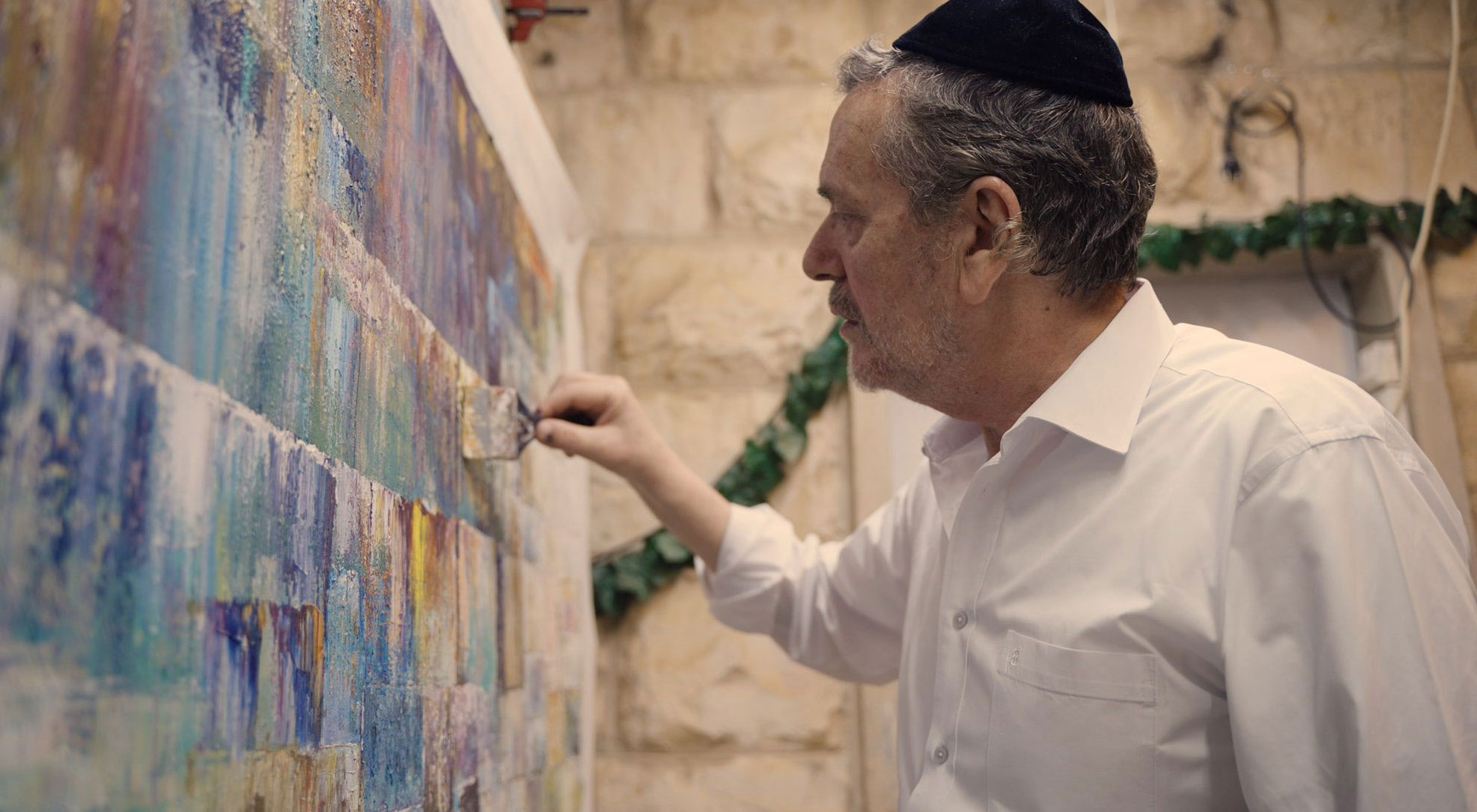
Machla Abramovitz
On entering Yossi Biton’s art gallery at 22 Agron St. in Jerusalem’s historic Mamilla neighborhood, southwest of the Old City, one is struck by an explosion of light and color. Large and small canvases display rich and muted colors, textures, and shapes. Each canvas, with its unique rhythm, seems to leap from the frame, capturing the distinctive vision of world-renowned artist Yossi Bitton.
The gallery is freshly renovated. One can almost smell the creamy-white hues on the walls as the sun-drenched Jerusalem light dances across them. The boutique is small and intimate. Its modern décor enhances the varied styles of this gifted artist’s works. Each piece conveys the yearnings of the Jewish spirit in its own way.
Inspired Images
Drawing inspiration from Jerusalem’s streets and landscape, Biblical history, and Jewish symbols, Yossi’s paintings are highly decorative: Vibrant reds, blues, and yellows emanate from the Western Wall’s stones and the ancient hills of Migdal David, while in others, pale, refined tones of white, off-white, grey, and gold capture their enduring beauty. The images remain recognizable yet move beyond realism. Instead, they “hover between figuration and abstraction, conveying a sense of place that exists on the periphery of dreams,” to quote collive.com.
It is this ephemeral quality that lifts the paintings beyond mere decoration and into a mystical, otherworldly realm. These multi-layered images represent both outward physicality and inner essence. Dancing Chassidim symbolize devotion and yearning for connectivity with Gd. The Hills of Zion, set against a vast illuminated sky, bind the ancient landscape to Gd’s eternal promises to His chosen people. The Splitting of the Sea, one of Judaism’s most iconic images, depicts the rebirth of a small, vulnerable people under Gd’s thunderous protection as they move toward a glorious future.
Soul Connection
“When I sit before the canvas to paint a great tzaddik or a holy scene, it is not just art; it is a soul-connection,” Yossi explains.
This soul connection between the artist and subject draws the viewer directly into the paintings themselves. One admirer said that he sees vital aspects of himself mirrored within [Yossi’s paintings]. Beyond that, the paintings also reflect our collective Jewish consciousness.
The other worldliness embodied in these towering images also echoes the artist’s expanding consciousness and quest for meaning and purpose – a quest years in the making that continues to broaden in scope and depth, while always remaining true to the self.
And like his art, Yossi’s quest is never complete but remains a work in progress.
Yossi’s Background
Born and raised in Tzfat in a creative secular family, creative expression was an integral part of Yossi Bitton’s inner development. His family, including parents, one brother, and four sisters, all play instruments or sing.
However, Yossi, now 70, was similarly drawn to the flourishing artists colony in Tzfat. As a teenager, he visited there frequently. Award-winning artists and poets, such as Chaim and Aliza Nahor, taught him the technical skills needed to create art and shared their experiential philosophy: artists must communicate feelings that move a painting beyond the literal and into the poetic. Bitton learned to paint there and has never attended any accredited art or design school since.
Although he tried his hand at drawing and painting, often scribbling on scraps of paper and napkins, at that stage in his life, music captured his interest. Mastering the bass guitar, Yossi later played in a band, brought musical movies to the north of Israel, and became involved in musical productions. His popularity grew, and his life progressed well, but the inner needs of his bourgeoning spirit were not satisfied. Surely, he thought, there was more to life than this.
“For five years, he chased the next gig, the next band, new productions. But it wasn’t enough.\His soul craved something deeper,” recalls his wife, Tamar Neomi.
The Pull Towards a Religious Life
After Yossi’s sister became a chozeret be’teshuvah, he, too, felt drawn to the religious life. With the support of Chabad rabbis, Yossi met other baalei teshuvah and rebbeim. He and Tamar moved to Jerusalem, where Yossi studied at Yeshiva Ohr Somayach. Even though Yossi’s siblings had become Lubavitch, Yossi and Tamar did not become Lubavitchers, although they respected the Rebbe greatly. “It was important to me that we be simple Jews,” Tamar says. “My husband is Sephardi. We keep the halachot of Hacham Ovadia Yosef.”
Yossi and Tamar wholeheartedly embraced religious life despite its challenges. They left Tzfat for the Geulah neighborhood in Jerusalem, the heart of Hareidi Judaism. “We wanted to live that kind of life,” Tamar says.
The couple went on to raise three daughters and a son and now live in Mekor Baruch, near Geulah, where Yossi creates most of his art.
Internal Struggles
Nevertheless, from the start, tensions developed between Yossi’s creative drive and his evolving spirituality.
“His rav at Ohr Somayach told him to abandon art and focus on learning Torah and living Yiddishkeit. The rav was possibly right at the time. Religious life is all-consuming and requires continual learning, and he needed to concentrate on that,” Tamar says.
However, inner peace remained elusive.
“The first ten years, Yossi took Yiddishkeit to extremes, often worrying: Am I doing the mitzvot right? Am I doing enough? For him, being religious is a huge zechut, and also a great responsibility – to be good, deliver a message, promote goodness, and help bring down Hashem’s holiness to people.”
When Yossi began painting again, Tamar says, his perspective changed. He loves living a religious life and expressing this love through his art. Moreover, he now blends his passion for artistic expression with his love of learning Torah. Yossi attends a daf yomi and halachah shiur twice weekly.
Intervention by the Baba Sali
But this is now. Eighteen years ago, the decision to dedicate his life full-time to his art was not as obvious. It took the Holy Baba Sali’s appearance in a dream to bring about this change. The tzaddik’s presence confirmed what Yossi had always subconsciously understood: his artistic talents were unique gifts from Hashem, desperately yearning for actualization.
The story goes as follows. In Yossi’s first ten years [as and artist], he completed two drawings of the Baba Sali – one for his parents, the other as a wedding gift for a friend. The bride disliked the black-and-white drawing and wanted color, so he added some color with crayon, but the bride was still not satisfied. On a later visit to the friends’ new home, Yossi noticed the drawing of the Baba Sali was absent. The wife had left it behind.
That night, Yossi went to bed extremely upset. He had invested much of his neshama into producing the picture, which magnificently captures the enigmatic holiness of this great man. Shortly afterward, the tzaddik appeared to him in a dream, equally disturbed. He nudged Yossi to right this incalculable wrong.
Yossi immediately awoke, called his friend, and demanded that he return to his former home to find the picture and bring it to him. At 2am, his friend called with sad news. He had found the picture in their garden, crumpled into a ball, and ruined. Regardless, he brought it to Yossi as requested.
At first sight, the situation appeared hopeless. The wrinkled, cracked canvas defied ironing. Undeterred, Yossi laid it out and placed his complete set of Gemaras on the drawing. After a week, Yossi removed the seforim. Tamar, a dressmaker who designs and creates magnificent wedding and evening gowns, gently ironed the picture. Yossi then repaired the missing strokes. Now, beautifully framed, the picture hangs in a place of honor in their home.
Return to Art
This incident proved consequential. The dishonor attached to the tzaddik deeply disturbed Yossi. Equally important, however, he came to realize how emotionally and spiritually connected he was to his artistic creations, which are soul connections between himself and G-d. Then and there, he decided that this is what Gd wanted of him: to give voice to beauty and holiness through his art, inspiring others toward spiritual elevation.
Giving up his career as a rebbe to pursue art full-time was not easy for this father of four. The challenges seemed formidable. Could he afford to do so financially? Did he have the inner wherewithal to weather the disappointments that were sure to come?
Hashem, though, paved Yossi’s way. He was fortunate to find employment at Melechet Machshevet Gallery, a popular Judaica gallery located in the heart of Meah Shearim, where he painted reproductions for some years. He did not particularly enjoy the work. Still, the practice proved useful. He expanded his skills by learning new techniques.
Out on His Own – Glorifying Gd Through Art
At the same time, Yossi began producing his own works and assessing their financial viability in the United States and elsewhere. He was pleasantly surprised by the results.
Neither Yossi nor Tamar takes Yossi’s enormous success in the art world for granted. They know how hard it is to make a living in this field. “When people are willing to pay for your work, it is a beracha from Hashem. Fortunately, people love his work so much. He receives such wonderful feedback, which gives him so much strength to continue,” Tamar says.
Producing art has enriched Yossi Bitton’s life to an incredible level. His paintings are not only extensions of himself. They are also explorations of the deeper aspects of spirituality.
“There’s no talking to him when he’s painting,” Tamar says. “He’s totally absorbed in the work. Every brushstroke reflects his love and joy for the subject he is painting. When I tell him the picture is finished, he answers, ‘What do you understand? It’s not finished. It doesn’t talk to me yet.’”
Each painting has its own path to completion. Sometimes, Yossi paints all night. Other times, he paints only a few hours during the day. There are times when inspiration burns bright. Other times, it just is not there. Still, Yossi’s enthusiasm for his art has never waned. His inner artist continues to flourish. He is grateful for this gift and for the positive impact his art has on people’s lives.
“Every day I thank Gd for the merit to glorify His name through art,” Yossi says.