



DAVE GORDON
Support for Israel has become a litmus test in New York politics, but on Fifth Avenue this year, the city’s Jews discovered the gap between what their leaders say and how safe – or abandoned – they actually feel. The Israel Day Parade still drew 100,000 people, a sea of blue-and-white and bipartisan dignitaries. Yet, the first-ever absence of a sitting mayor since the parade’s inception in 1964 – and the rise of a City Hall openly aligned with anti-Zionist activists – left many wondering whether political power is drifting away from those who march, and toward those who are against them. “It’s almost like not to be an anti-Semite or not to be anti-Israel, you’re in the minority today,” says veteran activist and former New York State Assemblyman Dov Hikind. “That is a fact.”
In the shadow of that new reality, the three Jews who were interviewed for Community Magazine say that they are working with others across the city to form their own responses – from quiet coalition-building, to grassroots digital advocacy, to calls for a Jewish defense force that will meet hostile demonstrators in the streets of Brooklyn. The parade has become more than a festive annual ritual. It is a stress test of New York’s political soul, exposing the widening distance between a community that still turns out in huge numbers for Israel and a political class increasingly split, hedging, or openly hostile.
Who Came and Who Did Not
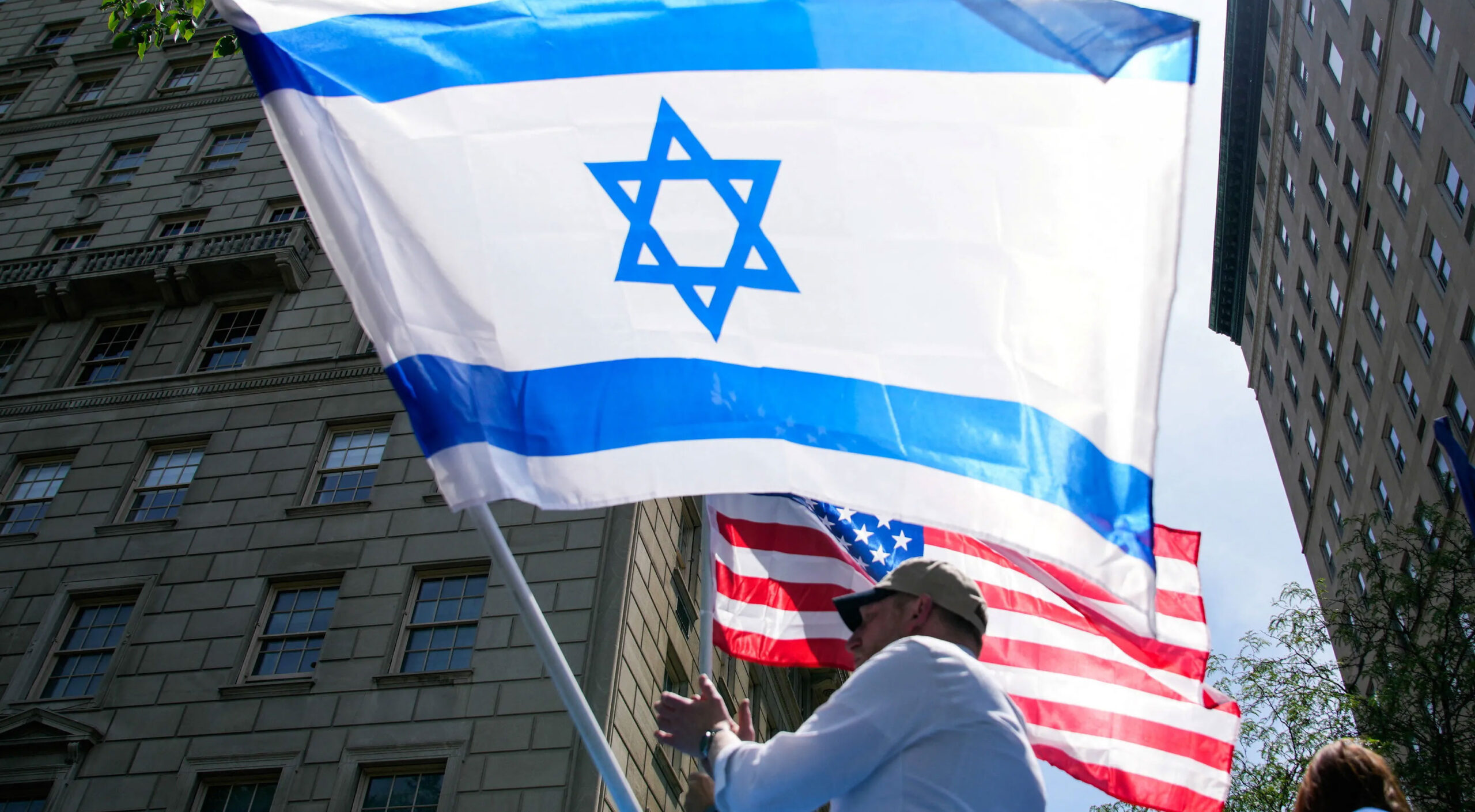
Last month’s Israel Day Parade should have been a straightforward display of solidarity. The route up Fifth Avenue was lined with Israeli flags and school banners, and the roster of dignitaries suggested business as usual: Senate Majority Leader Chuck Schumer, Representatives Jerry Nadler and Dan Goldman, Governor Kathy Hochul, Attorney General Letitia James, City Comptroller Brad Lander, and others were in attendance. NYPD Commissioner Jessica Tisch marched. Former mayors Michael Bloomberg and Eric Adams appeared, reinforcing a message that at least some of the city’s establishment still wanted to be seen on the pro-Israel side of the ledger.
But the absence of Mayor Zohran Mamdani was impossible to ignore. For the first time in 61 years, no sitting mayor walked in the parade, a decision Mamdani’s critics view not as scheduling trivia, but as a declaration of values. For a Jewish community watching anti-Israel activists grow more organized and more brazen, the no-show crystallized a fear that the center of gravity in city politics has shifted – and that the people who most loudly oppose Israel now have a friend in City Hall.
Jews with Views
Against that backdrop, three very different Jewish New Yorkers – an old-school Brooklyn power broker, a young Black Orthodox litigation assistant, and a former communal insider turned independent consultant – offer a composite portrait of a community trying to understand what changed, and how to respond.
For decades, Dov Hikind has been the archetype of the Brooklyn Jewish machine politician: a former State Assemblyman, founder of Americans Against Anti-Semitism, and a fixture in any discussion of New York’s Jewish power structure. Speaking from Israel, he sounds less like a retired lawmaker, and more like a man warning of an emergency that the usual institutions no longer know how to handle.
Dov Hikind – Shifting Tides
“In all the years, we’ve always had anti-Semitism,” Hikind says. “We’ve always had issues with particular people. But to the level that we have it now, it’s [anti-Semitism has] become more mainstream than ever before.” Hikind describes a political climate where hostility to Israel is no longer confined to fringe activists but increasingly shapes campaigns for the State Assembly, City Council, and Congress. In his telling, Democrats are especially susceptible, but he notes with alarm that among Republicans, more and more so the polling is turning, as well.
The mayor, in Hikind’s view, is not a disappointment so much as the logical outcome of this shift. Hikind blasts Jewish leaders who continue to attend receptions at Gracie Mansion – “laughing with this anti-Semite mayor,” as he puts it – as if nothing fundamental has changed. “You have to deal with the mayor – he’s the mayor,” he concedes. “But you don’t have to socialize with him. Really? Where’s your faith in Gd? Where’s your pride?”
Communal Strategy
Hikind reserves particular scorn for recall talk and hashtag campaigns, which he dismisses as childish. The hard question, he insists, is not who to blame but what the communal strategy should be. “We have a very serious problem,” he says, pointing to soaring anti-Semitism statistics that he believes undercount reality. “What’s the plan? Does the ADL have a plan? Does the American Jewish this or that have a plan? What is the plan to deal with the phenomena that exists now?”
His own emerging answer is blunt. Hikind, now 75, is working with others to create what he calls a Jewish defense force – a group of trained Jews committed, devoted to the Jewish community, professionally led. These are not vigilantes, but are individuals prepared to physically stand between hostile demonstrators and Jewish neighborhoods. “If they’re coming into Midwood, if they’re coming to Crown Heights or to Williamsburg or to whatever, we need to have people who are going to stand up and be proud and confront those who are terrorizing the Jewish community,” Hikind says.
The parade itself passed peacefully, but Hikind’s mind is on the footage that circulated the day after, a Jewish nurse assaulted on the subway, marches snaking through Brooklyn with demonstrators chanting in support of Hamas, intimidation outside synagogues and schools. For Hikind, these are not isolated incidents but are the visible symptoms of a mainstream culture that has grown comfortable treating Jews and Israel as legitimate targets.
DeVante Montgomery
If Hikind embodies a past era of Jewish clout, DeVante Montgomery represents a newer, less conventional face of Orthodox activism. Open about his conversion to Judaism, the 29‑year‑old litigation assistant in Manhattan is also a writer and online creator. He is shomer-Shabbat, and unabashedly online. Montgomery describes himself as “just an average, normal guy” who stumbled into prominence when his social media posts pushed back against anti-Israel agitators targeting Jewish neighborhoods.
At the parade, Montgomery felt something close to relief. “It was a very awesome and very uplifting experience,” he says. “It really felt like a weight lifted. It felt like we were in peace within nirvana, within our own little bubble within the perimeter of that parade.” Montgomery has attended three times – first with Park Avenue Synagogue and most recently as part of an organized group. He speaks with wonder about the diversity of the crowd – people of every age, some flying in from abroad, all there to say that Israel still matters.
Social Media’s Influence
Yet, the euphoric atmosphere exists alongside a growing sense of isolation. Montgomery notes that Jews scrolling Instagram and TikTok are bombarded with videos portraying Zionism as a crime and Israelis as oppressors, narratives he calls disgusting and deeply detached from historical fact. In his analysis, the election of Mamdani was partly a product of that information ecosystem. “Everyday New Yorkers were seeing the images come out of the Middle East,” he says. “They, again, are being fed a certain algorithm.” That feedback loop, he argues, helped normalize support for protesters who now march past Jewish schools and into Brooklyn’s heavily Jewish neighborhoods.
Montgomery is not nostalgic for the last administration. He is precise about its limits. Under Eric Adams, Montgomery says, the city witnessed a lot of anti-Semitic instances, particularly after October 7, even as the mayor spoke in defense of the Jewish community. But Montgomery describes a boomerang, ricochet type effect as Adams sided with Jews, anti-Israel voters became more energized, helping pave the way for a successor who is actively vocal in his support of the pro-Palestinian protesters.
Begin with Conversation
Where Hikind reaches for confrontation, Montgomery begins with conversation. He argues that big organizations and individual Jews alike need to meet people at where they are instead of speaking at them. That starts, Montgomery says, with listening to what critics actually believe – including the many who think that somehow, in some way, that Jews originate from Europe and disregard their own biblical history, let alone factual history. Often, he notes, protesters chanting, “from the river to the sea” cannot even name the river in question.
Still, even the outreach advocate has limits. Montgomery worries that interactions between Jews and anti-Israel protesters have grown very violent and very insulting, citing two instances of anti-Semitic confrontation. One was an incident on May 15th when dozens of Muslim men gathered in Brooklyn to pray directly outside Bnos Leah Prospect Park Yeshiva High School for girls. Secondly, he cited marches through Brooklyn that feel more like intimidation than political speech. These are very old tactics, he says, familiar from Jewish history. His hope, perhaps more fragile than he lets on, is that New Yorkers can agree to disagree yet maintain a level of respect – not because they will resolve the wars in Gaza or Lebanon, but because they still share a city.
Noam Gilboord
If Hikind and Montgomery speak from the street, Noam Gilboord speaks from the world of organized Jewish life – and from just outside it. The former senior official at the Jewish Community Relations Council of New York left the organization in December and now works independently. He spent years helping shape the very parade he attended this year as a rank‑and‑file parent.
A Parade with No Problems
Gilboord’s account of the day is almost defiantly normal. “I saw nothing. No problems. No problems whatsoever,” he says. “It looked like a normal parade to me.” Security was extensive and familiar, with metal detectors, blocked streets, sand trucks, fencing along the Central Park side, and the presence of NYC Police Commissioner Jessica Tisch herself. From Gilboor’s vantage point, marching with his kids’ school, it was the same careful choreography he had helped arrange in previous years.
Yet, he is acutely aware of the anxiety that preceded the parade. In his view, the community’s nervousness was less about credible intelligence than about the new mayor’s posture. “Because of the mayor and his antagonism towards Israel and his hatred of Israel, I sensed that the community itself was much more nervous in the lead-up to the parade,” he says. The worry was that a City Hall aligned with anti-Israel activists might quietly downgrade security. When that did not happen, he concluded that much of the fear had been, in hindsight, for no reason.
What Has Changed?
On the question of whether Israel has become more central to city politics, Gilboord offers a long view. “It’s been an issue in city politics for a very long time,” he says, pushing back on the idea that this is entirely new. What has changed, he argues, is the organizational muscle of the anti-Zionist left – especially the Democratic Socialists of America, whose campaigns against trips to Israel and pro-Israel legislation have dragged debates that once lived in internal party meetings into the full glare of public attention.
If Hikind sees institutional Jewish life as adrift and Montgomery sees it as too often reactive, Gilboord’s comments hint at a third layer – a community that still knows how to work the levers of power, is still capable of coordinating with police and keeping a massive parade safe, but is increasingly unable to reassure its own members that those levers will continue to work under a mayor who pointedly stays away.
The Real Story
Taken together, the three voices suggest that the real story of this year’s Israel Day Parade is not simply that it was more political – it always has been – but that politics has migrated from the reviewing stand into the streets, the algorithm, and the Jewish psyche itself.
Hikind calls for a literal line of defense in Brooklyn. Montgomery preaches hard conversations and mutual respect. Gilboord quietly measures whether the machinery he once ran can still be trusted. The flags still flew on Fifth Avenue, the bands still played, the children still marched. What has changed is that for many of New York’s Jews, the parade no longer feels like an endpoint of communal confidence, but a starting point for a much more fraught fight over how – and whether – their city will stand with them when the march is over.