



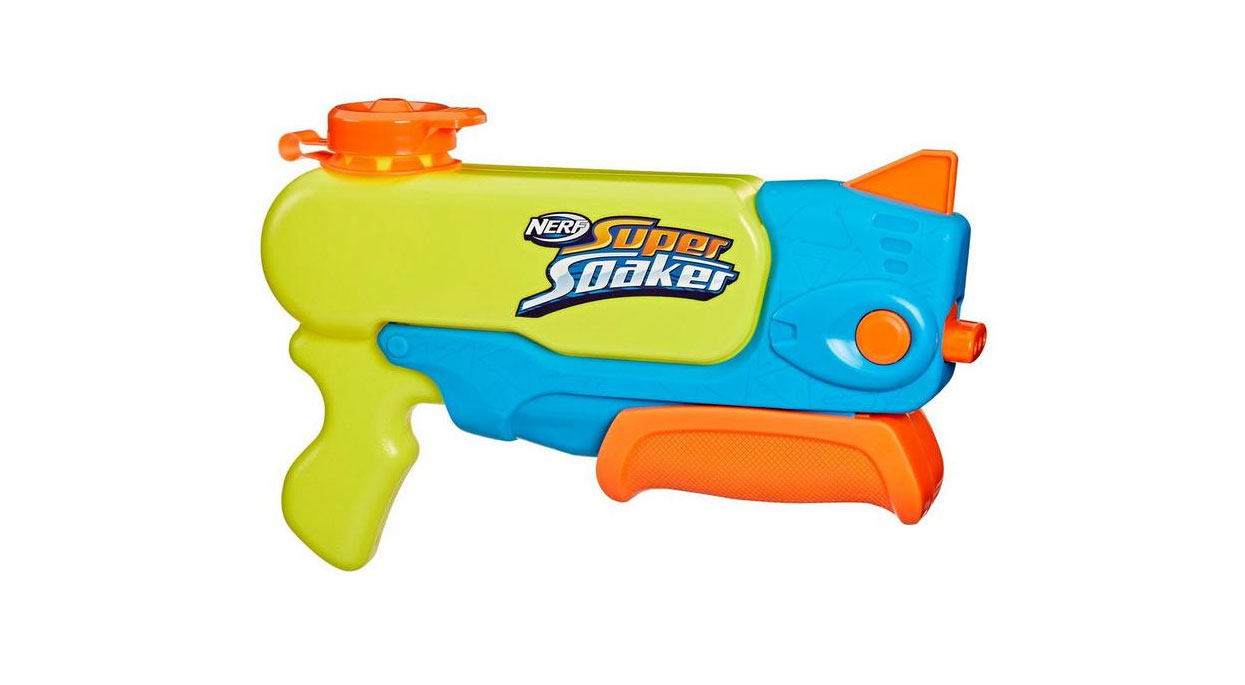
The Super Soaker quickly became a best-seller that transformed backyard water battles, and later earned a place in the National Toy Hall of Fame in 2015.
Some inventions are carefully planned over many years. Others appear completely by accident. Few inventions prove that better than the Super Soaker – the powerful water gun that became one of the best-selling toys in history.
What makes the story even more remarkable is the man behind it. The Super Soaker was invented not by a toy designer, but by an aerospace engineer and former NASA scientist named Lonnie Johnson.
Johnson’s invention transformed summer fun for millions of children around the world. Yet the path from experimental laboratory equipment to a billion-dollar toy was anything but straightforward.
A Curious Mind from the Beginning
Lonnie Johnson was born in Mobile, Alabama, in 1949. From an early age, he showed an extraordinary interest in science and engineering. While many children spent their free time playing games, Johnson loved building things and experimenting with machines.
His father was a World War II veteran and skilled handyman who taught Johnson how to repair household appliances and to think mechanically. Johnson later said that growing up in the segregated South made opportunities difficult to find, but he refused to let obstacles stop him from pursuing science and engineering.
As a teenager, Johnson built a robot named “Linex” for a science competition sponsored by the University of Alabama. Despite attending an underfunded school, Johnson’s robot won first prize against students from much wealthier schools. The victory helped convince him that he could compete with anyone through hard work, creativity, and determination.
After graduating from Tuskegee University with degrees in mechanical engineering and nuclear engineering, Johnson joined the United States Air Force. He later worked on important aerospace projects involving advanced weapons systems and stealth technology.
Work with NASA and the Air Force
Johnson’s engineering career quickly became impressive. He worked for the U.S. Air Force and later for NASA’s Jet Propulsion Laboratory (JPL) in California.
At NASA, Johnson contributed to several important space missions. He worked on spacecraft power systems and thermal-control technologies connected with missions such as Galileo; the unmanned probe sent to study Jupiter. The Galileo mission dramatically expanded scientists’ understanding of Jupiter and its moons after arriving at the giant planet in 1995.
Johnson also worked on projects involving the B-2 Spirit stealth bomber, one of the most advanced military aircraft ever developed. His work required precision, creativity, and deep scientific knowledge.
But despite his serious work in aerospace engineering, Johnson continued inventing in his spare time. He held dozens of ideas for new technologies and spent evenings experimenting at home.
One of those experiments would unexpectedly change the toy industry forever.
The Accident That Changed Everything
In the early 1980s, Johnson was experimenting with a new type of environmentally friendly heat pump. At the time, many refrigeration systems relied on chemicals such as Freon, which scientists increasingly worried could damage the environment.
Johnson wondered whether water could be used instead.
One evening, while working in his bathroom laboratory at home, he attached a nozzle to some tubing connected to a sink. When he activated the system, a powerful stream of water suddenly blasted across the room.
Most people might have simply cleaned up the mess and moved on.
Johnson immediately saw something else.
“This would make a great squirt gun,” he later recalled thinking.
That single moment sparked the idea for what would eventually become the Super Soaker.
Building the First Prototype
Johnson quickly began designing prototypes in his basement workshop. Unlike the small squirt guns available at the time, Johnson’s invention used air pressure to fire a powerful continuous stream of water over long distances.
The design was revolutionary.
Traditional water pistols relied on tiny squeezable reservoirs that held very little water. Johnson’s invention used a hand pump to build pressure inside a larger water chamber, allowing users to shoot stronger streams much farther than before.
His early prototypes were built from plastic tubing, Plexiglas, and spare parts. Johnson tested them on family members, neighborhood children, and coworkers. The response was immediate excitement.
Everyone who tried the prototype loved it.
Johnson realized he might have invented something far bigger than a backyard experiment.
A Long Road to Success
Although the invention showed enormous promise, turning it into a real commercial product proved difficult.
Johnson initially hoped to manufacture the toy himself, but production costs were far beyond what he could afford. Bringing a new toy to market required expensive molds, manufacturing facilities, packaging, shipping, and retail agreements.
For years, toy companies rejected his invention.
Some executives simply did not understand how different Johnson’s water gun was from existing toys. Others doubted children would want a larger, more powerful water blaster.
Johnson continued improving the design while searching for the right business partner. Finally, after nearly seven years of persistence, he partnered with Larami, a toy company known for producing inexpensive outdoor toys.
Larami agreed to manufacture and market the invention.
The Birth of the Super Soaker
The toy first appeared in stores in 1990 under the name “Power Drencher.”
It sold well, but the following year Larami redesigned and rebranded the toy as the “Super Soaker,” creating one of the most successful toy launches in history.
Children loved the Super Soaker’s ability to shoot water farther and faster than any previous squirt gun. The toy became a cultural phenomenon almost overnight.
During the summer of 1991 alone, more than two million Super Soakers were sold.
Soon, children across the world were staging massive backyard water battles armed with brightly colored Super Soakers of every shape and size.
The toy generated enormous profits and inspired countless imitators. Over time, Super Soaker products generated more than $1 billion in sales, making it one of the most successful toy franchises ever created.
In 2015, the Super Soaker was inducted into the National Toy Hall of Fame in recognition of its enormous cultural impact.
The Legacy Continues
Today, more than three decades after Lonnie Johnson accidentally invented the Super Soaker, the famous water blasters are still being sold in stores and enjoyed by children around the world. Modern versions such as the Power Drench, Mega Dunk-Fill, and XP35 continue to fill toy store shelves each summer, carrying on the legacy of one of the most successful outdoor toys ever created. While the designs have evolved over the years, the excitement remains the same – backyard water battles, neighborhood competitions, and hours of summer fun. What began as a simple engineering experiment has become a lasting part of childhood for generations, proving that a single creative idea can make an impact far beyond what anyone imagined.