



What Mayor Mamdani’s Anti-Semitism Plan Means for Our Community
Our shuls. Our schools. Our children’s safety. But – is it enough to protect us?
Linda Argalgi Sadacka
In the first seven months of this year, the NYPD confirmed 205 hate crimes against Jewish New Yorkers. That is nearly 57 percent of every confirmed hate crime committed in the city was directed against a community that makes up roughly ten percent of its population. In July, a Jewish man was stabbed outside a synagogue on the Upper West Side. Behind every one of those victims’ numbers is a person who was punched, spat on, cursed at, or followed home because he looked Jewish. Many of them look like our fathers, our sons, and our neighbors on the way to minyan.
The trend is moving in the wrong direction. Those 205 confirmed attacks are up from 189 during the same months last year, even as murders and shootings across the city have fallen to historic lows. In other words, New York is getting safer for almost everyone, while Jewish New Yorkers remain the single largest target of hate in the city by a wide margin. Anti-Jewish incidents have outnumbered every other bias category for three years running.
So, when NYC Mayor Zohran Mamdani stood up on September 29 to unveil what City Hall described as the first municipal plan in the country dedicated to fighting anti-Semitism, our community had every reason to read it closely. The mayor told New Yorkers that anti-Semitism is real and on the rise. On that point, nobody in Brooklyn needs convincing. But our tradition has never measured commitment by speeches. It measures commitment by maaseh, by what someone actually does. A plan is a set of decisions about money, priorities, and definitions. When you read past the announcement and follow those decisions, the story is far less reassuring than the headlines suggest.
What the Plan Contains
Start with the numbers, because they are the most concrete part of any government document. The plan sets aside $1 million to improve security at synagogues and other houses of worship. It directs $6.4 million to a city grant program called Partners Against the Hate, more than double what that program received last year. It commits $2 million to complete a Holocaust memorial in Queens and $2.5 million to a new Jewish cultural center in Brooklyn. It promises expanded student trips to the Museum of Jewish Heritage and a public campaign on city kiosks highlighting the contributions of Jewish New Yorkers.
Separately, the budget for the city’s Office for the Prevention of Hate Crimes has grown to $29 million a year, up from $3 million. The administration describes that increase as unprecedented, and in raw terms it is. But that office serves every community in the city, and the money is not earmarked for fighting anti-Semitism. When officials cite the 800 percent increase in response to questions about attacks on Jews, it is worth remembering that the figure describes a citywide budget, not a Jewish one.
The mayor also kept the Office to Combat Anti-Semitism, which his predecessor created. Its executive director, Phylisa Wisdom, has called it unacceptable that more than half of the city’s hate crimes target Jews. Yet when asked about those numbers, her office simply cited the citywide hate crime budget increase, a figure not earmarked for Jews at all. An office created to fight anti-Semitism should be the loudest voice for Jewish safety inside City Hall, not another messenger for the administration’s talking points.
The Smallest Number Is the One That Matters Most
Of all the figures in the plan, physical protection for places of worship is the smallest. One million dollars, spread across every synagogue, church, and mosque in five boroughs, will not put a trained guard at the door of the shuls in our own neighborhoods. Critics quoted in the press called it a drop in the bucket, and anyone who has served on a shul board and priced out guards, cameras, and reinforced entrances knows the critics are right.
Holocaust memorials and cultural centers have real value. Education about the Shoah matters, and our children’s generation will need it more than ours did. But the families walking to shul on Shabbat morning, the yeshiva buses lined up on Ocean Parkway, and the kollel men walking home after dark need protection now. A plan that invests more in remembering Jews who were murdered than in protecting Jews who are being targeted today has its priorities upside down.
What Was Erased on Day One
To understand the plan, you have to remember what came before it. On his first full day in office, Mayor Mamdani issued an executive order revoking every order his predecessor signed after September 26, 2024, the date Eric Adams was indicted. Among the executive orders was the city’s adoption of the International Holocaust Remembrance Alliance working definition of anti-Semitism, the standard used by governments, universities, and law enforcement agencies around the world. Also revoked was an order barring city agencies from boycotting or divesting from Israel.
The mayor defended the decision by pointing out that a number of Jewish organizations had their own concerns about the IHRA definition, and that is true. The debate over it is real, including among Jews. But there is a difference between refining a standard and leaving the city with no standard at all. City Hall said at the time that the mayor would reissue the orders he still supported. Nine months later, the city still has no adopted definition of anti-Semitism, and the new plan stops short of providing one. The administration’s position is that it can fight anti-Semitism effectively without committing to a single formal definition. The plan also makes no mention of Israel, the war, or the anti-Israel demonstrations that have driven so much of the harassment Jewish New Yorkers have faced since October 7th.
This is not an academic dispute. A definition determines what gets counted, what gets investigated, and what gets taken seriously. Anyone who has been cursed at for wearing a kippah, blocked from entering a building, or confronted outside a shul by protesters chanting about Zionists knows that today’s anti-Semitism very often arrives dressed as anti-Zionism. The IHRA definition was written precisely to recognize that reality while still protecting legitimate criticism of Israeli policy. Remove it, and the people deciding what counts as anti-Semitism are left free to decide that much of what our community experiences as anti-Semitism does not count.
It is worth noting who celebrated that decision. When the definition was revoked, the New York chapter of the Council on American-Islamic Relations publicly welcomed the move, describing it as a restoration of free speech. Hold onto that detail, because it returns later in this story.
Following the Money
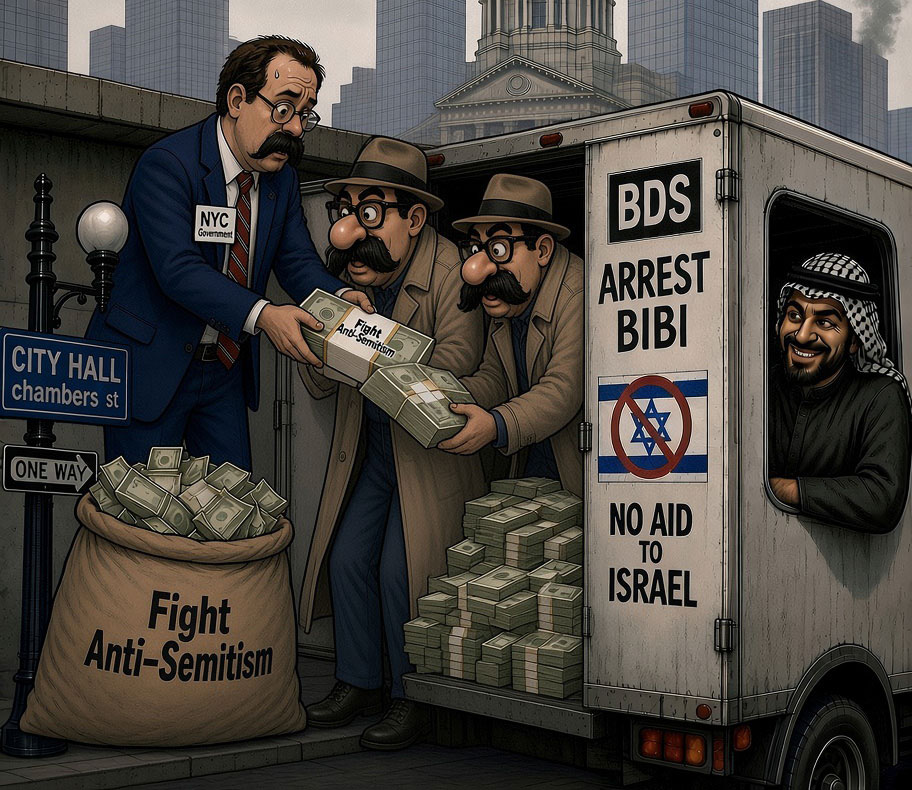
The largest new commitment in the plan, $6.4 million, flows through Partners Against the Hate, known as P.A.T.H. The program was launched under Mayor de Blasio in 2021. It funds six anchor organizations, and those anchors in turn distribute grants to more than fifty smaller groups across the city. The anchors are the Anti-Violence Project, the Asian American Federation, the Hispanic Federation, the 67th Precinct Clergy Council, the Jewish Community Relations Council, and the Arab American Association of New York. According to the city, the program’s goals include community-based approaches to public safety, training on bias, better reporting of hate crimes, and improved data collection. Those are worthy goals. The question is who is entrusted to carry them out.
That inclusion of the Arab American Association of New York should give every Jewish New Yorker pause. This organization was led for more than a decade, from 2005 to 2017, by Linda Sarsour, one of the most prominent anti-Israel activists in the country, a figure many Jewish organizations have long accused of anti-Semitism, and a vocal supporter of the mayor. After Mamdani’s election, Sarsour declared she would work to remove pro-Israel Democrats from power. According to records compiled by the watchdog group OpenTheBooks, Sarsour’s organization received more than $3.3 million from the city between 2017 and 2024, most of it not designated to any specific agency. Reporting on the group’s public record shows support for pro-Gaza demonstrations, including a 2024 protest connected to the Columbia University encampment that left Jewish students afraid to cross their own campus.
There is one more connection, and it comes from the organization’s own words. In testimony before the City Council last year, a representative of the Arab American Association described the organization’s work under P.A.T.H. and identified one of its own grantees: CAIR New York. The Council on American-Islamic Relations is the largest Muslim civil rights and advocacy organization in the U.S. That is the same organization that applauded the mayor for scrapping the definition of anti-Semitism. Put plainly, public money intended to prevent hate has flowed through an anchor organization to a group that celebrated the removal of the city’s standard for identifying hatred against Jews.
What We Know, and What We Do Not
Fairness matters here, because our credibility depends on it. Some posts circulating online claim that Sarsour’s former organization will receive the entire $6.4 million. That is not accurate. The Arab American Association is one of six anchors, and the Jewish Community Relations Council, which serves our community, is another. The program’s grants have also funded real work on behalf of victims of hate in many communities, and the city’s anti-Semitism plan includes elements we should welcome.
But the city has not published how the new money will be divided among the anchors or which subgrantees will receive it. That is precisely the problem. When a program presented as the centerpiece of an anti-Semitism strategy routes funds through an organization with this record, and onward to a group that cheered the dismantling of the city’s anti-Semitism definition, the public has a right to know how much is going where and what it is being used for. Transparency is not a favor the city does for the Jewish community. It is the minimum standard for spending public money.
None of this requires us to assume bad faith about every person working on these programs. It requires something simpler: that we judge the plan by its structure rather than by its slogans. A strategy against anti-Semitism that will not define anti-Semitism, that underfunds the physical protection of Jewish institutions, and that channels its largest commitment through partners with this history is a strategy that has not yet earned our trust.
How We Respond Matters Too
Our community will be tempted to respond to this story with anger, and some of the anger is justified. But the way we respond will determine whether anyone outside our own neighborhoods listens. Some of the commentary circulating online has already slid from criticizing one organization’s record into sweeping statements about Muslims and the future of New York. That does not help us. It hands every critic of our community an easy excuse to dismiss legitimate concerns, and it is beneath a people commanded to pursue emet and to keep our speech clean even when we are angry.
The strongest position we can hold is the one built on documented facts: the dollar figures, the public records, the organization’s own testimony, and the definition that was revoked. Those facts do not need exaggeration to be alarming. They need to be put in front of the people who make decisions, by constituents who are calm, precise, and impossible to ignore.
What a Serious Plan Would Look Like
Our community has always been most effective when we show up informed, organized, and specific. Outrage fades by the next news cycle. A documented, reasonable demand does not. Here is what we should be asking for, clearly and publicly.
First, full transparency. The city should publish exactly how the $6.4 million will be divided among the P.A.T.H. anchors, which subgrantees will receive funding, and what each grant is meant to accomplish.
Second, real security. Funding for the protection of houses of worship should be multiplied many times over. It is the most urgent need, the easiest to measure, and the hardest for anyone to argue against.
Third, a clear definition of anti-Semitism. The city should adopt a recognized definition that does not leave the targeting of Jews over Israel outside its reach.
Fourth, consistency. Any organization receiving public money to fight anti-Semitism should have a public record consistent with that mission, and should be able to say clearly that harassing Jews outside their shuls and schools is anti-Semitism, whatever slogan accompanies it.
City Council Speaker Julie Menin has called the year’s rise in hate crimes against Jewish New Yorkers unconscionable, and she is right. The City Council will have its own opportunities to press for these changes through hearings and the budget process, and our community should be in the room when the City Council meets.
What Each of Us Can Do Now
Call your Council Member’s office and ask where they stand on each of these four points. Contact the Mayor’s Office to Combat Anti-Semitism (MOCA) and ask for the P.A.T.H. funding breakdown in writing. You can do this online. If your shul, school, or organization has not yet applied for state and federal nonprofit security grants, make sure someone on the board does so now. Attend the next City Council hearing on hate crime prevention or the budget, and if you cannot speak, submit written testimony. The record is public, and officials read it. Bring a friend or neighbor with you. Report every incident, even the ones that feel too small to matter, because the numbers that shape city policy only include what gets reported. And talk to your neighbors who do not read the fine print, because an informed community is a protected community.
We have been told that anti-Semitism has no place in New York City. We agree. Now let’s make sure the budget, the definitions, and the partners say the same thing.