



Victor Cohen
Our community is known for treasuring its heritage. We are strongly connected to our past. Many of us are named for family members and we know our family tree. We learn in school and from our parents and grandparents about how our families arrived here throughout the 20th century and even earlier. We intentionally practice our family and community traditions and honor our heritage.
Hillel Yeshiva’s Seventh-Grade Heritage Fair is a celebration of our community’s values. The heritage program helps students learn where they come from, when their families arrived in America, and how they reached where they are today.
The program originated over 25 years ago with Mrs. Susan Rishty, and is now run by Mrs. Sally Cohen. Mrs. Cohen teaches Sephardic Heritage both to seventh graders and high school students.
A Year of Research
Throughout the year, the students explore their unique family histories. They research their names, learn about the etymology of their name’s meaning and why they were given those specific names. Students look at their family lineage, tracing their parents, grandparents, great-grandparents, and potentially further in a vertical fashion. Horizontally, they track their cousins, great-uncles, and distant relatives. The students also interview older family members to learn directly from past generations about their family story.
The culmination of the students’ research is celebrated at the Heritage Fair, where they proudly display their family’s background and celebrate their traditions. Each student gets a patch with their family’s primary country of origin. The largest number of patches were Syrian. Others included Egypt, Israel, and Europe.
Rabbis Katz and Hanon
Rabbi Katz, the Head of School, spoke briefly about the role of the lechem hapanim and how it ties into the importance of our shared and unique traditions. Why are there 12 loaves of the lechem hapanim? One loaf is for every tribe of Israel, of course. But what is the significance of the lechem hapanim ?
When the Jewish people are in Jerusalem for the shalosh regalim, they look at the lechem hapanim, and they see the 12 loaves. Rabbi Katz explained how important this was, as they saw each tribe of Benei Yisrael received a separate representation. Every tribe of Israel is different, and has a different role to play. “Yehuda is different from Levi, for instance.”
Despite their differences, however, all of the tribes all have one thing in common, and that is their devotion to Hashem. Yes, some factions have different minhagim, which is fine. But when it comes to what is important, we are and will always continue to be united. Rabbi Katz applauded how, year after year, the Heritage Fair continues to help to preserve each student’s family’s unique minhagim. He encouraged the students to learn more about where they come from, to closely embrace their traditions, and to cherish their heritage. “Go over the tunes that you sing at the table, go through some of the things that your families have done – everyone has their own story about something – let’s celebrate it.”
Rabbi Ike Hanon expressed his admiration, watching this night come together year after year. “There’s nothing more important than our heritage,” he said, and emphasized that for the students, this is just the start of a lifelong process.
Mrs. Sally Cohen
Mrs. Sally Cohen spoke next. She welcomed everyone to the 2026 Heritage Fair, and thanked everyone who helped make it happen. She also thanked her father, Mr. Charles Saka, a”h. “My Dad would always say, ‘We are standing on the shoulders of giants who came before us, and it’s our responsibility to build towards the next generation.’” Mrs. Cohen also thanked her mother, Mrs. Brenda Saka, who is also passionate about their family heritage and has researched an impressive family tree, which goes back many generations.
Mrs. Cohen expressed how grateful she felt that the students grew to care about and appreciate their family histories. This year’s theme was “Maaseh Avot Siman Le’Banim.” Mrs. Cohen pointed out how much of tonight’s success was the result of the diligent work and enthusiasm from the parents and grandparents of these students, teaching them and encouraging them to learn more about where they come from. “I can’t thank you enough for passing this message along, and bringing meaning to the work we have done.”
She then described how the students learned about their countries of origin, noting the languages spoken in those countries, the foods eaten, the culture, and the number of Jews remaining there today. There are no remaining Jews in many of these places today.
The Work Accomplished
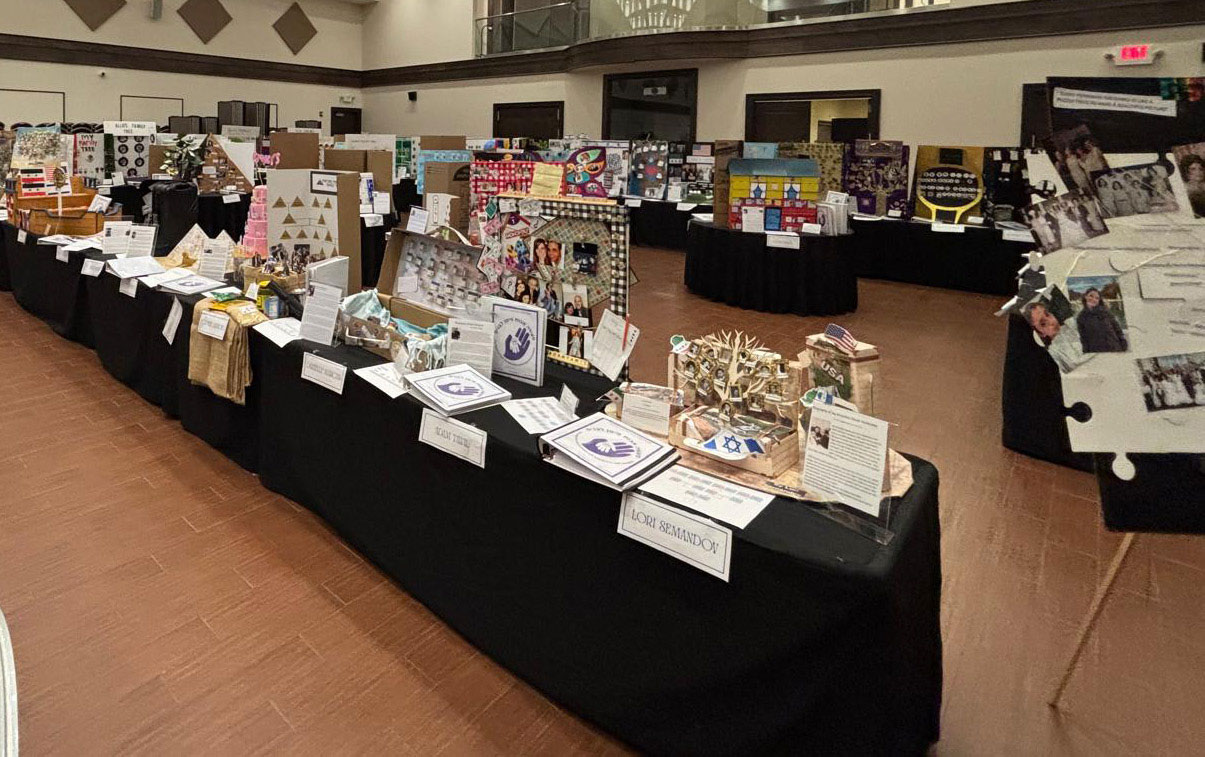
As an important part of the project, the students spent time talking to their elderly family members, and learning the stories of their relatives’ past and how they arrived in America. The students made family trees, often going back over four generations or more. Some students found out they were related to each other! Each student’s work was displayed at their own station, where they depicted their family trees in unique ways, connecting what they learned about their families and incorporating that information into the tree. Some did so through depicting an actual tree, others chose to use grids, and one student, Jonah Dweck, draped his tri-board station with three flags – the Colombian flag, the Syrian flag, and the Mexican flag. Jill Gindi turned her station into a 3-D popout tree. Shelly Cohen built a life-size boat with different flags and photos of each of her family members who came here by boat. Students stepped up to the plate to use creativity and ingenuity to display their roots.
On the walls, the students showed what they learned about their names, how their name relates to who they are, and how it helps them connect to themselves. One wall was dedicated to innovations and immigration. What was invented the year the student’s family reached America?
Family Treasures
In Founder’s Hall, each student had the opportunity to display a treasured family artifact, imbued with family history and significance. This year, a pair of cousins, Evelyn Sakkal and Samantha Cohen, included a nearly 200-year-old family shawl, known as the “Missry family shawl” as their artifact.
With the display of the Missry shawl this year, many distant cousins of the Missry family pulled out pictures of the many family occasions on which they wore this precious family shawl. Sarina Roffe, an author, genealogist, and historian, and is well-versed in the traditions and history of our community, was also in attendance.
Carrying the Torch
The Heritage Fair is important because it helps solidify the link between generations. The students at this year’s fair learned much about where they come from, the journeys that prior generations took to get here, the stories that they took with them, and in turn, the students learned about themselves. It is now their job to continue the examples set by the prior generations, and to carry the torch forward and into the future. Through the Heritage Fair, and other programs of our community – the Sephardic Heritage Museum, the Sephardic Heritage Videos, and more – we ensure that those who came before us are never forgotten, and are always with us as we take our next steps forward.