

Dirshu Led by Rabbi Eli Mansour and Rav Dovid Hofstedter Transform Panama
Chaim Gold
“The first time I visited your community in Panama was twenty-five years ago. At that time, I remember meeting the unforgettable Chief Rabbi of Panama Haham Sion Levy, zt”l. During our conversation he told me, ‘HaRav Eli, do you know what the acronym (in Hebrew) of Panama is? It stands for Po Nimtzah Mamon Harbeh!’ [Here there is a lot of money.]
“That’s what he said twenty-five years ago. However, I have no doubt that if your great Rabbi, Haham Sion would be here tonight, he would for sure change the acronym and say, ‘Panama tonight – Po Nimtza Mattan HaTorah!’”
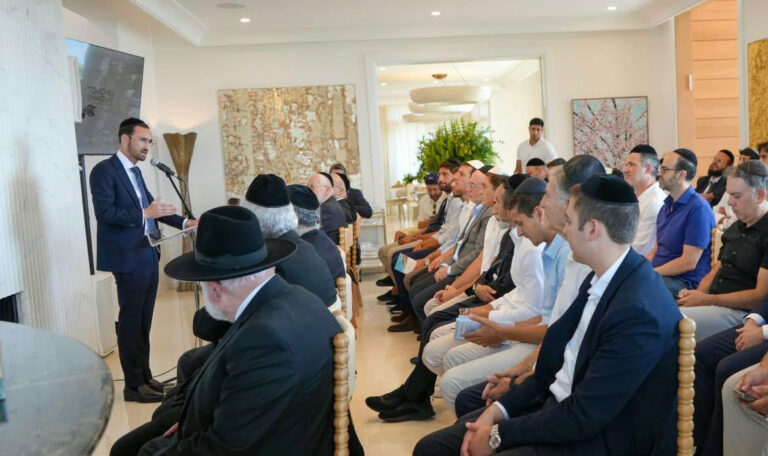
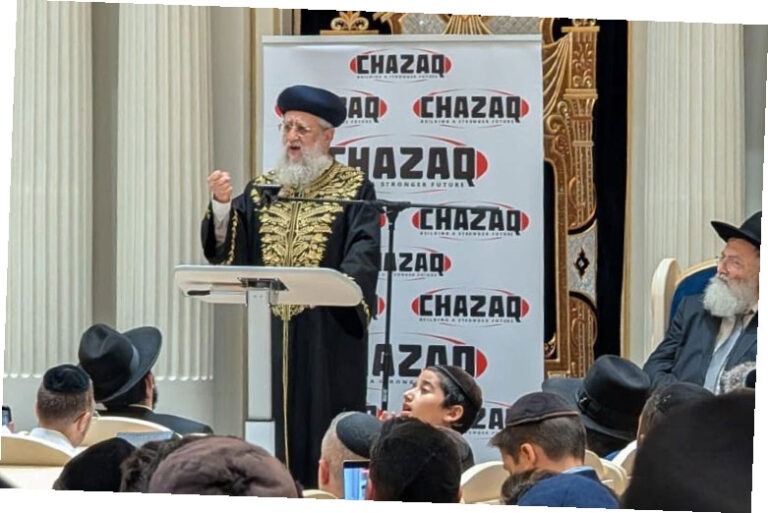
That was the powerful opening of a seminal address delivered by Rav Eli Mansour, Rabbi of the Safra Synagogue, at the historic Dirshu Maamad Ahavat HaTorah recently held in in Panama.
Dirshu Spectacular Community Event
To understand the history of the Torah revolution that the Panama Jewish community is undergoing, one had to witness this Dirshu event! It was an event where more than 1,000 men, women, and children representing the entire cross-section of the community came to celebrate Torah learning and to pledge their commitment to sustain accountable limud haTorah.
Never in its history has the Panama Jewish community ever experienced an event for the sole purpose of promoting limud haTorah. As one community leader related, “When I told people about the upcoming Dirshu event, the first thing they asked me was, ‘How much money do you want from me?’ Indeed, most Rabbinic guests who come to Panama come to raise money, but I told them that in this case Dirshu and its Nasi, Rav Dovid Hofstedter, are NOT coming to raise money! They are coming to GIVE! They want nothing more from the community than to increase Torah, to try facilitating more shiurei Torah, to try raising the level of daily accountable Torah learning in our community.”
Twenty-Five Years Ago Versus Today
“Should I tell you a bit more about my first trip to Panama twenty-five years ago?” Rabbi Mansour asked. “I’ll tell you! Twenty-five years ago, I wasn’t speaking in this beautiful, large auditorium. It was a gathering in The Club. Many of you weren’t even born! Rav Sion told me, ‘Rabbi Eliyahu we have a crisis in Panama, we need hizuk in kedushat hamishpacha, in shemirat Shabbat, in kashrut!’
“And who did I address in that club twenty-five years ago?” Rabbi Mansour exclaimed, “There were no white shirts! There were no black jackets! No one was wearing a hat! There was no band playing Jewish music, no Yoreh Deah on the tables, no talmidei hahamim at the dais! Nothing like this!
“I gave a speech for men and women sitting together. We were trying to convince them that it is kedai to keep tahara, to eat kosher, that it is kedai to keep Shabbat. Who would have believed that one generation later we would already be coming here?! Who would have believed that now the discussion is Daf HaYomi, Amud HaYomi, Daf HaYomi B’Halacha, Mishnah Berurah, this learning, that learning, more iyun, less iyun… Now we are already dealing with different sheailot!!
“I know our tradition says that there is yeridat hadorot but I question this because here in Panama we are witnessing aliyat hadorot! We are witnessing what the Gemara says, ‘achsar dara’ – the generation is getting better!”
A Line of Demarcation and a Night of Highlights
In truth, the Dirshu Evening of Hizuk was a rally on behalf of limud haTorah and a demarcation line that perhaps will forever be a “before and after moment” regarding the renaissance of Torah in the Panama Jewish community.
Never before in the history of the community has everyone – all the community’s Rabbanim, Ashkenazim, Sephardim, yeshivish, baalebatim – come together to show their support and admiration for something like Dirshu, an organization whoseraisond’être is to enhance Torah opportunities in the community.
One highlight of the evening was the speech of the Nasi of Dirshu, Rav Dovid Hofstedter, whose remarks, personality, and life story made a profound impact on the community. Rabbi Hofstedter also took the opportunity while he was in Panama to visit numerous Torah institutions throughout the city and address many of them as well.
Another highlight was the emotional, enthusiastic, beautiful musical entertainment led by Naftali Kempe and accompanied by a large band and choir, all of whom came especially to Panama for the event.
The combination of drashot and divrei Torah for the heart and music for the soul, provided the more than one thousand members of the Panama community an all-encompassing spiritual experience that will remain with them for the rest of their lives.
One of the most heart-warming moments was the grand entrance of all the Rabbanim of the community culminating in more than twenty-five Rabbanim representing the entire spectrum of Panama Jewry taking their place at the dais. There could be no greater expression of the hashivut of what Dirshu is doing for the community than the presence of the entire Rabbinic leadership.
After the event, one prominent askan commented in amazement that the most powerful moment was when all the Rabbanim joined together to dance with ahdut and simha.
A Stellar Lineup
The evening began with welcoming remarks by Rabbi Gavriel Betesh, Rav of the Hebrew Academy of Panama, followed by addresses from four of the most prominent Rabbanim in the community, Rav David Perets, shlita, Rav Avraham Silvera, shlita, Rav Elazar Ben Hamu, shlita, and Rav Eliyahu Monobello, shlita.
An awe-filled silence settled on the room as Rabbi Eli Avraham, a prominent marbitz Torah who is at the forefront of many of Panama’s Torah activities, was asked to make a siyum on Masechtah Pesachim that is being completed by Dirshu’s Amud HaYomi program. After Rabbi Avraham completed the Kaddish the entire assemblage burst into spirited song led by Naftali Kempe. The emotion in the room was palpable as the feeling of being connected to the wider Torah world enveloped Panama’s Jewish community.
In an evening replete with highlights, the singular video messages recorded especially for the event by leading Gedolei Torah from Eretz Yisrael was particularly impactful. Special messages tailormade for the Panama community were delivered by HaGaon HaRav Moshe Hillel Hirsch, shlita, Rosh Yeshiva of the Slabodka Yeshiva, HaGaon HaRav Avraham Salim, shlita, Rosh Yeshiva of Yeshiva Me’or HaTorah, HaGaon HaRav Dovid Cohen, shlita, Rosh Yeshiva of the Chevron Yeshiva, and HaGaon HaRav Shlomo Yedidya Zafrani, shlita, Av Beis Din, Kesser Torah and Rosh Yeshivas Sifsei Chaim.
Their individualized words of hizuk contained timely messages for the community combined with a sense of joy, as each one of the Gedolim expressed their excitement over the fact that the Dirshu revolution is coming to Panama.
Strengthening Torah Learning
Rav Moshe Hillel expressed tremendous joy about the remarkable Torah strides made by the Panama community in recent and then he spoke about Dirshu, saying, “I have seen what Dirshu’s programs to strengthen the learning of Torah, whether it is Gemara or halacha, have done for the Jews of Eretz Yisrael and America. They have added so much to the spiritual lives of those who are part of Dirshu and who have profoundly upgraded their Torah learning. I am certain that joining Dirshu’s programs will likewise tremendously elevate the level of Torah learning in Panama.”
Rabbi Gavriel Chizkiya, who leads Dirshu’s operations in Panama, related, “The community was very strongly moved by the fact that senior Gedolei Yisrael such as Rav Hirsch, Rav Salim, Rav Dovid Cohen, and Rav Zafrani sent special messages encouraging the Jews of Panama to join Dirshu’s programs and describing for us how they have seen the phenomenal impact that Dirshu made in many locales across the world!”
Rav Dovid Hofstedter
There is no doubt that one of the highlights of the evening was the powerful drasha given by Rav Dovid Hofstedter.
Rav Dovid began by recalling his last visit to Panama over thirty-five years ago.
“The reason I came then was not because of the wonderful weather or the other recreational opportunities that Panama has to offer. You’ll be surprised to hear this, but thirty-five years ago, the economic situation in the city of Toronto was such that several mosdot haTorah were in danger of closing their doors! Klal Yisrael is amazing! What does one do when faced with such a challenge? I was told that I should go to Panama because the wonderfully warm-hearted Jews in Panama would take care of us… and indeed, this wonderful community didn’t ask why Toronto was coming for support! Rather, they accepted us with open arms and did whatever they could to help us! And today? Look around. Wow! What a wonderful community! What a community with spiritual aspirations!”
Rabbi Hofstedter then went to deliver a dvar Torah that showed how a person having to come out of their comfort zone to go above and beyond. He explained that Mordehai HaYehudi had every reason in the world and every justification to bow down to Haman. It was permitted. It wasn’t idolatry. Nevertheless, the passuk tells us, “U’Mordehai lo yichreh v’lo yishtahave – and Mordehai refused to bend and refused to bow.”
Panama at a Crossroads
Rav Hofstedter continued, “There are times in life when a person or a community is faced with a challenge. There are times when there is every reason in the world not to try achieving a specific goal and many times it is possible that the reasons are even justified. Sometimes, however, when a difficult challenge presents itself, we, just like Mordechai, come to the realization that this is our purpose and if we don’t elevate and motivate ourselves to meet this challenge head-on, we may squander the opportunity forever.
“This wonderful community that has, bli ayin hara, grown so much, is at a crossroads. The foundation has been built. Now the people of this community are empowered to accept upon themselves and decide with an ironclad decision to elevate themselves and achieve an important goal! This city can become an ihr v’em b’Yisrael [a Jewish “mother-city,” a cultural center for the Jewish people] in Torah study! It can be a community that when people come to visit, they can say that this community, this unique community, has flourished to become full of talmidei hahamim from east to west and from north to south.”
The applause was deafening as the entire assemblage stood on their feet clapping. You could see the glint of the challenge in their eyes as they contemplated meeting that challenge head on.
Rav Hofstedter concluded his remarks with a fascinating story that emotionally drew the assemblage into his personal world.
A Young Girl’s Story
“We are now in the period between the Yamim Tovim of Purim and Pesah. I want to tell you a story about someone who had all the excuses in the world but instead rose to the occasion and merited in that zehut something eternal.
“Around one-hundred years ago this person, a young girl, lived in a tiny little village in Europe before the Holocaust. There was no Bet Yaakov school in her village, no day school, no summer camps, and no Bnot groups. There wasn’t even a minyan in town during the week. The hinuch she received was what she learned from her mother, her father, her grandmother, and her uncles. The town was so small that in order to have a minyan on Shabbos, they would have to bring in bahurim from a nearby town. In our world, we would say that she had no hinuch…
“When the war broke out, she was all of sixteen years old. At that young age, she was taken to Auschwitz, and from there to a brutal slave labor camp called Allendorf. Then came Pesah, Pesah, 1945. She knew that it was simply impossible for a Jewish girl to eat hametz on Pesah. But not eating hametz meant starving. Nothing less. Still the hinuch she had received at home was so real, so sincere, so Gd-fearing, that she felt that, come what may, she would not eat bread on Pesah. There was a problem, though. If the Nazis saw that the prisoners didn’t take the bread, they would beat them to death, so she had to take the bread. What did she do? She took the bread and buried the pieces in the ground.
“Not long after that fateful Pesah, the last Pesah of the war, the allies began bombing Allendorf. The Nazis liquidated the camp, sending that girl with all the other prisoners on the infamous Death March. They marched for days and days. People were falling and dying all around. There was no food, no water… nothing!
“And then it happened! One day, the Nazis suddenly disappeared! The allies were almost there! That girl and her friends were a short distance from a farmhouse when she collapsed. She simply couldn’t carry on. Her friends, however, brought her to the farmhouse, gave her water and some food that revived her and brought her back to life.
“What enabled her to last on the Death March until that point even though so many others had died? Just before they were herded away to begin the Death March, she remembered the hidden bread and retrieved it. It was that bread, bread that she had not eaten on Pesah so that she could refrain from eating hametz. That bread saved her life, giving her sufficient nourishment to withstand the cruel march into Germany…! Until they were finally liberated.
“Morai v’Rabbotai! That young girl was my mother, a”h! It is because she survived that I am here with you tonight! Because there was a young girl who had all the teirutzim, all the excuses in the world, but pushed herself above and beyond, to do what she felt was important in order to fulfill her purpose in the world!”
The History of Dirshu in Panama
Rabbi Gabriel Chizkiya, who leads Dirshu’s activities in Panama, described how Dirshu has grown in Panama, raising the spirituality of the community. Dirshu has been in Panama for more than a decade. It began with a group that learns the Daf Hayomi B’Halacha and more recently the Amud Hayomi. In the last few years, however, the community has grown exponentially. There is a very large yeshiva and there are also teachers of Torah who have come to the community and this has facilitated a tremendous spiritual growth and Torah learning. The younger generation, here in Panama, have also gone to learn in yeshiva in Eretz Yisrael and have later returned to the community after their marriage. These young people are coming with a background in Torah learning and are now being offered serious learning opportunities even as they are already involved in the business world.
Many baalebaim learn at the kollel in the morning or in the evening and they have avreihim as havrutot. Dirshu programs such as Amud Hayomi are perfect for them! The set schedule along with the built-in review and possibility of taking tests serve as even greater motivators. In addition, an Amud Yomi haburah has opened, where there are many havrutot learning at the same time and a rosh haburah who is available to answer questions.
“Now,” Rabbi Chizkiya continued, “in the aftermath of the event, I have been swamped with phone calls, messages and even people coming up to me in the street saying that they want to join a program. They came to the evening of Ahavat HaTorah and were so inspired! They don’t want to lose their enthusiasm! They want to grab the opportunity to incorporate more Torah into their life in a sustainable way.
“Another byproduct of the event,” Rabbi Chizkiya stressed, “was the very positive impact it made on the women of the community. Although many young men go to learn in yeshiva, most of the girls and women remain in Panama and don’t have any exposure to the Torah world as the boys do. One community member told me that the presence of prominent rabbanim and the opportunity to hear messages from gedolim, the inspiring music, and the fact that so many came to the event just to celebrate limud haTorah has strengthened observance and Judaism in many homes!”
The Price for Torah!
There was pin-drop silence as Rabbi Eli Mansour rose to deliver the keynote address of the evening. Rabbi Mansour elaborated on the miraculous way that Torah has endured throughout the Galut. He explained that we see how throughout the years, the only way Torah survives and thrives is when we pay a price for Torah. At the time of Purim, the Bnei Yisrael were threatened with death, but they were saved! Afterwards, Chazal teach us that the Bnei Yisrael accepted upon themselves the Torah with ahavah, with love as a result of the miracle of Purim, as a result of going from mitah l’haim, from the decree of death to life!
What ensued was most fertile periods of Torah. That was when the Talmud was written, the Mishnah, Gemara, etc.
“The bottom line,” Rabbi Mansour exclaimed, “is that every time there has been a renaissance of Torah it was only after the Jewish people paid a price! Now, in our generation,” he continued, “we are getting toward the end of the tunnel! We are starting to see the light of the Torato shel Mashiah. All the great roshei yeshiva who came after the Holocaust, whether it was Rav Aharon Kotler in America or the Klausenberger Rebbe. The Rebbe lost all his children, but he went on! These Gedolei Yisrael built Torah! They went forward! And since the price paid by Klal Yisrael during the Holocaust was so expensive – they went not from mitah l’haim. During the Holocaust six million Jews were killed! Now, look at the result! The result is unstoppable!”
A Novel Interpretation
Looking around at the crowd, Rabbi Mansour said, “I would like to offer a novel interpretation in your honor, and it is based on a story that happened with me. Many years ago, a wealthy Syrian Jew asked me to accompany him to Eretz Yisrael, so I took him. When I asked him where he wants to go, he replied, ‘I want to go see Rav Chaim Kanievsky.’
“Now, of course, I know where Rav Chaim lives. I had been to the rabbi many times. I had been to his father, the Steipler. I bought my set of Kehillat Yakov from the Steipler himself.
“So we go. Now, this wealthy man has everything. And there we were, walking up the steps and he gets rust all over his hands from the rusty banister. The steps are creaking like a haunted mansion. When we open the door to walk in, the door squeaks. We enter a very austere, modest abode. The light bulbs are hanging. There are no [light] fixtures. The Rebbetzin comes out, ‘Come, let me show you the kitchen.’ The kitchen we see is a small little hole in the wall with a Bunsen burner, a small skillet with some eggs and tomatoes – the Rabbi’s lunch.
“This rich man cannot believe what he is seeing! And then we go in to see Rav Chaim. He is sitting there on this warm spring day at his shtender, his jacket off, tzitizit over his shirt, the window is open and he is learning, with a smile from ear to ear. We got brahot, of course…
“On the way out, this fellow start crying and he says to me, ‘This man has nothing, no physical [comforts] or anything material. How is it possible that I have everything, I have planes, helicopters, and all the money in the world, but I don’t have the simhat haim that he has?! I don’t have the joy, the contentment that this man has! How is it possible?’
“I replied, ‘Please don’t feel bad for him. He must have something that is more pleasurable than what you have! That’s all. He is not sacrificing at all. As a matter of fact, he thinks you are making the ultimate sacrifice because you haven’t yet found something sweeter! Therefore, what you are involved in, your addiction, doesn’t bring you the same bliss, the same joy. You don’t have to pray for Rav Chaim.. His quality of life is perfect!’
“Hello! When you study Torah, you are doing yourself a favor! Our ancestors have paid the price for this Torah! They paid a price with their blood.
Following Hashem
“When the Jewish people left Mitzrayim, Hashem said, ‘Lechtech Acharei bamidbar’ and we followed Him to the midbar because we knew He was going to take good care of us. Gd would not tell us to go to the midbar if He wouldn’t provide ananei kavod, mohn, and the well of Miriam.
“But in the Holocaust?! ‘Lechtech Acharei’ – to where? To Auschwitz, to Treblinka??!To Dachau? We got nothing! After the 2,000 years of galut, we still came back to Hashem and said we want more Torah. What did we get? We only gave our lives! Hashem broke us!
“Today’s Torah is ahava she’ein teluyah b’davar. On Pesah, after 210 years of slavery, we got something. We accepted the Torah. On Purim, after the decrees of Haman, we got something, we accepted the Torah. In the 2,000 years of Galut, we gave our lives and no one had any claims! We still go to the Daf HaYomi, the Amud HaYomi, the Daf HaYomi B’Halacha. We are still plugging away and we are still learning!
“That is the highest level! The highest level of commitment!
“Mashiah is coming very soon! I am not a prophet. I have no inside information any more than any saddikim here. They can probably tell you more about what is going to happen. I know basic facts from what I read in the Talmud.
“I am just looking at forecast. All the simanim in Masechta Sota already came true including putting talmidei hahamim in prison. That was already predicted in the Torah. All the signs are here. All the simanim are coming together and I am glad that Panama did not miss the boat, that you didn’t miss the train!
Baruch Hashem you got in before it was too late. Not only did you get in, but you are doing very well! You caught up a lot! And I can testify! This event is not in The Club with your parents and grandparents. This is a new generation!
My blessing is ‘Ki Mi’Sion teitzei Torah.’ Your Grand Rabbi was Sion, his great sacrifice was planted on empty fallow ground and today we are reaping the benefits of ‘hazorim bedimah berinah yeksoru’ and I say on events like tonight, we can say, ‘laYehudim haysah orah v’simha v’sasson vikar!’”
“Panama Will Never be the Same Again!”
What happened next was also unique for the Panama community. A large part of the community including many of bnei Torah and bnei yeshiva gathered hands, coming together in a large circle and joined Naftali Kempe for a beautiful kumzitz.
The spiritual high and the inspiration were palpable as they sang with Naftali into the night. Many women remained in the Ezrat Nashim observing and swaying along with the moving music. It was a magnificent testament to their Ahavat haTorah. Perhaps the words of a prominent community leader said in the aftermath of the Dirshu event in Panama, says it all. “The day after the event, I went to pray in the kollel, and I met an avreich. This avreich told me, ‘You know, when we were saying Minha today, during Modim, do you know what I did? I thanked the Ribbono Shel Olam for sending this amazing event to Panama. Panama will never be the same again!”
“The Warmth of the People!”
During Rav Hofstedter’s stay in Panama, he visited many of the Torah institutions, yeshivot, the Bet Yakov, the cheder, and kollelim. His first visit was to the Talmud Torah where he was greeted with excited singing. The principal offered him the opportunity to ask the boys questions on what they were learning and Rav Hofstedter was amazed at their ready knowledge and instant answers to the questions they were asked. He then gave a small schmooze related to the weekly parshah. Rabbi Eli Avraham, who accompanied him, explained the miraculous nature of the renaissance seen by Rav Hofstedter. Many of the parents of the older grades never went to yeshiva, never had a Torah education, and now their children are able to recite entire Masechtot by heart.
When he came to the Beit Yakov of Panama, Rav Dovid was very moved by the respectful conduct and refinement of the Benot Yisrael. From there he proceeded to the Mehina, the yeshiva for boys around the ages of thirteen-fourteen and he also imparted words of hizuk to them.
One of the most inspiring visits was Rav Hofstedter’s visit to the yeshiva. The bahurim, still on a high from the previous night’s event, greeted Rav Hofstedter with spontaneous singing and dancing. Rav Hofstedter then delivered a mussar discourse full of words of encouragement and goal-setting suggestions. From there, he went to the kollel where he was asked by the Rosh Kollel to address the avreihim.
He then had a meeting with four of the prominent community and Torah leaders to discuss issues of communal relevance.
When Rav Hofstedter was asked by one of the community leaders which of all the visits made the greatest impression on him, he replied with just a few words, “The warmth of the people!” Yes, it was the warmth of the community members and the way the community had embraced the message that made the most profound impression!