“I always wanted to be a teacher and view life from a positive perspective. Therefore, as an educator my goal is to help students be the best version of themselves.”
~~ Rachel ~~
I met Rachel in the courtyard of a synagogue in La Jolla, California, while playing with my grandson during a family visit. What a win for me! As we played Jewish geography Rachel and I immediately found common ground in our Brooklyn roots.
Rachel Abraham, née Tawil, grew up in Brooklyn and is the youngest child of Carol Abady and Mikey Tawil. Rachel has five older brothers, who are all an integral part of her life. Both her parents and grandparents are of Syrian descent and are members of the Brooklyn Syrian community. Rachel’s great grandparents emigrated from Aleppo, Syria. Time spent with her Ashkenazi maternal grandmother from a young age instilled in Rachel a strong appreciation for different cultures.
Rachel attended Magen David Yeshiva from nursery through high school. “MDY was the most formative institution in my life and was the lifeblood of my childhood. I grew up with legends of the school. My grandparents were involved with MDY, my mom is a teacher there and so was my maternal grandmother and my sister-in-law. My oldest brother is a MDY rabbi, my first cousin, an assistant principal, and my dad was a school president. It’s no surprise that my dream was to be a teacher.”
Rachel describes herself as a spiritual, energetic, enthusiastic, social, and friendly person. She is passionate about people and loves making new friends. Rachel cherished her years at MDY and found school to be safe and fun. “I was my best self as a kid. I loved the other students and won the student athlete sportsmanship award because of my relationships with my teammates,” Rachel recalls. Reading and literature were her favorite subjects and her summers in Deal were “idyllic.” She thrived as both a camper and counselor at Camp David in NJ, building strong relationships with her siblings and mentors there.
A Love of Learning
As I listened to Rachel’s account of her childhood, her trajectory as a student, and her career path, I understood that a strong love of learning is a major driver in Rachel’s life. Love of learning is more than just intellectual curiosity. Love of learning is connected with the way a child or adult engages new information and skills. The educators in Rachel’s life, including her mother, grandmother, and siblings, were inspiring role models. Her maternal grandmother became a pre-school teacher at 60!
Rachel dreamed of becoming an English teacher. She was accepted into the Willian E. Macauley Honors Program at Brooklyn College. As Rachel approached high school graduation, she resolved to keep her Judaic spark alive and enrolled in the Allegra Franco Sephardic Women’s Teachers College.
After graduating from Brooklyn College, Rachel signed up for an online master’s degree in Jewish Education at Yeshiva University.
Rachel yearned to give back to her community. She wanted to infuse children’s lives with the love of Torah, and to influence them by imparting the Torah’s guidance and life lessons.
A Match Made in Heaven
As my readers know by now, as a matchmaker, I enjoy hearing how couples met, if they care to share. Rachel knew her husband Mickey and his family from childhood. They prayed at the same shul. Several people had told Mickey and Rachel about one another, saying they would be great together. Rachel’s oldest brother, Ikey, gave Mickey Rachel’s phone number but forgot to tell Rachel that Mickey would be calling.
“Mickey phoned me thinking I was expecting his call. He starts off with, ‘This is Mickey’ and it was so awkward! I asked, ‘Mickey who?’”
Rachel agreed to go out to dinner with Mickey and the two really hit it off. Mickey, two years older than Rachel, had many qualities and experiences that drew her to him. “He was intelligent, worldly, and dedicated in his commitment to helping people by choosing medicine. Mickey attended Ashkenaz yeshivot and had a diverse background, straddling both the Talmudic and science worlds. He was so warm and kind, and his family was wonderful!”
Mickey studied in China and Peru and volunteered for a year with Kids of Courage, an organization that is dedicated to supporting sick children and their families.
Mickey’s grandfather was born in a Japanese internment camp in Shanghai to an Iraqi Jewish family. He moved to England and eventually to Brooklyn’s Syrian community.
Rachel and Mickey were married in 2015. Rachel taught second grade at her alma mater, MDY, and Mickey graduated YU, enrolled in a graduate program in bioethics and applied to medical school. The following year, the couple moved from Brooklyn to Deal when Mickey entered Rutgers University Medical School. In Deal Rachel taught Jewish studies at Hillel Yeshiva for four years. She worked with lower division students (third to fifth grade) as well as middle division children.
While Mickey enjoyed his deep dive into med school, Rachel was developing her mission as a teacher.
“I help kids navigate their challenges while treating them with respect. I support them to be their best selves the way my teachers did. A Judaic studies teacher can be a spiritual guide and a lifeline to students. I aim for a cyclical learning environment where I learn from them, too.”
The couple’s son Morris (now three years old) was born during Rachel’s second year at Hillel. Having paid daycare at Hillel allowed her to return to teaching when Morris was three months old. Rachel connected with her prior year’s Hillel female students during weekly evening shiurim. One of the topics covered was women in Tanach.
Moving Out West
San Diego, California
When the couple relocated to California for Mickey’s seven-year residency in neurosurgery at University of California San Diego, Rachel realized she was facing a huge transition. “I was terrified, and I felt so many emotions. I had never even visited California. Mickey had made two trips. We opened the match email on a Zoom call with both families. After we recovered, Mickey and I agreed this would be our next adventure and an opportunity to live in a beautiful and warm city. After all, on our first date, Mickey told me he wanted to be a neurosurgeon!”
Rachel’s positive energy and half-glass full approach to life paved the way for a successful move. Moving across the country in June 2020, three months after the onset of the pandemic, with a two-year old, was no easy feat.
Rachel proudly kicked off her sixth year of teaching in California. In the morning, she is at Torah High School of San Diego, an all-girls Orthodox high school, and in the afternoons she teaches third grade at Soille San Diego Hebrew Day School. “I adjust from high school to third grade in the same day. School saved my life this year. When we made the tremendous move out west, teaching gave my day meaning and was my anchor, and was something exciting to look forward to.”
Rachel enjoys teaching her high school students about female role models in Tanach, communicating that they can learn from women of our ancient texts. She asks her students to articulate at least one takeaway.
Rachel consistently strives to enhance her teaching approach. “Mickey is the most supportive human being on the planet, encouraging me to further my education and do what fulfills me.”
Finding Balance
Rachel has a lot on her plate with teaching at two schools, a toddler in pre-k, and a baby in daycare, with no grandparents close by as back up. Mickey works long days and sometimes six days a week. How does Rachel keep all the balls in the air? “We give each other grace. Family comes first. No phones during dinner, I grade papers after we eat, Sunday is family day – it’s quality vs. quantity when it comes to time together and Mickey’s demanding schedule.”
Community and Connection
Before moving, the couple reached out to Rabbi Daniel Reich and his wife Brooke of Congregation Adat Yeshurum. Rachel lined up job interviews and presented model lessons on Zoom and even found an apartment virtually.
Rachel and Mickey are grateful for the warm welcome of the Reich’s and the Adat Yeshurun community, including the young professionals.
Although Mickey attended Ashkenaz yeshivot, Rachel admits that Shabbat services were a culture shock at first. They adjusted to the davening and things improved from a Covid standpoint. Their daughter Jennifer, five months old, was born in California. The community generously provided a Meal Train, invited them for Shabbat meals, and they began to feel “comfortable, loved, and settled.”
Rachel has cooked for her new friends and introduced them to Syrian delicacies. “Food is a huge cornerstone and brings people together. I share all my Sephardic cookbooks.”
To relax and recharge, Rachel loves to read and spend time with her family. You can connect with Rachel by email at [email protected].
Ellen Geller Kamaras, CPA/MBA, is an International Coach Federation (ICF) Associate Certified Coach. Her coaching specialties include life, career, and dating coaching. Ellen works part-time as an entitlement specialist at Ohel Children’s Home and Family Services. She can be contacted at [email protected] (www.lifecoachellen.com).
Eight years ago, the Mitzvah Man organization received a unique request. The caller, Mrs. H., explained the following:
“Baruch Hashem, we are a wealthy family living in a luxurious home. Everything our family could possibly need is at our fingertips. Financially we are on top of the world. However, our 14-year-old son, Joey, just takes it all for granted. He is becoming extremely spoiled. We want to instill him with a sense of values, but he just doesn’t seem to be appreciative.
“I have an idea, but it might not work. We know that the Mitzvah Man organization sends volunteers to deliver food packages to the needy and elderly. Could you send a volunteer to pick up my son so that he could help him on his route?”
“It would be our pleasure,” answered the Mitzvah Man.
The Experiment
The next Thursday afternoon a volunteer named Avi went to pick Joey up. Their first stop was to load the car with the boxes.
Avi explained, “These food packages provide sustenance for those who are in financial trouble, are ill, or elderly. The people who get them have no families to provide for them. Today we have six deliveries to make. Thank you for helping with this act of kindness.”
It was a sweltering, humid summer day, the temperature reaching 95 degrees, It was not a day most would relish schlepping heavy boxes.
After loading the van, the first stop was to an apartment building where two families lived who were food recipients. Avi got out of the van and Joey asked him if he should wait for him.
“No, I want you to feel the mitzvah,” Avi responded.
Joey had never seen such a place in his life. The building was totally rundown. It screamed of poverty, which was something that Joey had never been exposed to.
Joey told Avi that he was not going to lift the boxes. But Avi responded that he needed his help.
“I will take one box and you will take one box.”
Joey looked up at the tenth floor and asked, “Why are the windows open? Don’t they have A/C?”
Avi said, “They can’t afford it. Not everyone can.”
Joey noticed all the flies in the building and hesitated. Avi was right there with him.
“We have no choice. This is poverty and this is how these people live their lives 24/7. Let’s go. These families are waiting for their food delivery. You go to apartment 10L, and I will go to apartment 8B. You go first.”
“How do I open the lobby door?”
“Simple. Put the box down, press the button to open the door, pick the box back up, and push the door open. Then, when you get to the apartment, knock on the door and leave the box there. Don’t wait for them to open the door. We don’t want to embarrass the family.”
Joey looked around. The sight of the inside of the dilapidated building gave him pause for thought.
Avi and Joey finished all the deliveries and by the end of their route they were both covered in sweat. Avi reported back to the Mitzvah Man that their mission was accomplished. He assumed that Joey would not be back.
The Happy Ending
Mrs. H. called the Mitzvah Man. “What did you do to my son? He loved it!”
“Excuse me, but what do you mean?” the Mitzvah Man asked.
“He wants to go again!”
Avi picked up Joey the following week. It was hot and humid just like the previous week. Joey did the deliveries like a pro. He continued to join Avi doing deliveries for another five weeks until school started.
His mother called the Mitzvah Man thrilled. “I think that this hesed has really made a difference. Joey is showing more appreciation for everything. I am incredibly grateful for the hesed that you did for our family.”
Eight years later Avi saw his old delivery buddy Joey, now with his own car, which is loaded full of food boxes!
When Avi approached Joey, Joey said to him, “I have my own car and I decided to dedicate myself to making food deliveries. The people need the food, and I am going to get it to them no matter what.”
Give your children the training to give to others early in life. They deserve your investment in making them ba’alei hesed. Doing hesed is best learnt young. Lead by example and it will produce results.
Niçoise salad is a dish that originated in the French city of Nice. It is traditionally served on a bed of lettuce and topped with cooked potatoes, hard-boiled eggs, string beans, olives, and tuna, and topped with a savory olive oil dressing. This recipe has a delicious honey-mustard vinaigrette which compliments the saltiness of the olives. Add-ons vary from cherry tomatoes to chickpeas. Feel free to add or subtract any ingredients to your liking. Regardless of what you add to this flavorsome salad, one thing’s for sure – you’ll be wanting more!
Salad
3 cans tuna in oil, drained
6 hard boiled eggs, peeled and halved
4 small red potatoes
2 Persian cucumbers, sliced
Salt
Black pepper
1 large bag chopped romaine lettuce
1 red onion, thinly sliced
1 cup canned black beans
8 ounces green beans, trimmed and cut
1/4 cup kalamata olives
Vinaigrette
1/3 cup lemon juice or red wine vinegar
3/4 cup olive oil
2 tablespoons basil or 4 frozen cubes basil
2 tablespoons Dijon mustard
1 tbsp honey
2 cloves minced garlic
Salt and pepper to taste
1. Make vinaigrette: In a jar, vinaigrette ingredients and cover with a lid and shake until well blended. Add salt and pepper to taste. Set aside.
2. Scrub potato peels and slice in half. Cut into wedges and place potatoes on a large baking sheet with 2 tbsp olive oil. Add salt and pepper and toss to coat. Bake uncovered at 350 degrees Fahrenheit for 20 minutes. Set aside.
3. While the potatoes are baking, fill a medium-sized pot halfway with water. Add 2 teaspoons of salt. Bring to a boil and add the green beans to the boiling water.
4. Cook the green beans for about 3-5 minutes and drain and either rinse with cold water to stop the cooking, or shock for half a minute in ice water and set aside.
5. Arrange a bed of lettuce on each salad plate. Mound tuna in the center of lettuce.
6. Arrange the potatoes and green beans at the edges of the plate.
7. Add the remaining salad components – sliced onions, black beans, hard boiled eggs, cucumbers, and olives
8. Dress salad with vinaigrette just before serving.
There has never been a better time to delve into a world of knowledge with only a computer and a curious mind.
Ever wanted to learn game development or web programming from the experts at Harvard? Or how to create web design from the California Institute of the Arts? Now you can, tuition-free, and without even leaving your home!
Some two hundred universities around the globe have created thousands of courses, which are absolutely free to the public and can be accessed online. These available courses are in addition to the already exiting ten thousand courses from more than 800 universities participating in what is called “MOOCs,” or Massive Open Online Courses, an initiative that began about ten years ago by edX, a global non-profit that calls itself “the educational movement for restless learners.”
All the courses mentioned here are available for free. They run the gamut of educational subjects, including computer science, math, programming, humanities, health, business, engineering, art, and design. Many of the courses can be taken at the learner’s own pace. They are offered in a variety of languages.
Acquire Skills and Learn About the Latest Trends
Learn problem solving skills that can be applied to everything from science and engineering to economics and finance in Harvard University’s “Introduction to Probability” course. Try your hand at front-end web development or app development with courses from the Hong Kong University of Science and Technology. The University of Alberta offers a video game programming course. The University of Minnesota offers “IT Infrastructure and Emerging Trends,” which covers the latest trends in IT (Information Technology) such as blockchain, security, and the ways the fundamental technical aspects of IT are influenced by emerging trends.
In today’s world it is critical for professionals to recognize that technology is integrated into nearly every industry, which is why institutions like IE Business School (Instituto de Empresa in Madrid, Spain) offer “Intelligence Tools for the Digital Age.” This course helps business professionals adopt an intelligence analyst’s perspective for the age of AI (Artificial Intelligence). “Social and Digital Media Analytics” from Purdue University dives into the application of digital and social media for business operation. Rutgers University’s “Influencer Marketing Strategy” doubles down on social media to help one better understand how to become a successful influencer across multiple industries.
Duke University and the Massachusetts Institute of Technology (MIT) offer machine learning. Several post-secondary institutions, including the University of California, Berkeley, offer free courses on the blockchain, Bitcoin, and cryptocurrency. The course offers an in-depth overview of these currencies’ fundamental concepts and are open to anyone, regardless of background or level of expertise.
Palo Alto Networks offers a number of cybersecurity courses. Yonsei University of South Korea offers a course called “Big Data Emerging Technologies.” It covers the industry of big data in hardware, software, and professional services, with a focus on the three big data technologies: Hadoop, Spark, and Storm. The course is designed to help you in business strategy in the upcoming “big data” era.
Embark on a Learning Adventure in Business, Physical Sciences, or Social Sciences
Courses in the field of business abound. Harvard offers “Improving Your Business Through a Culture of Health.” MIT and Stanford give real estate courses, and other schools offer a wide range of business-related subjects, dealing with fintech (financial technology), stock market concepts, finance, and accounting. Rutgers University offers a course titled “Influencer Marketing Strategy,” and Korea Advanced Institute of Science and Technology offers “Finance for Startups.”
In the social sciences arena, courses include Harvard’s “Citizen Politics in America: Public Opinion, Elections, Interest Groups, and the Media,” “U.S. Public Policy: Social, Economic, and Foreign Policies,” and “US Public Policy: Social, Economic, and Foreign Policies.” The University of Amsterdam offers a social sciences course entitled “Logic for Economists,” which provides a brief introduction to logical mathematical concepts.
Learn meteorology from Harvard, quantum computing from MIT, or nuclear reactor physics basics from the National Research Nuclear University. The University of Alberta offers a course on black holes. King’s College London provides a course on “The Science Behind Forensic Science.” For those who prefer gazing directly at the sky rather than using computer models, Harvard offers “Backyard Meteorology: The Science of Weather,” which teaches students how to make observational weather forecasts while also highlighting the limitations of predicting weather with the naked eye.
Many universities offer courses in journalism and health sciences. Similarly, institutions like the University of Toronto and Coventry University offer personal development courses like “Communication Strategies for a Virtual Age” and “Emotional Intelligence at Work,” which will help professionals of all ages, both within and outside of the workplace.
And finally, if you did not manage to make the cut as an astronaut, at least you can take a course on “Engineering the Space Shuttle,” offered from MIT.
The examples above are only a small sample of the thousands of free online courses available to students, professionals, and inquisitive minds around the world. Hundreds of new courses are added each year, as more and more universities, colleges, and educational institutions provide tuition-free lessons taught by leading academics. There has never been a better time to delve into a world of knowledge with only a computer and a curious mind.
This meal just screams summer! Nothing better than these beer-battered fish tacos. I always pair them with avocado corn salad and coleslaw.
Beer-Battered Fish
1. Use either flounder or tilapia and cut into strips.
2. For the batter start by combing all-purpose white flour with seasonings. I like to use chili lime spice. Or you can season with salt, garlic powder, and paprika instead.
3. Add in any beer you have on hand until your batter reaches the consistency of pancake batter. You do not want it to be runny. It should be more on the thicker side.
4. Marinate the fish until you’re ready to fry them.
Avocado Corn Salad
1. Roast a bag of frozen corn. Lay the corn (no need to defrost) on a tray sprayed with Pam.
2. Drizzle 1 tbsp. oil on top, and season with 1 tsp. salt and 1/2 tsp. garlic powder. Mix it all together. Bake at 350 degrees Fahrenheit for around 35 minutes until the kernels look nice and roasted.
3. Now for the red pepper. You can use the jarred ones but I always prefer to make them myself. Cut a red pepper in half the long way. Take out the seeds and bake face-down on a tray lined with parchment paper. Bake at 450 degrees for around 20 minutes until the outer skin starts to get black and blistery. Cool and then peel off the skin. It comes off very easily. Cut the roasted pepper into small pieces.
4. Mix all ingredients together (you won’t need all the corn – leave the rest to snack on). You can also add in a seeded cubed jalapeño pepper for a little extra heat.
5. Dress the salad with 1/2 cup lemon juice, 2 tbsp. olive oil, 1 tsp. salt, 2 tsp. garlic powder, and 2 tsp. cumin.
Coleslaw
Make a basic coleslaw. I use the ready-bagged coleslaw mix and dress it with 1/2 cup mayonnaise, 1 tbsp. sugar, 1 tbsp. white vinegar, 1 tsp. salt, and my secret (or not-so-secret) ingredient is 1 tsp. celery seeds. Mix together and let it marinate until you’re ready to assemble!
Taco Shells
You can use a regular corn taco shells but I like to make my own. I use my favorite tortilla wraps and put them in the oven in between the oven racks to make the taco shell shape.
Bake wraps at 350 degrees for around 15 minutes until they start to harden.
Now assemble your tacos right before serving and enjoy!
Sarah Husney is a food photographer servicing NY & NJ. She has clients from the food businesses in the community upgrading their photos for Instagram and websites. She also takes photos for restaurants on UberEats, and is featured on Kosher.com for styling and photography. Contact info: 917 626 2991 / @sarahhusney_foodphoto.
I hope you are enjoying summer and staying cool. This month, I would like to bring you into the world of valuing a house. How do agents decide how much your house is worth?
Tailoring a Home’s Valuation
I do not price a home using the CRM (Customer Relationship Management) system. Many brokers do. They input the information into the computer system, and it spits out a price. Every broker has a system that works for them.
I recently met a seller, and I priced their home at $1 million. They told me that another broker had told them it was worth $937K, which is an oddly specific number. The broker had put the information into the CRM, which analyzes data of other homes that were recently sold in the area. If a house sold three blocks away for less, but it was backing the train or was on a less desirable block, the system does not take those things into account. CRM will price your home for less and the opposite can happen, too. A seller has to check the price and see if it makes sense.
One of the more difficult parts of a selling a home is figuring out what a home’s value is and being confident in the value you named.
Sometimes I think a home is worth a certain price, but I’ll give wiggle room in the asking price and will be surprised by what is offered. But sometimes I’ll see a house that is amazing, but 40 showings later it’s still on the market. I gave an educated valuation, but these are not always perfect.
Factors to Consider for Pricing
Every house is both different and the same. Many sellers have something in their house that they love and think raises their home’s value, but this is not necessarily true. Buyers might not care to renovate and may not need all the finishes. What may be something positive to you, and therefore increases the price in your eyes, may not be something that everyone cares about.
I educate the seller about what actually determines the value of a home. I speak about lot size, build, and most importantly what is currently available and what has recently sold.
Just because your neighbor sold a similar home for a certain amount three years ago does not mean you can get the same price. The market is at two different places.
I met with a seller a while back and they ended up going with an agent that priced the home a lot higher than what it was worth. It was a four bedroom, with no third floor. The asking price was $3 million. Down the block was a ground up construction asking for $3.1 million. Their house did not sell.
Brokers need to educate sellers. What’s on the market? What’s on the market and isn’t moving? What is selling?
I analyze the market weekly to keep my finger on the pulse. I check out what sold, what’s in contract, and in what area. Once I show the seller how I valued their home and why, we give it a bit of wiggle room, launch the house, and see how the market reacts.
For example, if we launch a house, with a full marketing work up plus advertising and three weeks go by without an offer, we go back to the drawing board and readjust the price.
When you sell your home, ask questions. Ask how the realtor decided on that price. Perhaps your home is actually worth more or less. Do not let brokers just pull a number out of a hat. I love it when sellers want to know more and I am sure other brokers love it, too. Stay curious!
Fun Fact
$1M home values are becoming more common. The number of cities where the typical home values are at least $1M has grown 51% over the last five years. 218 cities are deemed “million-dollar cities” according to Zillow. It’s interesting because the “mansion tax” is 1% of the purchase price of a home over $1M. I don’t know about outside of Brooklyn, but these days there is nowhere in the area I service where you can get a “mansion” for $1M. I think the city needs to reevaluate what they consider a mansion, lol!
I’m always worried about what other people think of me. I would like your advice on how to stop myself from seeking the validation of others.
I have read many articles about not caring what others think, but it has not really helped much. Sometimes I do things that I truly believe are right and best for me, but my close friends or family members strongly disagree and they let me know it (in a harsh manner).
I feel anxious about it even though I know the only opinion that matters is my own. How do I stop my thoughts from constantly being worried about what my friends think, even though I know that what I’m doing is right for me?
Signed,
Thinking of Me
Dear Thinking of You,
Several months ago, a mother wrote in with a question of whether it was proper for her to stop her young son from associating with another boy who was always putting him down. My advice to her was that her son needs to be with friends who are going to make him feel good about himself.
Ditto for you. How?
Our Sages tell us “Aseh lecha rav u’koneh lecha chaver” (Pirke Avot 1:6). Find someone who is going to advise you and guide you. Someone you consider to be wise. Maybe even just street smart. Secondly, surround yourself with friends who enjoy being with you, those who share your interests, hobbies, and outlook.
Interestingly, the end of that particular Mishnah ends with the advice to judge all people favorably. The modern expression that everyone uses today, usually attributed to the Chafetz Hayim, is “If you have nothing good to say, say NOTHING.” Encourage your family and other nay-sayers to try to follow this important dictum.
Here are two other great, simple ways to feel better about yourself (even if you are spending a little too much time thinking about it). Number One – smile at others. It automatically lifts your
spirits and creates an instant bond between people. Number Two – focus on things that you KNOW you do well (even to those who might think otherwise). Build little successes every day.
In the final analysis, you are not here on earth to impress others. And as Rabbi Avigdor Miller, zt”l, used to say, “What do you care what others think about you? Hashem knows how good or bad you are.” That’s all that matters.
The pasuk in Tehillim (126:1) says, “When Hashem redeems us from this exile, it will feel like a dream.” Sometimes, when a person has a dream, the situation looks dreadful and he feels very frightened. But then he wakes up and realizes that there was nothing of which to be afraid. Similarly, the troubles we endure in this world appear dreadful, but one day they will all be “like a dream,” we will “wake up” and realize that there was never anything to fear.
In fact, as the next verse says, “our mouths will then be filled with laughter.” We will see not only that our troubles were nothing to fear, but that they weren’t troubles at all, and that they were actually the greatest things that could have happened to us. And upon achieving this recognition, our mouths will exultantly sing praises to Hashem, thanking Him for everything we went through in life. At that time we will understand why that shidduch did not work out, why it took that girl so long to get married, why that couple could not have children for so many years, and why that woman miscarried. It will become so clear to us how everything that happened was an expression of Hashem’s immense love and compassion for us that we will erupt in joyous song and dance.
The Yalkut Shimoni (Eichah remez 997) writes that the future redemption will come in reward for our emunah; our faith is what will bring Mashiah. What kind of emunah will bring our redemption? Rav Elchanan Wasserman describes this faith as follows: The belief that Hashem is controlling everything and nothing happens by chance. The Ya’aros Devash (1:1) writes that this refers to accepting the way Hashem deals with us lovingly and without complaint.
How does one know if he has succeeded in implanting this firm belief within himself? He knows by his reaction to the challenges in life. A person who believes that Hashem’s only interest is to benefit us and He always does the best thing for us will be able to endure painful situations with a smile. If we know someone is doing something beneficial for us, we will even be willing to pay them to do something that causes us pain.
I reflect upon this point every time I have my teeth cleaned. The dentist is scraping my teeth, causing discomfort, pain, and bleeding, but I am happy to go through with it and even pay for the experience. People pay to sit with nutritionists who severely restrict their diets, and they’re happy to do it, knowing how beneficial this is for them. Weightlifters endure a great deal of pain, but they do so happily, recognizing how it benefits them.
I heard a comparison drawn to someone who saw a person leave the courtroom singing and bouncing with joy. He asked the person why he was so happy, and the man told him that he just paid $10,000. “Why are you so happy if you just paid $10,000?” the man asked. “Because I was sued for $10 million.”
This is precisely the way we should view our issurim (suffering). If there’s a leak in the roof and it costs $1,000 to fix it, he should rejoice, knowing that this was caused by Hashem Who always has only our best interests in mind. And he should thus pay the money with joy. We need to have this simple faith that everything Hashem does is for our benefit.
A person told me the other day that one of his workers stole a great deal of cash from the store and ran away. The man said that in the past, he would have lost his mind in frustration and anguish, but now, because he has worked on strengthening his emunah, he fully accepted that this is what Hashem wanted and it must therefore be the best thing that could have happened to him. If a person stubs his toe he should realize that it had been decreed in the heavens that this would happen, and there is thus no reason to feel upset.
It is difficult for us to imagine the merit we earn by accepting misfortune with love. We don’t always have the answers for why things happen the way they do, but if we strengthen our emunah then Hashem will bring Mashiah, and we will then rejoice and our mouths will be filled with laughter, as we will understand why everything happened as it did.
The international scientific community has produced a series of remarkable studies relating to plants. According to their research, the world of plants – which outwardly appears devoid of senses and feelings – is not what we imagine it to be. Plants actually have a rich emotional life and highly developed senses, and are even capable of expressing a wide range of emotions, including, but not limited to, pain, fear, and joy.
Do Plants Have Feelings?
A major comprehensive summary of these findings appeared in the book The Secret Life of Plants by Peter Tompkins and Christopher Bird, which was first published in 1973 and subsequently released in numerous editions, garnering a major audience and generating tremendous interest. This book, and others that followed, have revealed spectacular insights into the hidden world of flora. Renowned scientists now confirm without a doubt that plants have emotions and feelings, and that they are able to understand and be understood by the world around them.
We begin with a scene from The Secret Life of Plants:
In a lab, located in the City of Westminster, there is an unfortunate carrot strapped to the table of an unlicensed vivisector. Wires pass through two glass tubes full of a white substance; they are like two legs, whose feet are buried in the flesh of the carrot. When the vegetable is pinched with a pair of forceps, it winces. It is so strapped that its electric shudder of pain pulls the long arm of a very delicate lever which actuates a tiny mirror. This casts a beam of light on the frieze at the other end of the room, and thus enormously exaggerates the tremor of the carrot. A pinch near the right-hand tube sends the beam seven or eight feet to the right and a stab near the other wire sends it far to the left.
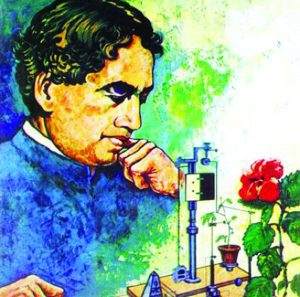
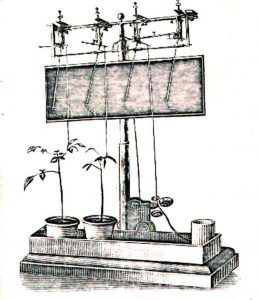
This amazing description was cited from the British magazine, Nation, reporting on discoveries revealing that plants inhabit a rich world full of senses and feelings. The specific experiment cited by Nation was the work of Sir Jagdish Chandra Bose, researcher of international renown and one of the pioneers of research in the field of plantlife. Bose had been studying plant responses to various stimuli in their environment by the end of the 19th century, and one day, a bold idea entered his head. He placed a crescograph – a device he had invented for measuring growth in plants – upon the leaves of a plant in his research area. The results were incredible! Not believing what he had found, Bose tried his experiment again and again to ensure that his discoveries were accurate. It became clear to Bose that plants responded to various kinds of contact and experience in the same manner as other living creatures. From that moment forward, Bose dedicated himself to investigating his findings, revealing that many plants and vegetables express sensations in ways that are measurable by science.
When he first reported his research results to the British scientific community, his colleagues found it difficult to comprehend – this despite the fact that Bose’s research had been performed with impeccable scientific precision. But after Bose personally presented his findings to the chief British scientific institutions, the scientific establishment had no choice but to accept his discoveries, evoking tremendous excitement.
Bose was invited to demonstrate his findings before the members of the Linnean – the society of scientists in London. The most respectable professors of the Linnean could not believe what they saw: a special magnifying system showed a cabbage leaf cringe in agony as it was being boiled to death. They saw a radish grow “exhausted” just like a muscle and then become “angry” as if it had a nervous system. They witnessed how a tremble passed through a vegetable at the moment of “death,” in the same way that a dying creature shudders in the seconds before its life ends.
In the wake of his demonstration, Bose received funding to launch a research institution of his own, and received an honorary degree for his work.
Decades later, the scientific establishment in what was then the Soviet Union also recognized that plants have feelings that can be expressed in a clear manner. In 1970, the leading Russian newspaper Pravda announced in an explosive headline:
“Plants Speak. Yes, They Shout! Only to Avoid Embarrassing People Do They Keep Their Pain to Themselves.”
In the article attached to the headline, Vladimir Chertkov, one of the most important journalists at Pravda, described in vivid detail his visit to the climate laboratory at the famous Moscow Agricultural Academy, Timiriazev. Among other things, he recalled a sheaf of wheat crying out in terror as its roots were boiled in steaming water. A highly sensitive electronic meter, similar to an EKG utilized for measuring human heartbeats, registered each and every cry of the plant, as red ink jumped across rolls of white paper. Chertkov also described Russian experiments suggesting that plants could comprehend signs sent to them from their environment and were able to offer signs of their own to the world around in return. These were incredible discoveries, marvels of the world of modern science aided by highly sensitive, delicate electronic devices.
But now I want to ask a question.
Before the invention of electricity and highly complex sensory equipment, could it have been possible for someone to have known this amazing secret of nature – to say with complete confidence that plants experience feelings and pain that force them to cry out in tiny unheard voices?
About 1,500 years ago, when the Oral Torah was being transcribed, the following teaching was recorded in the Midrashic text, Pirkei d’Rabbi Eliezer (Chapter 34):
“When a tree is felled, its voice travels from one end of the earth to the other, though it is not heard.”
How could these teachers of Torah have known a secret of nature that was only recently discovered by means of complex electronic devices?
Throughout its history, the Jewish people have always known the answer: The One who created the world knows the mysteries and secrets of creation, and every detail He deemed appropriate to reveal in the Written or Oral Torah has been preserved and passed on by the sages from generation to generation.
Let us suggest that despite their many advances, scientific discoveries are still in their “infancy.” The electronic devices that exist today are primitive when compared to the Torah’s understanding. Modern-day equipment does not have the ability to measure the distance that the voice of a chopped tree can travel. Yet, the Creator of the world revealed it to us: The voice of the tree travels around the entire globe.
(Let me state the obvious here: The pain and suffering of plants is not exactly like that of other living creatures. Rather, what was discovered were particular frequencies which are similar in form to emotional responses. For this reason, we don’t find a Torah prohibition against causing plants suffering, as we do regarding other living creatures.)
Can Plants Perceive?
Another important section from The Secret Life of Plants describes how the incredible world of plants was discovered “accidentally” in another part of the world – this time in the United States.
In 1966, Cleve Backster, an American expert in the use of polygraphs (lie detector machines), decided to attach a polygraph machine to a plant in his office as he watered it. To his utter amazement, the needle on the polygraph jumped in a manner similar to a person who had become mildly excited. The slightly dismayed expert wanted to check if he would be able to create stronger reaction and he decided to burn the plant. Before he could even say a word about his plan, let alone put it into action, the needle of the polygraph shot up dramatically. The plant was behaving just like a person being tested and exhibiting a strong emotional response. Apparently, the plant was able to perceive the approaching danger more than if it could if it had human eyes.
This was only the beginning. The American expert dropped all his other pursuits and dedicated himself to experiments concerning plants and their stunning mysteries. “I soon discovered that plants can see better without eyes, and sense better without a nervous system,” he said.
Cleve Backster is a best known for his experiments with biocommunication in plant and animal cells using a polygraph machine in the 1960s which led to his theory of “primary perception.” He reported observing that a polygraph instrument attached to a plant leaf registered a change in electrical resistance when the plant was harmed or even threatened with harm. He argued that plants perceived human intentions, and as Backster began to investigate further, he also reported a finding that other human thoughts and emotions caused reactions in plants that could be recorded by a polygraph instrument. He termed the plants’ sensitivity to thoughts “primary perception,” and published his findings from the experiments in the International Journal of Parapsychology.
Backster then formulated a “blind” test, devoid of all human intervention, in order to exclude the possibility that the experimenter was somehow influencing the polygraph needle. He assembled a special device that randomly spilled the contents of various containers into a pot of boiling water every few minutes. Some of the containers held water, the others goldfish. Three types of philodendron were placed alone in a room with these containers and connected to a galvanometer, a device used for measuring weak electric signals.
The results of this experiment were startling. Each time the fish were poured into the pot of boiling water, all the plants responded as if in great distress.
This discovery created a stir in the scientific world and resulted in worldwide recognition for Backster. Thousands of scientists requested printed results of his work, and researchers throughout America began to speculate about potential uses of his findings.
This brings us to a teaching from the sages, which describes how one of our great rabbis understood plants’ ability to perceive, and reveals his deep understanding of plants’ emotional intelligence:
There once was a date tree that stood in the village of Hammatan that never produced fruit. People tried grafting [other date shoots] onto it, but still there was no fruit. Rabbi Tanhuma said to them, ‘This date tree sees the fronds of another date palm in Jericho and longs in her heart for them.’ The people brought some of the fronds to the date tree and grafted them on, and it produced fruit right away. (Midrash Rabbah, Bamidbar 3:1)
There is a phenomenon well-known to horticulturists: A climbing vine that is working its way towards the closest post will change its direction if someone moves the post. How is this possible? If we accept the premise that plants can see or sense their surroundings, this phenomenon can now be understood.
It is important to note the official explanation for this phenomenon from the world of botanical researchers: “Climbing plants send out tendrils that turn in ever widening circles (or that sway from side to side), until they encounter some object around which they then wrap themselves. If the object is moved or removed before the tendrils are able to wrap themselves well, they return to their previous movements, until they wrap themselves around a nearby object.”
Science, however, knows only how to describe events, but not why they happen. It has no tools to explain the ultimate goal of a plant’s movement – whether it is blindly seeking whatever it may find, or willfully moving itself towards something it desires. According to the sages (as well as recent scientific discoveries), the second explanation may indeed make more sense.
If, however, you still doubt that plants have feelings that motivate them, take careful notice of the following account.
Are Plants Affected by Love and Attention?
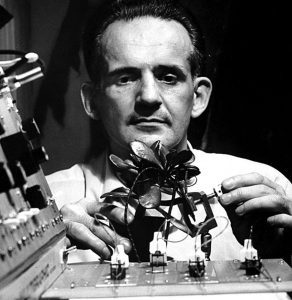
It is hard to believe that bestowing love and attention upon plants can cause them to grow, but this is the conclusion reached by scientists after extensive research. According to various studies, plants have an inexplicable ability to sense what is happening around them and respond in a sophisticated manner. Here is an example from The Secret Life of Plants, describing the research of Marcel Vogel, a chemist from California:
He asked one of his friends, a clinical psychologist, who had come to see for himself if there was any truth to the plant research, to project a strong emotion to a philodendron 15 feet away. The plant surged into an instantaneous and intense reaction and then, suddenly, “went dead.” When Vogel asked the psychologist what had gone through his mind, the man answered that he had mentally compared Vogel’s plant with his own philodendron at home, and thought how inferior Vogel’s was to his. The “feelings” of Vogel’s plant were evidently so badly hurt that it refused to respond for the rest of the day; in fact, it sulked for almost two weeks.
In the next stage, after dozens of experiments that proved a connection between plants and their surroundings, Vogel reached the point where any strong emotions he felt would be immediately mirrored by the plants, even when they were at a distance. The following experiment, reflecting this accomplishment, was performed by one of Vogel’s colleagues:
Back in her garden, Vivian Wiley picked two leaves from a saxifrage, one of which she placed on her bedside table, the other in the living room. “Each day when I get up,” she told Vogel, ‘I will look at the leaf by my bed and will that it continue to live; but I will pay no attention to the other. We will see what happens.”
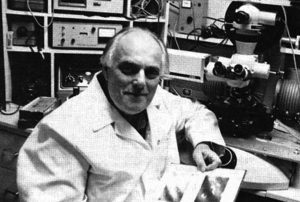
Dr. Vogel was a research scientist for IBM’s San Jose facility for 27 years. In the 1970s Vogel did pioneering work in man-plant communication experiments. His experiments helped prove that plants have an inexplicable ability to sense what is happening around them.
A month later, she asked Vogel to come to her house and bring a camera to photograph the leaves. Vogel could hardly believe what he saw. The leaf to which his friend had paid no attention was flaccid, turning brown and beginning to decay. The leaf on which she had focused daily attention was radiantly vital and green, just as if it had been freshly plucked from the garden.
The sages also reveal that plants experience feelings of shame. The Jerusalem Talmud (Orlah 1:3) discusses an agricultural technique called havrachah, which entails the bending and planting of a branch into the ground until it takes root, at which time it is severed from the mother tree and allowed to grow on its own. The rabbis term the original tree an “old lady” and the new tree, a “child”:
How does the tree owner know [that the “child” has taken root, such that he may now sever its connection with the “old lady”]? If the leaves of the “child” are turned toward itself, it is clear that it lives on account of the “old lady.” If the leaves are turned toward the “old lady,” it is clear that the “child” lives on its own accord, for a person who lives off of his friend is embarrassed to look him in the face.
Can Plants Hear?
We have already seen that plants are aware of what is happening around them. But can they hear, as well?
Dr. T. S. Singh, Head of the Department of Botany at Annamalai University in India, asked this very question in 1950 after hearing rumors that plants that were played music to grew faster and better. Seeking proof to substantiate this claim, Singh set up a scientific lab that contained a variety of normal, healthy plants of about the same age, and had a device play tones from three different instruments at a fixed distance from the plants. The results were startling: These plants grew and produced seeds at an above average rate.
After a series of experiments confirmed these findings, a number of farmers tried applying this technique to their crops. They recorded pleasant music and played it on loudspeakers for an hour each day in fields bearing six different strains of rice. The resulting harvests were 25-60 percent greater than the normal yield.
Peter Benton, a staff member of the Canadian Department of Agriculture, tried applying the results of these experiments to help corn crops battle insect infestation, which usually resulted in heavy damage. He recorded sounds similar to those of bats and played them in the fields. The fields were rapidly cured of the intruders.
However, if these researchers thought that their efforts would increase the full complement of crops around the world, they were wrong. It turns out that certain types of music that promote the growth of one strain of plant decrease the growth rate of another. Science has still not been able to solve the mystery of the individual tonal preferences of plants.
The Talmud also speaks about the effect of sound on plants.:
The person who [cut the plants used for incense in the Temple] would say, ‘Grind it well, grind it well!’ because the sound improves the spices.
On the other hand, Rabbi Yochanan said that while the sound is good for plants, it can actually damage wine, which improves far better when it sits in a quiet place. (Keritut 6b)
In 1950, Dr. T. S. Singh conducted experiments that proved that plants that were played music to – grew faster and produced seeds at an above average rate. Farmers who recorded pleasant music and played it on loudspeakers for an hour each day had harvests that were up to 60 percent greater than the normal yield!
Plants Can Communicate!
A more recent discovery, based upon studies conducted in California, Japan, and Germany since 1996, is that plants have a sophisticated chemical language through which they communicate not only with members of their own species, but also with different types of plants, and even with insects.
For instance, when scientists clipped leaves of a sagebrush plant in a way that mimicked the damage caused by insects, the plant released a puff of a chemical called methyl jasmonate. Tobacco plants growing downwind picked up on the chemical and immediately began boosting their own level of an enzyme that makes their leaves less tasty to insects. These tobacco plants suffered 60 percent less damage from grasshoppers and caterpillars than tobacco plants situated next to unclipped sagebrush.
More recently, scientists at Kyoto University in Japan let spider mites loose on lima bean plants and tracked the plants’ responses. They found five different defense mechanisms. First, each injured plant released a chemical that changed its flavor, making it less attractive to the mites. Then, the plants released other chemicals that drifted away. Other lima bean plants received the chemical and immediately began giving off the same chemicals, making them less tasty and warning still more lima bean plants, before the mites had even reached them. Most amazingly, some of them released chemicals which summoned a whole new batch of mites, those which actually eat the spider mites attacking the lima bean plants.
These amazing discoveries of plant language, at the cutting edge of botanical research, were already known to the Jewish sages thousands of years ago.
The Ramban, in his introduction to his commentary on the Torah, wrote:
King Solomon, of blessed memory, to whom Gd gave both wisdom and knowledge, knew everything in the Torah. In fact, his grasp of the Torah was so deep that he understood the secrets of all things, including the language of plants, the language of trees and roots, and all things both hidden and revealed. He discovered all this through the study of Torah and its commentaries and teachings.
Additionally, the Talmud describes the wisdom of Rabbi Yochanan ben Zakkai, the leading sage in the Land of Israel in the first century CE: “Rabbi Yochanan ben Zakkai knew every part of the Tanach, Mishnah, Gemara, Halachot…, astronomy, numerical calculations, the language of the angels, the language of the spirit world, and the language of the trees…” (Sukkah 28a).
Indeed, plants do have a language and can communicate – a fact revealed by Gd through His Torah millennia ago!
Rabbi Zamir Cohen is the founder of the Hidabroot organization and has written several books on the topics of Jewish thought and law, including his national bestseller, The Coming Revolution.
One day, while having coffee in an Upper East Side café, two elderly women were overheard talking.
First woman: “What did you do to your hair? It looks like a wig!”
Second woman: “Actually, it is a wig.”
First women: “Really?! You’d never know it.”
Jack V. Grazi
Homework Helper
Teacher: Jacob, your composition on “My Dog” is exactly the same as your brother’s. Did you copy his?
Billy: No, teacher. It’s just the same dog!
R. G.
Tax Talk
As income tax time approaches, did you ever notice that when you put the two words “THE” and “IRS” together it spells “THEIRS”?
Arlene R.
The Bakery Sign
After starting a new diet I altered my drive to the gym to avoid passing my favorite bakery. I accidentally drove by the bakery this morning and as I approached, there in the window were a host of goodies. I felt this was no accident, so I prayed: “If it was Divinely destined that I should have any of those delicious goodies, show me a sign in the form of an empty parking space right on the block of the bakery.”
And sure enough, my prayers were answered… On the eighth time around the block, there it was!
Jonathan F.
Saudi-Con
Q: What do you call a first-time offender in Saudi Arabia?
A: Lefty!
Raquel B.
That’s Nuts
Q: What is the only nut without a shell?
A: A donut!
Susan C.
Worth Stewing Over
A man walked into an old-looking restaurant and sat down. The waitress came over and asked, “What’ll you have?” “I’d like a plate of stew and a kind word,” the man replied.
The waitress brought his stew a few minutes later and as she put it down, the man asked, “How about the kind word?”
“Oh yeah,” the waitress said, “don’t eat the stew!”
Sam S.
Wisdom of the Times
Living on Earth is expensive, but it does include a free trip around the sun every year.
How long a minute is depends on what side of the bathroom door you’re on.
Birthdays are good for you. The more you have, the longer you live.
Ever notice that the people who are late are often much jollier than the people who have to wait for them?
Working for Gd on earth does not pay much, but His retirement plan is out of this world.
Ron E.
National Colors
An American and a Dutchman were talking.
“What does your flag look like?” asked the American.
“It has three stripes,” replied the Dutchman, “red, white, and blue. We say they have a connection with our taxes – we get red when we talk about them, white when we get out tax bills, and we pay them until we’re blue in the face.”
“That’s just how it is in my country,” replied the American, “only we see stars, too!”
Yona F.
Keeping Busy
Q: What’s the nicest thing about meditation?
A:. It makes doing nothing quite respectable.
Jack V. Grazi
The Bathtub Test
During a visit to the mental asylum, a visitor asked the Director for the criteria by which a patient is institutionalized.
“Well,” said the Director, “we fill up a bathtub, then we offer a teaspoon, a teacup and a bucket to the patient and ask him or her to empty the bathtub.”
“Oh, I understand,” said the visitor. “A normal person would use the bucket because it’s bigger than the spoon or the teacup.
“No,” said the Director. “A normal person would pull the plug out. Do you want a room with or without a view?”
Lisa D.
Sick Day Story
I urgently needed a few days off work, but I knew the boss would not allow me to take a leave. I figured that maybe if I acted crazy, he would think I was burned out and tell me to take some time off. So I hung upside down from the ceiling and made funny noises. My co-worker asked me what I was doing and I told her that I was pretending to be a light bulb so that the boss would think I was burned out and give me a few days off. A few minutes later the boss came into the office and asked, “What are you doing?”
I told him I was a light bulb. He said “You are clearly stressed out. Go home and recuperate for a couple of days.” I jumped down and walked out of the office. When my co-worker followed me, the boss asked her, “And where do you think you’re going?”
She said, “I’m going home too. I can’t work in the dark!”
Ezra C.
Art Appreciation Bandit
Recently, a guy in Paris nearly got away with stealing several paintings from the Louvre. However, after planning the crime, and getting in and out past incredible security, he was captured only two blocks away when his minivan ran out of gas. When asked how he could mastermind such a well thought out crime and then make such an obvious error, he replied: “I had no Monet to buy Degas to make the Van Gogh!”
Helen S.
Kosher Menu
A man walked into a kosher seafood restaurant and asked, “Do you serve crabs here?”
The hostess, an older Jewish lady, looked at the man and said, “Sure, we serve anyone – where would you like to sit?”
David B.
In Case of Emergency
Although this married couple enjoyed their new fishing boat together, it was the husband who was always behind the wheel operating the boat. Concerned about what might happen in an emergency, the husband decided to see if his wife could handle the craft on her own. One day out on the lake he said to his wife, “Please take the wheel. Pretend that I am unconscious for some reason and you must get the boat safely to shore and dock it.”
Proving that she was up to the challenge, the wife drove the boat to shore with no help from her husband.
Later that evening, the wife walked into the living room where her husband was reading the newspaper. She sat down next to him, took a section and said to him, “Please go into the kitchen. Pretend I’m unconscious for some reason and you must set the table, cook dinner and wash the dishes.”