

Home Blog Page 34

The Road to the 2025 M&S World Series

Sam Sutton

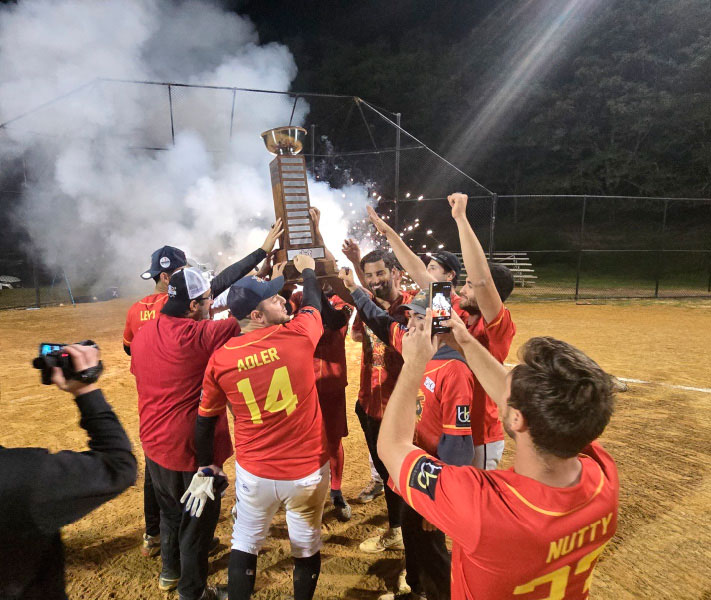
The lights at M&S Park shine brightest in the postseason. The 2025 M&S Playoffs delivered everything – slugfests, web gems, heartbreak, and the rise of new stars. From the opening Wild Card to the Semifinals chaos, every pitch mattered. Now the World Series stage is set: Kaboom vs. King Salomon Part Deux.

Wild Card: Vandelay 12 – Stayin’ Alive 7

The postseason opened with fireworks. Vandelay Industries slugged their way past Stayin’ Alive in a 12–7 shootout, powered by Nussi, who was locked in at the plate, and Wamma, who drove in runs and flashed leather all night.

The defining moment came on defense – with Stayin’ Alive threatening, Sammy Seruya and Wamma turned a game-changing double play that crushed momentum. Jimmy Malakh pitched with grit, keeping Vandelay steady against a dangerous lineup.

Stayin’ Alive refused to go quietly. Bresher launched a no-doubt bomb over the fence to jolt his squad, but it wasn’t enough. Vandelay’s defense carried the day and booked a semifinal showdown with #1 seed Kaboom.

Semifinals Night 1: Longhorns (#2) vs King Salomon Pt Deux (#3)

The first semifinal night was classic. The #2 Longhorns and #3 King Salomon Pt Deux clashed in a best-of-two set, and King Salomon swept both games in thrilling fashion.

Game 1 ended 7–6, with the tying runs stranded on base.

Game 2? Pure chaos. Locked in a tie, Eric Cytryn delivered the swing of the series – a rocket into the right-field gap that rolled out for a home run. The clutch blast broke the deadlock, sent the King Salomon dugout into a frenzy, and completely unraveled the Longhorns. Then momentum belonged to King Salomon.

The highlight reel didn’t end there:

· Rookie phenom JoJo “Box Office” Levy launched his third bomb of the season, a no-doubt nuke that shook the Park.

· Nathan Kushner stole runs with an impossible over-the-shoulder grab.

· And Cytryn closed the series with a diving catch in center to secure the sweep.

Final: King Salomon swept the Longhorns in two games and advanced to the World Series.

Semifinals Night 2: Kaboom (#1) vs. Vandelay Industries (Wild Card)

The second semifinal night belonged to #1 seed Kaboom. Facing Wild Card survivor Vandelay Industries, they delivered a sweep of their own.

Game 1 turned into a pitcher’s duel. Abe Saka was dominant on the hill for Kaboom. Jimmy Malakh stunned the Park with his own shutdown stuff for Vandelay. Both offenses struggled to break through – until chaos struck. With the game on the line, Sol Fallas made a jaw-dropping, game-saving diving catch to end it. One of the greatest plays in postseason history.

Game 2 saw Kaboom’s lineup break free. Patient at-bats and timely hits piled up runs, and their defense stayed sharp. Vandelay battled but ran out of steam.

Final: Kaboom swept Vandelay in two games, locking in their World Series date with King Salomon Pt Deux.

The World Series: Kaboom vs. King Salomon Pt Deux

Now, the finale. Two rosters built for this moment.

Kaboom, captained by Uri Adler, looked like the juggernaut all season. They’ll lean on ace Abe Saka, the ripped power-hitting force Sol Fallas, and a lineup that knows how to grind. Veterans Barry Finkel, a former postseason hero with a walk-off World Series winner on his résumé, MoMo Levy, and Nutty Aurbach bring leadership, playoff experience, and plenty of pop.

King Salomon Part Deux, led by Hall of Famer Michael “Sabon” Salomon, comes with equal firepower. They’re anchored by the legendary Mo Shamah, the elite all-around threat Zack “Z” Ashkenazie, and steady arm Yitz Sutton – who once pitched a perfect game in the World Series and is hungry to add another championship to his career. Add in championship-tested leaders like Teddy Ishak and Sammy Esses, and this team has the pedigree and resilience to shock anyone.

Throw in the breakout rookie JoJo Levy, the always-clutch Eric Cytryn, and their hungry supporting cast, and King Salomon comes into the World Series with swagger.

Two Giants. Two Paths. One Cup.

Will it be Kaboom’s year, or will King Salomon’s mix of legends and young guns capture the immortal M&S Cup?

Stay tuned…

Mabrouk – October 2025

Births – Baby Boy

Mr. & Mrs. Max Sutton

Albert & Kaden Terzi

Maurice & Sonia Mosseri

Bert & Lizzy Chabot

Joe & Claudia Epstein

Ofir & Merlene Zehavi

Solly & Esther Mosseri

Donny & Michelle Nakar

Dennis & Nicole Dweck

Births – Baby Girl

Albert & Esther Cohen

Isaac & Lauren Dana

Isaac & Juliana Nasar

Eddie& Reina Levy

Ralph & Raquel Massry

Joe & Marcy Gammal

Morris & Fortune Chera

Teddy & Eileen Braha

Sol & Sari Cohen

Bar Mitzvahs

Manny, son of Michael and Etti Menahem

Engagements

Zach Kassin to Sarina Dadoun

Aharon Cohen to Gali Cohen

Leor Keda to Hannah Dayon

Moshe Sutton to Deborah Ashkenazi

Elliot Setton to Terry Gindi

Henry Tawil to Deborah Sutton

Morris Zarif to Ruthie Khaski

Victor Salem to Moselle Zeitouni

Weddings

David Tawil to Iris Esses

Michael Gammal to Naomi Dayan

Meyer Sakkal to Jamie Shamah

Joey Dayon to Sarah Siri

Larry Natkin to Rachel Fallas

Jews at Risk Under Mamdani

“Imagine encampments spilling into residential neighborhoods, protests outside synagogues, mobs outside schools, and police ordered to do nothing. Under a Mamdani administration, it will not be a question of if these things happen. It will be a question of when.”

Linda Sadacka

From Baghdad to Aleppo, from Cairo to Beirut, from Damascus to Tripoli, Jewish communities once flourished. They created schools and synagogues, vibrant markets, and family homes. They poured everything into neighborhoods they believed would last forever. Yet time and again, when hostile leaders rose to power and law enforcement looked the other way, those communities vanished. Families were uprooted, businesses destroyed, lives shattered.

In New York, many believed it could never happen here. They said America was different, safe, permanent. Yet history warns us that it can happen anywhere. Today, with Zohran Mamdani, a self-proclaimed radical and candidate of the Democratic Socialists of America, leading in the mayoral race, those echoes are becoming frighteningly familiar.

Who Is Zohran Mamdani?

Zohran Mamdani is not a mainstream politician. He is a radical whose public record should alarm every New Yorker.

He defended the slogan “Globalize the Intifada,” a phrase embraced by extremists as a call to spread violence against Jews beyond the Middle East. Despite criticism, he attempted to sanitize the phrase, even as respected institutions condemned it as dangerous. He declined to denounce DSA’s anti-Zionist resolutions and instead doubled down, claiming he is accountable only to “the people.” He has also stated, “If you win an election, you go ahead and implement the platform, even if you do not have a majority mandate.” That is a promise to impose an ideology regardless of public consent.

He has said, “Billionaires should not exist,” adopting rhetoric that directly targets Jewish values of enterprise, ownership, and family legacy. He stood alongside Bernie Sanders at rallies against “oligarchy,” calling for rent freezes, free buses, and punitive taxes on the businesses and families that fuel New York’s economy.

Mamdani’s platform includes dismantling capitalism and abolishing landlords, which many see as a direct attack on the Jewish community that has long relied on property ownership to provide stability and continuity for families. He advocates slashing police budgets, empowering radical protest movements, and normalizing reckless policies that weaken law and order. He has spoken about creating a borderless America, a vision that would overwhelm already fragile city resources.

These are not quiet opinions. They are public declarations, proudly and unapologetically defended.

The Danger of a Mayor Mamdani

History already showed us what happens when a mayor refuses to protect his city. Under David Dinkins, New York witnessed the Crown Heights riots. For three painful days, mobs targeted Jews while police were ordered to stand down. The result was violence, destruction, and death.

Now imagine a mayor who is not merely hesitant, but ideologically committed to siding with radicals. Imagine encampments spilling into residential neighborhoods, protests outside synagogues, mobs outside schools, and police ordered to do nothing. Under a Mamdani administration, it will not be a question of if these things happen. It will be a question of when.

When that day comes, the NYPD will have no choice but to obey the mayor’s orders. That is the power of the office. That is why this election matters more than any other in recent memory.

What We Stand to Lose

Our community has invested generations of work into this city. We have built schools, synagogues, and community centers that serve tens of thousands of families. We have supported businesses that drive New York’s economy. We have turned entire neighborhoods into sanctuaries for Jewish life.

All of that is now at risk.

Families are already whispering questions at Shabbat tables and community events. What will we do if he wins? Do we leave? Do we uproot everything? The fear is real, and it is growing. People understand what is at stake: safety, security, and the very survival of our way of life in New York.

It is not just activists raising the alarm. The rabbinic leadership of our community has spoken with one voice, issuing a letter that removes any doubt about the urgency of this moment. In their words:

“Every eligible member of our community must vote. This is not about politics. It is about our sacred duty to our families, to our schools, to our yeshivot, to our synagogues, and to our way of

life. Voting is not merely a right. It is a halachic and moral responsibility. We cannot afford silence. We cannot afford apathy. This is not optional. It is a mitzvah, a communal obligation, like tefillah, like tzedakah, like educating our children.”

When every rabbi of the Syrian-Sephardic community of New York and New Jersey signs a letter like this, it is not rhetoric. It is a clarion call. They are telling us plainly: our future, and the future of our children, will be decided by what we do in this election.

A Shadow of Privilege

For someone who rails against privilege, Mamdani’s background tells another story.

His mother, filmmaker Mira Nair, has enjoyed generous Qatari patronage. Qatar’s ruling family financed her 2012 film The Reluctant Fundamentalist, supported her Maisha Film Labs, and paid for a lavish adaptation of Monsoon Wedding during the World Cup. These were not token cultural gestures. They were major investments from a regime that uses money as political leverage.

Why does this matter? Because Qatar is not a benign patron of the arts. It is the single largest financier of Hamas. It bankrolls extremist clerics, shelters terror leaders, and pours billions into propaganda networks that delegitimize Israel. When Qatar invests, it is never charity. It is strategy.

So while Mamdani preaches about justice and rails against “privilege,” his family has benefited from the largesse of a regime that enables the very terror groups murdering Jews in Israel. That contradiction is not nuance. It is a red flag.

The Awakening

And yet, thank Gd, something extraordinary is happening.

For too long, good people avoided politics. That era is ending. Schools are now telling parents: you cannot register your child unless you are registered to vote. Synagogues and community centers are requiring voter registration for participation. Even singles events are saying: no registration, no entry.

This is nothing short of historic. For the first time, our community understands that survival depends on civic engagement.

But registration is only the beginning. It is not enough to sign a form. We must vote. We must show up on Election Day and make our voices heard. Otherwise, all this newfound effort will mean nothing.

Years of Warnings

As an activist, I have been saying this for years. I have written, spoken, pleaded, and urged action. I said it when people rolled their eyes. I said it when people insisted politics would never touch us.

Now, at last, the community is mobilizing. Volunteers are registering voters outside stores, in schools, and even at social gatherings. Their work is extraordinary and deserves recognition. But it should not have taken fear to push people into action.

The past is behind us. What matters is what we do now.

A Community on the Move

The energy is real. Families are recognizing the stakes. Institutions are demanding accountability. Volunteers are carrying clipboards and voter forms because they know our survival depends on it.

Beginnings matter only if they lead to results. Registration is the first step; turnout is the test. The ballot box is where this awakening must be proven.

Politics does not reward intentions; it rewards action. The radicals know this, which is why they always show up. If we match our convictions with ballots, we will decide the future of this city. If we stay home, others will decide for us, and the outcome will be one we cannot accept.

The choice is clear, the responsibility is ours, and this time no one will be able to say they were not warned.

Turn The Page: Home Is Where Your Story Continues…

Karen Behdar

October always feels like a bridge. The holidays wind down, the sukkah gets packed away for next year, and fall quietly settles into Brooklyn. The air feels sharper, the sidewalks gather crisp leaves, and the rhythm of life shifts back to routine. School schedules are in full swing, sweaters are pulled from storage, and we begin to notice the subtle but steady change, not just in the weather, but in ourselves.

Transitions

This is the season of transition. Just as the trees shed what they no longer need, families and individuals alike begin asking themselves what it might mean to step into something new. For some, that reflection comes quietly. A kitchen that once felt lively and warm now feels too small when everyone gathers. A commute that seemed manageable in September begins to feel like a weight by October. For others, the realization is sparked by joy, like hosting guests over the summer and dreaming about a dining room that could seat everyone comfortably, or imagining a backyard where children’s laughter might ring more freely.

Real estate has its own seasons, too. Fall is rarely about rushing. It’s about planning, envisioning, and wondering. It’s when people start planting the seeds for what could become a new beginning in the spring or summer. This is the moment when questions rise to the surface, often quietly at first:

Is this the right neighborhood for the stage of life I’m in?

● Do I want to stay rooted here, or is something pulling me elsewhere?

● What kind of space would truly feel like a home?

● What would it feel like to live in a place that doesn’t just fit my needs, but nurtures my dreams?

The beauty of this season is that it doesn’t demand answers right away. Just like the leaves don’t fall all at once, change unfolds gradually. Sometimes, the first step isn’t a decision. It’s simply giving yourself permission to wonder. To picture what life could look like if your surroundings matched the stage you’re in right now.

And there’s something grounding about October itself. It’s a reminder that change is part of the rhythm of life. We move through cycles of celebration and quiet, expansion and reflection, building and resting. The homes we live in are part of that cycle, too. They carry us through seasons, but they also invite us to ask when it’s time to turn the page.

Sprouting Thoughts

Maybe this is the month you realize the walls that once sheltered your young family now feel like they’re pressing in as your children grow taller. Maybe it’s the month you walk home from school pickup and think, “I’d love to live just a little closer.” Maybe it’s the month you look around your living room and think about the warmth of hosting Shabbat or holiday meals in a space that feels more open, more yours.

Whatever sparks the thought, October gives us space to pause and consider. To sit with the questions without rushing into answers. To look at our lives and ask, “What would the next chapter look like if I allowed myself to dream a little bigger?”

So as the leaves turn and the air shifts, let yourself reflect on more than just the season. Think about where your story is unfolding and whether it’s time to imagine a different backdrop for the chapters ahead.

Because home isn’t just where you live. It’s where your story continues…

Critical Voter Registration Drive Unites Sephardic Community

Eddie M Esses and Sari J Setton

The Sephardic Community Federation (SCF) has launched one of the most ambitious voter registration drives in the history of our community. Led by Haim Dabah and Marshall Aronow, in partnership with SCF’s executive team – Ronnie Tawil, Sari Setton, Eddie Esses, Joey Saban, Joe Mansour, and Charles Chakkalo. This unprecedented initiative is already reshaping civic engagement across our community, having registered thousands of new voters with the goal of adding many thousands more before the November mayoral election.

The campaign was launched this past August at a meeting hosted by Haim Dabah at his home in Deal, NJ. Leaders from schools, synagogues, and community institutions gathered for a powerful morning of strategy and planning. Presentations by Haim Dabah Marshall Aronow, and Ronnie Tawil set the tone for the weeks ahead, followed by a lively discussion among the assembled leadership. In addition to uniting our institutions around this mission, the meeting also raised enough money to fund the campaign’s rollout.

From that moment, the SCF team – guided daily by Haim and Marshall – set in motion a wide-ranging and highly coordinated effort:

· Rabbinical Proclamation: A landmark statement, signed by the majority of our community Rabbis, declared that registering to vote is both an obligation and a mitzvah, energizing the effort with moral clarity.

· School-Based Registration: Magen David Yeshivah, under the leadership of Gladys Haddad, mandated voter registration among its parent body in order to receive class cards. The result was extraordinary: a 99 percent registration rate in just three days. Yeshivot nationwide have since reached out, seeking to replicate this model.

· Synagogue Engagement: Congregation Shaare Zion instituted a policy requiring voter registration to reserve High Holiday seats, demonstrating the alignment of our institutions behind this effort.

· Community Registration Tables: Under the leadership of Linda Ebani, along with Rebecca Harary, volunteers have been running registration drives at summer events, synagogues, and local stores across Brooklyn, engaging our community at every level.

· Door-to-Door Canvassing: Joey Saban led a professional door-to-door campaign that has registered significant numbers of voters directly at their doorsteps.

· Direct Texting Campaign: Most recently, the group launched a major texting initiative targeting unregistered voters. In just a few days, the effort has registered hundreds, and it is rapidly expanding to registering thousands.

Together, these initiatives have already registered thousands of voters in just weeks. The goal is to register many thousands more before November, ensuring that our community’s voice is heard loud and clear in this critical mayoral election, and all future elections.

This campaign is a testament to what can be achieved when vision, leadership, and unity come together. The extraordinary dedication of Haim Dabah and Marshall Aronow, combined with the tireless efforts of the SCF team, has inspired a wave of civic engagement unlike anything our community has seen before.

With the upcoming mayoral election, we are living through uncertain times that call for decisive efforts – and community leadership is stepping up to the plate. With the continued energy and unity behind this campaign, the Sephardic Community is poised to play a significant role in shaping the future of our city and state.

Once Upon A Thyme – Balsamic Roasted Chicken with Farro

By Adina Yaakov

This flavorful, Mediterranean inspired recipe is the perfect one-pan meal. Juicy chicken roasts on a bed of farro, leafy greens, olives, and sun-dried tomatoes, soaking up a tangy balsamic and lemon marinade as it cooks. The flavors are incredibly rich and satisfying, and the best part is that it bakes together in one dish, making cleanup easy.

Ingredients

● 2 lbs. chicken breasts

● 2 cups farro

● 4 cups boiling water

● 2 tbsp chicken consommé

● 9 cloves garlic, minced (divided)

● 10 sun-dried tomatoes

● ½ cup pitted Kalamata olives

● 1 purple onion, sliced

● ½ cup lemon juice

● ½ cup balsamic vinegar

● 2 cups baby spinach or kale

● 2 tbsp salt (divided)

● ½ tsp black pepper

● Fresh parsley, for garnish

Instructions

1. Preheat the oven to 350 degrees Fahrenheit.

2. In a large bowl, combine the boiling water, chicken consommé, balsamic vinegar, lemon juice, 6 cloves of minced garlic, and 1 tablespoon of salt. Stir well, then add the farro and let it soak briefly while you prepare the chicken.

3. Sprinkle the chicken breasts with black pepper and the remaining 1 tablespoon of salt. Gently lift the skin and rub the remaining 3 cloves of minced garlic underneath.

4. Transfer the soaked farro and its liquid into a large oven-safe baking dish or sheet pan. Spread the baby spinach evenly over the farro. Place the chicken breasts on top.

5. Evenly distribute the sliced purple onion, sun dried tomatoes, and Kalamata olives around the chicken.

6. Cover the dish tightly with foil and bake for 45 minutes. Then uncover and bake for an additional 15 minutes on 450 degrees Fahrenheit until the chicken is fully cooked and slightly golden. Add a splash of water if the farro looks too dry.

7. Remove from the oven and let rest for a few minutes.

8. Garnish with fresh parsley and serve warm.

Vaccines, Variants, and Vulnerability: What Every Parent Needs to Know

By Stuart H. Ditchek, MD Board Certified Pediatrician Faculty, NYU School of Medicine

As a follow up to last month’s article (The Reality of Vaccine-Preventable Diseases), I have been asked to continue the discussion regarding the importance of childhood vaccinations and why parents should understand this complex issue. In addition, I will provide a follow up on the current Israel measles outbreak.

Unfortunately, as of the end of August, Israel saw a reported 700 cases of measles over three months resulting in the death of two toddlers to date. The majority of hospitalized seriously sick children are unimmunized. Historically, both Israel and New York have had outbreaks in similar time periods as there is so much travel between the two locations, especially for the New York Jewish community. Unfortunately, with the number of families who have sought out falsified vaccination records recently, we do not currently know how many children in our communities are unimmunized or under immunized. This makes the risk to susceptible individuals much greater.

Why Vaccine Protocols Have Changed

Understanding historical perspectives and how many of the vaccine protocols have developed is an important part of good parenting. Let’s take a few examples of how recommendations evolved as science advances over time. For example, flu vaccines are recommended now for all children over six months, whereas years back it was only recommended to vaccinate the highest risk individuals such as those with heart or respiratory disease. The answer lies in the complication rates over the past 20 plus years and how it has changed.

In 2010, the flu vaccine was added to the annual recommendations for all children. The two factors that changed the recommendations were bacterial secondary complications and the post swine flu lessons of 2009.

Years back, there was minimal bacterial resistance throughout the United States. Over time with the overuse of antibiotics, we have seen a tremendous emergence of MRSA (Methicillin Resistant Staph Aureus). This dangerous aggressive bacteria finds the most susceptible hosts and wreaks havoc on certain patients.

Flu Patients Have Gotten Sicker

The research supports the fact that as MRSA and other bacterial strains became dominant, those sick with flu were getting hospitalized at much higher rates. The majority of flu complications are the result of secondary pneumonias, many with MRSA. This type of complication often leads to hospitalization and serious complications including respiratory failure.

ICU-level care became more common for the unimmunized. Many of the sickest patients suffered terrible outcomes including deaths and amputations as a result of the severe infections. In children, the overwhelming majority of hospitalized children with flu complications are those not immunized. The fact remains that immunized children have a dramatically lower complication rate specifically for hospitalization.

While the flu vaccine is approximately 60 percent effective to prevent getting the flu, it is more than 90 percent effective in preventing hospitalizations in children. The other factor that has evolved and made the seasonal flu much more serious is the effects of the H1N1 swine flu variant.

Swine Flu

The novel swine flu variant appeared in the late spring of 2009. Existing flu vaccines were ineffective against this variant. That year, many pregnant and postpartum women were very sick and hospitalized with swine flu. Babies were being delivered by C-section in the ICUs as the mothers were too critical to risk transport to the operating room.

Why did the new variants cause such serious disease? Firstly, pregnant and postpartum women lose immunity to many infections as a result of a normal pregnancy. The other factor is related to these newer variants effects on the bone marrow causing an inability to fight infections. The current flu variants cause very significant and often unnoticed suppression of the white blood cells originating in the bone marrow. This suppression can lead to the inability to fight off the bacterial complications seen in flu, especially pneumonias.

In other words, this was not your mother’s seasonal flu that mostly affected those at highest risk. Flu vaccination is critical for all children especially the youngest ones. In my practice, flu vaccine compliance has been very good as the result of efforts to educate families. However, since the recent anti-vaccine movement has erupted, this has become more difficult.

RSV Vaccine

Let’s look at the RSV (Respiratory Syncytial Virus) vaccine, which is now a standard recommendation for all babies either after delivery or by the mother receiving it in the third trimester.

RSV is a very dangerous respiratory virus that affects tens of thousands of babies annually, often resulting in hospitalization and sometimes, unfortunately, death. This virus is benign to most healthy older children and adults (with the exception of seniors) but is very serious in newborns.

In the past two years, a recommendation came about to give babies these monoclonal antibodies to prevent complications. Those who object to vaccines would have you believe that this is a brand new vaccine and not studied. That is false. RSV vaccine is a passive antibody administration, much like the monoclonal infusions that saved so many during early COVID. There is no immune response required by the infant. The vaccine simply provides long-acting antibodies to the infection that lasts for a period of months.

This monoclonal antibody is not new. Pediatricians have been giving a product called Synagis to preemies and high risk infants since 1999. Synagis is very similar to the RSV monoclonal product (Beyfortus) except that it is a short acting antibody that requires five doses per season rather than one, as required for Beyfortus. Since the introduction of the RSV monoclonal vaccine, hospitalizations have been dramatically reduced. It is very well tolerated with minimal side effects as the baby is not required to actively mount an immune response. The antibody is given to protect the baby during RSV season in the first year of life and in the second year for higher risk babies. It is very important for parents to understand the critical nature of how this simple passive immunization with monoclonal antibody is saving lives.

Chickenpox Vaccine

One more vaccine innovation that did not exist until the early 1990s is the vaccine for Varicella (chickenpox), initially developed for use in high risk children recovering from cancer or other immunosuppressive treatments.

The recommendations changed in the early 1990s to now give this vaccine to healthy children. This is due to the complication rates from MRSA and other bacterial risks. When I was a child, chickenpox was a rite of passage with minimal bacterial secondary complications. Once antibiotic resistance and MRSA came about in the late 1980s, we started seeing children hospitalized with bacterial sepsis (blood infections), cellulitis (soft tissue infections), and serious complications.

The reason is that a typical child with Varicella has a large number (sometimes in the hundreds) of open wounds that are easy penetration points for bacteria such as MRSA. Once again, this is not your mother’s chickenpox of past years. As a young practitioner, it took me two years to adopt this recommendation as I wanted to see more data before using it broadly with my patients. It was clear that the vaccine led to dramatic hospitalization reduction and the associated complications. Is it as perfect as natural immunity? No. But the benefits far outweigh the risks. Once again, in my private practice, I have not seen a single case of chickenpox since the mid-1990s.

Mercury in Vaccines?

As you can see, understanding disease processes and solutions is critical for parents. I am often asked if vaccines contain thimerosal (ethyl mercury), a preservative. The thimerosal scare is a myth often touted by anti-vaccine activists. In my 35-year history, my practice has never used the only thimerosal containing vaccine, which is the multi-dose flu vial.

These vials are primarily used in countries where storage and shipping of single dose vaccines is difficult, such as third world countries. More importantly, ethyl mercury is excreted easily in all humans and not stored in tissues. Methyl mercury present in carnivorous fish (i.e. tuna) and present in certain environmental exposures is potentially toxic. In the book that I authored in 2001 on integrative pediatrics, Healthy Child Whole Child (Harper Collins Publishers), I advise no fish during pregnancy and limited carnivorous fish for all children and adults in general. Mercury is not an issue in childhood vaccinations in almost all medical practices.

In Conclusion

In closing, be smart and don’t let the politics of vaccination influence your decision process. We have an obligation to protect our own children and all children in our communities. When we allow those who refuse vaccinations into our schools, it puts many at risk. I have many families with children who are in the highest risk categories in schools all over Brooklyn and Manhattan. These are children recovering from cancer, immune disorders who are on immunosuppressive therapies, and others.

They must often wait until their immune systems recover from the effects of their treatments to receive boosters or get re-immunized after their immune system gets washed out by the treatments. That makes them very susceptible. The parents of those children are terrified right now as they are well aware that there are those in the community who have falsified their children’s vaccination status. That is not who we are as a community.

Please listen to your doctor and do the right thing to protect all children.

Voices of Vision

“Jeffrey and I have been raising our family and working together for over two decades. My family is Ashkenazi Hungarian and his is Egyptian. Our home is the best mix of both Ashkenaz and Sephardic customs and food. We run a home health care company that we built together.”

~~ Agnes ~~

Ellen Geller Kamaras

Please meet Agnes Shemia.

Agnes exudes positive energy, warmth, and an upbeat perspective. She is definitely a people person.

Agnes describes herself as giving, hardworking, diligent, and relentless. Agnes is both driven and is committed to her family, business, and community.

Agnes was born in Hungary and moved to New York with her parents, Susan and Leslie Gollender, at the tender age of one. Her grandparents were Holocaust survivors. Agnes speaks fluent Hungarian. She is very close with her brother, Alen, who is five years younger and lives in New Jersey.

Growing up in Mill Basin, Brooklyn, Agnes attended Shulamith Elementary school until sixth grade. She then transferred to Yeshiva of Flatbush and studied there through high school.

“I was shy as an adolescent and became less so as I got older. By the time I graduated college I was a total extrovert.”

Agnes greatly enjoyed her Judaic and Hebrew classes and preferred science to math and history. Languages came easy to her, and she was an above average student. Agnes was very social, however, and admits to chatting a lot in class.

After high school, Agnes studied at New York University and majored in speech-language pathology (SLP). Why speech? “I always loved medicine, and I thought I could be a great teacher. SLP seemed like a great combination of the two.”

Family

Agnes was introduced to her naseeb, Jeffrey Shemia, of Egyptian descent, through her high school friend, Debbie. The couple have been married for twenty-six years and combined forces to create a family and build successful home health care companies operating in New York, Florida, and Missouri.

Their children are Victor (25), Esther (22), Jacob (18), and Sophie (16). Victor attended NYU Stern School of business and is working in the family health care business. Esther is studying nursing at NYU and is married to Samuel Krost, who is like a son to the Shemias. Jacob is starting his sophomore year at NYU and Sophie is a junior at Ramaz High School.

Agnes and Jeffrey raised their children in Brooklyn and spent summers in Deal. Their office is in Brooklyn. As they started their family, the Shemias moved to Mill Basin to be close to Agnes’ parents. “My career would not have flourished if not for my parents. They helped us with our kids tremendously.”

With their youngest in school in Manhattan, Agnes and Jeffrey are planning a move from Brooklyn to the Upper East Side.

Their Journey

As a newlywed, Agnes completed her master’s degree in SLP at Lehman College. She has always preferred working with adults. Her patients were primarily stroke victims or had traumatic brain injuries.

It was Jeffrey’s idea and dream to build a home health care company. An avid newspaper reader, he recognized in his early twenties that the aging baby boomers would need and desire home health care. The U.S. Department of Health and Human Services cited that by 2050 those over age 85 are projected to more than triple, and an estimated 70 percent of older adults reaching age 65 are expected to require, in their lifetime, some type of long-term care assistance, such as help with bathing, dressing, meal preparation, medication management, housekeeping, and transportation.

Jeffrey worked in Agnes’ father diamond business and Agnes practiced SLP at outpatient rehabilitation centers. They worked hard to build up savings to realize their dream. A few short years after graduation, Agnes and Jeffrey built their home health care business one patient at a time.

After many failed and challenging attempts, the Shemias were licensed by the NYS Department of Health. They opened their first home health care business, HCS Home Care, in 2004, providing non-skilled services. In 2017, they expanded their scope and purchased Girling, which includes a range of skilled services, nursing, SLP, physical therapy and occupational therapy.

Approximately a year ago, HCS-Girling entered into a strategic partnership with Pinnacle, one of the largest private Medicare certified providers of skilled home health and extended care services in Florida.

Passions

On a personal level, Agnes is most proud of her children and family.

Professionally, she is thrilled with the business she and Jeffrey created. Agnes loves the purposeful work that she does.

She is impassioned about health care and truly enjoys helping people.

“Unfortunately, there will always be a need for home health care. Fortunately, with the advances in technology, we have been able to take care of so many patients, their caregivers, and families.”

Agnes’s biggest challenge is finding the right people to take care of the patients. She is always looking for new opportunities and new creative and smart talent.

During the pandemic the Shemias went to their office daily. If their staff was required to work and be there for their clients, then they were there, too.

Agnes explained how HCS-Girling is different than other agencies – it’s about their adherence to compliance with government regulations and also her accessibility. “I can be reached on the phone and help a family find the right caregiver. I genuinely care. I am aware and appreciative that my secret to success is Hashem.”

Balance

“I am obsessed with my children. I don’t want to miss out on being a mom, a wife, a daughter, a sister, a hostess, and a community member. I do what needs to get done. I love to cook and entertain. Chicken soup for Shabbat and cholent parties are a must. Juggling business and family is challenging but greatly rewarding.”

Agnes is grateful that she and Jeffrey have very similar values, and they are on the same page regarding parenting. “We work a lot, talk shop a lot, and our kids grew up in the business. Both my daughters want to have careers.”

The Shemias appeared on a Propel panel called Couples Who Work. Watching the interview, one could see the love and effort they both gave and continue to contribute to their children and the business.

Agnes is happy that she was able to practice SLP for several years and has grown in her time management skills, organization skills, and as a clinical director and administrator of HCS-Girling. “I don’t work less but I work with more intention.”

Jeffrey is proud of how he and Agnes partner on both fronts, at work and at home, and he confesses that achieving work-life balance is not easy and requires a lot of effort.

Community is essential to Agnes. She is involved with SBH, Propel, various mikvehs, and helping Chabad houses all over the world. She does not say no when organizations reach out to her.

Agnes acknowledged that she is not so good at relaxing, but she does enjoy cooking and she loves music.

Tips for Young Adults

Don’t give up and don’t take yourself too seriously. Do what you love, and it won’t feel like work. Stay humble especially when you are successful – it’s not only because of you.

You can connect with Agnes at Ashemia@hcshomecare.com. Please check out her Instagram pages @HCS Home Care, @Girling Healthcare, @Extended Home Care and @Pinnacle Home Care.

Ellen Geller Kamaras, CPA/MBA, is an International Coach Federation (ICF) Associate Certified Coach. Her coaching specialties include life, career, and dating coaching. Ellen can be contacted at ellen@lifecoachellen.com.

Community Highlights – New Torah High School Opens at the Jersey Shore

A transformative new institution is opening its doors at the Jersey Shore: Jersey Shore Yeshiva (JSY) – a premier yeshiva high school for boys dedicated to raising the next generation of Torah-driven leaders.

JSY’s mission is to inspire and cultivate Bnei Torah who are proud of their identity, grounded in Torah and mitzvot, and deeply connected to Am Yisrael and Eretz Yisrael. The school offers a warm, structured, and forward-thinking environment where each talmid is encouraged to grow – spiritually, intellectually, and emotionally.

Blending rigorous Torah learning with a dynamic general studies curriculum, JSY fosters critical thinking, effective communication, and inner confidence – skills that will serve students in the beit midrash, in their careers, and throughout their lives.

Under the guidance of leading rabbis and educators of the Jersey Shore community – Rabbi Shlomo Diamond, Rabbi Saul Kassin, Rabbi Joey Dayan, and Rabbi Joseph Dana – the Yeshiva is poised to fill a crucial gap in the community.

“An institution like JSY has long been missing,” said Rabbi Diamond. “This Yeshiva isn’t just a school – it’s an investment in the future of Klal Yisrael.”

NY Supreme Court Halts Yeshiva Closures

A New York State Supreme Court judge has ruled that six Brooklyn yeshivas are allowed to remain open while working to meet state education standards.

Last month, Judge Richard McNally issued an injunction after the New York State Education Department revoked the schools’ accreditation. The department claimed the yeshivas – located in

Borough Park and Williamsburg – failed to provide instruction in math, science, and English that was “substantially equivalent” to public schools.

A new law passed over the summer allows private schools to create alternative “pathways” to meet state requirements. However, the Education Department argued the yeshivas were ineligible because they were already deemed noncompliant when the law passed. Parents were told students would need to find new schools for the 2025–26 year.

McNally ruled the state acted “contrary to law” by asserting the yeshivas were no longer schools once found noncompliant. He said they remained schools – albeit ones needing improvement – and are therefore eligible to pursue the new compliance pathways.

The decision means the yeshivas can stay open during the review process and continue receiving public services like transportation and special education.

Agudath Israel, which supported the schools, said the ruling sets an important precedent: “If, in the future, any school is declared non-equivalent, it can still choose to avail itself of a pathway. The ‘non-school’ argument was soundly defeated.”

The Last Step Before the Siyum

The Olam HaTorah is abuzz with anticipation as multitudes of Oraysa lomdim take their final strides toward a siyum on Seder Moed. With the beginning of Masechet Chagigah, tens of thousands across the globe are embarking on the last leg of a journey that began nearly six years ago. And now, for the first time in Oraysa’s history, a global community of lomdei Torah stands on the threshold of completing an entire seder of Shas together.

Kehillot across the U.S., Eretz Yisrael, and Europe are preparing to converge for a historic ma’amad kavod haTorah to celebrate this milestone. This will be a once-in-a-generation aseifa – not only marking an ending, but celebrating a shared journey and the start of something even greater.

The journey of Seder Moed has been extraordinary, but the accomplishment that awaits is greater still. With gedolim, roshei yeshiva, and thousands united in celebration, the Siyum promises to be monumental. Each daf of Chagigah is more than learning – it is a contribution to a global accomplishment, a chance to write yourself into the history of Oraysa.

To learn more about the Siyum, please go to oraysasiyum.org.

Living Emunah – Did You Anticipate?

The pasuk in Parashat Balak (Bamidbar 24:17) says, “A star will emerge from Yaakov [and will rule the entire world].” The Targum explains that this is a prophecy regarding Mashiach. He is called a star, says the Maharal, because of his lofty level.

The belief in the coming of Mashiach is one of our Thirteen Principles of Faith. We are supposed to reaffirm every day, “I believe with a complete faith that Mashiach will come.” Not only do we have to believe, but we also must actively anticipate his arrival. Chazal (Shabbat 31a) tell us that this is one of the questions we will be asked after we leave this world: “Did you anticipate the salvation? Were you anxiously awaiting his coming?”

Our Rabbis did us a great favor by incorporating into every Amidah a berachah about anticipating Mashiach: “We have anticipated Your salvation throughout the day.” If we say these words with understanding and belief, then we will be able to answer that question affirmatively.

The days of Mashiach will be the greatest era in history. He will be a regular mortal, like everyone else. As is written (Yeshayahu 11:1), “A staff will emerge from the stump of Yishai.” He will descend from the branch of Yishai [father of David HaMelech, which is the tribe of Yehudah]. In every single generation, someone is born who could be Mashiach. He will be a master of Torah wisdom and possess sterling character traits. If the generation is worthy, Hashem will send Eliyahu HaNavi to anoint him as king.

Rav Chaim Vital (Likutei Torah) writes that he will receive an extra neshamah from Heaven that will imbue him with extraordinary siyata d’Shmaya. He will have more wisdom than Shlomo HaMelech. The Midrash Tanchuma (12) says that he will be greater than even Moshe Rabbeinu.

When people hear him speak, they will all be drawn to his wisdom. Every nation will appoint him their new leader, until he becomes the leader of the entire world. There will be unprecedented unity and peace. Not only will there be an end to war, but no one will even train to be a soldier. No country will need a military, because everyone will be united and at peace with one another.

The world will be filled with the wisdom of Hashem. We’ll be able to understand the hidden secrets of Creation and why Hashem runs the world the way He does.

The Maharal (Chapter 7) writes that the spiritual level of the world will be as it was before the sin of Adam HaRishon. The Bet HaMikdash will be rebuilt. It will be a glorious time of pure happiness. The streets will be filled with young children playing. Even the animals will cease to harm. There will be no more fear. We will be free to delve into the wisdom of Hashem.

The pasuk (Daniel 12:2) states, “Many of those who sleep in the dusty earth will awaken. Many of those who have passed on will once again come back to life. Families will be reunited. The great luminaries of all times will once again walk this earth. In the merit of our anticipation of these glorious days, may we see them, speedily in our days. Amen.