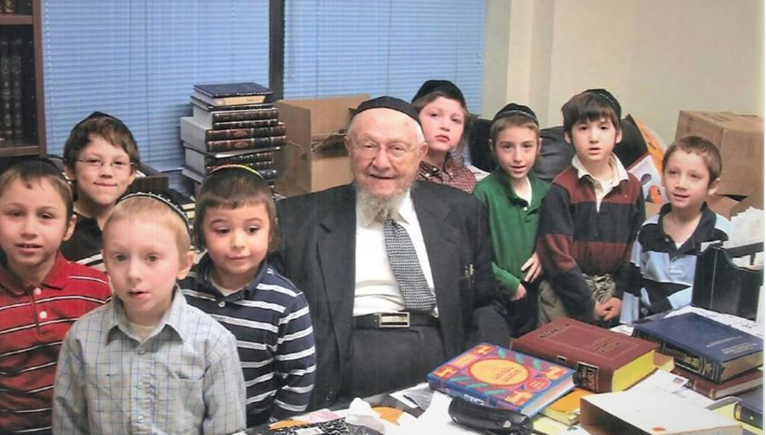
Rabbi Dovid Feinstein, the Rosh Yeshiva of Mesivta Tifereth Jerusalem in New York and a leading halachic authority in North America, passed away on Friday, November 6. He was 91 years old.
Rabbi Feinstein was born in 1929 to the illustrious Rabbi Moshe Feinstein and Rebbetzin Sima Feinstein in the city of Lyuban in the Soviet Union (currently Belarus). When Dovid was eight years old, the family immigrated to the United States and settled on the Lower East Side of Manhattan, where he was to live for the rest of his life.
A few years after arriving in the United States, Rabbi Moshe Feinstein was named Rosh Yeshiva of Mesivta Tifereth Jerusalem (known as MTJ). It was then a small yeshivah that gained renown under his leadership. Over the years, he became world-famous as one of the foremost halachic authorities of his generation.
Upon his father’s passing in 5746 (1986), Rabbi Dovid took charge of the Manhattan branch of the yeshivah, while his brother, Rabbi Reuven Feinstein, directed the Staten Island branch of MTJ. Despite the changing tide of neighborhoods in New York City, Rabbi Feinstein remained a stalwart presence in the historically Jewish neighborhood of the Lower East Side.
Like his father before him, Rabbi Dovid Feinstein soon became a leading halachic authority. He was known to have his phone busy at all hours of the day and night, with calls from around the world seeking his advice on all areas of halachah.
Rabbi Dovid Feinstein was also a member of the Moetzes Gedolei HaTorah of Agudath Israel of America and authored many works and commentaries on the Torah, Talmud, and halachah. For example, in the classic Stone Edition of the Torah printed by Artscroll, there appears an explanation from Rabbi Feinstein as to the significance of the Masoretic note that appears at the end of every parashah.
A Humble and Engaging Leader and Teacher
Despite his illustrious background and prominent position, Rabbi Feinstein was known to be exceedingly humble and easy to relate to. He would often say that “I am much more comfortable in the back of the room with the students,” than in the front of the study hall, traditionally reserved for respected figures and teachers. Over the course of his many years of leadership, he was always approachable, shying away from the spotlight and fanfare usually afforded a man of his stature.
When Rabbi Dovid Feinstein celebrated his bar mitzvah, he took on a practice which would change his entire life. He felt that since he was born during the week of Parshat Korach, he had come to the world to fix the sin of lashon hara (evil talk). From this time on he took upon himself to speak sparsely and he would often shorten his discussions on general topics and would remain silent. The Satmar Rebbe, who came to console him after the death of his sister, said that “from Rabbi Dovid’s silence I can learn more than any mussar speech I heard in my life.”
“Rabbi Feinstein was so unassuming that if you did not who he was, you would never guess that he was a world-class Torah scholar,” said Rabbi Yisroel Stone, co-director of Chabad of the Lower East Side with his wife, Chani. “At public events or weddings, he would never rise to speak, always shunning honor. What’s more, though he would willingly offer his opinion on any halachic matter, he would never push it on anyone.”
Indeed, wherever he was needed, he would be there. His son, Rabbi Mordechai, relates how despite his father’s tremendous responsibilities, if he heard that someone needed a rabbi to officiate at a wedding, he would make it a point to personally tend to it.
Rabbi Feinstein is survived by two sons and a daughter, and by grandchildren and great-grandchildren. A third son died in his youth.
The funeral took place in the Lower East Side of Manhattan, and then in Jerusalem.
Here’s a riddle: What do Hanukah and PROPEL have in common? Stumped? In a word: LOTS!
Hanukah represents the Jewish people’s tenacious refusal to give up on its values. It represents working hard to change the situation. It stresses education and an eye toward the future. Confronted by the evil assimilationist decrees of the Syrian Greeks, the tiny band of Hasmoneans said, “This has to change.” Despite the seemingly insurmountable odds, they persisted, and achieved the only period of true independence during the Second Bet Hamikdash. And women played a key role in the story.
At its core, PROPEL represents many of the same values. Its dedicated board members, supporters, and professional staff do not give up, helping each client dream and then make plans to actualize that dream. Obstacles are encountered and jointly overcome. PROPEL staff members work to marshal resources within the community and beyond, providing encouragement and a cheering squad every step of the way, PROPEL has helped over 200 women this year alone. PROPEL’s career coaches tailor plans to specific client needs, and have facilitated change in these women’s – and their families’ – lives and incomes. COVID-19 brought a new set of challenges. And PROPEL was there, researching and implementing the best ways to serve, without compromising on any aspect of their service delivery.
Can’t meet coaches face-to-face? Zoom and cell phones have made technology our best friends. Want to start college? Classes are available on-line and by Zoom. Thanks to the internet (and the good old-fashioned phone), clients still receive that signature PROPEL personal touch. PROPEL continues to provide mentoring, coaching, and information to women entering the workforce. PROPEL enables the women of our community to earn and help support their families while maintaining our values. PROPEL provides career advice to women of all ages, including young women in high school, college, and graduate programs. The organization encourages the women of our community to tap into their potential by utilizing education to transform a passion into a profession. Working with area colleges, the PROPEL team finds the “best fit” for each client, based on her goals, background, and personal circumstances. Training and professional certification programs are also available to PROPEL clients. Financial support is available to help women reach their goals. PROPEL also promotes networking opportunities for community members. Clients can receive targeted advice and mentorship for specific careers and work to advance their earning potential. PROPEL encourages women to be the heroes.
Want to create your own Hanukah miracle? Reach out to PROPEL.
————————
If you are interested in a career, please reach out to PROPEL and we can help you fulfill your professional goal. Follow PROPEL on Instagram @PropelNetwork.
Homemade doughnuts are usually a time consuming project, but these baked doughnuts topped with colorful cereal are super simple to whip up. All you need are a couple of mixing bowls, a whisk, and a doughnut pan. If you don’t own a doughnut pan, you need to get one ASAP. Using a doughnut pan means less time spending frying and less oil in the final product as well. Using classic, colorful cereals as doughnut toppings gives an awesome crunch along with a nostalgic taste of childhood. You may use soy milk and margarine instead of milk and butter to make these doughnuts dairy-free.
Makes 12
2 cups flour
⅔ cup sugar
2 tsp baking powder
1 tsp salt
4 tablespoons of butter
1 cup milk
2 tsp vanilla extract
1 can white frosting
1 can chocolate fro
sting
Cereal of choice such as Cocoa Puffs, Cinnamon Toast Crunch, Captain Crunch, or Fruity Pebbles
Preheat the oven to 350 degrees Fahrenheit.
Spray a doughnut pan generously with nonstick cooking spray and set aside.
Whisk together the flour, sugar, baking powder, and salt in a large bowl.
In another bowl, whisk together egg, milk, butter, and vanilla extract.
Mix wet ingredients to the dry ingredients and stir together until no flour bits remain. Do not over-mix.
Spoon the batter into a large Ziplock bag. Cut a corner off the bottom of the bag and pipe the batter into each donut cavity, filling 3 ∕ 4 of the way full.
Place the pan in the oven and bake for 10 to 12 minutes.
Remove from the oven and remove from the pan.
Split white frosting into 3 small bowls. Add 3 drops of desired food coloring into each and mix well.
When doughnuts are cooled, frost each doughnut with colored or chocolate frosting and immediately top with cereal.
The Mitzvah Man organization is always on the lookout for how to bring joy to any Jew in need. And what better time to bring extra joy than during Sukkot, one of the happiest times in the Jewish calendar! In fact, the Mishna in Tractate Sukkah tells us that one who never saw the simha (joy) at the Place of the Water-Drawing (the Simhat Beit HaShoeva in the Beit HaMikdash) has never seen joy in his life.
Many sukkot adorn the front and back yards and terraces of the neighborhoods in our community. However, circumstances often do not permit for some families to have their own sukkah, even if there is room for one on their property.
Enter the Mitzvah Man. To help families to perform the mitzva of residing in their sukkot, this year the Mitzvah Man organization delivered 27 brand new sukkot to families that never before had their own sukkah.
On erev Sukkot, after all the deliveries were made and the sukkot were set up, the Mitzvah Man received a text. He could not get to it immediately, and thirty minutes later he opened it. It read: “Hi Mitzvah Man, my husband is in the sukkah store and wants to donate two brand new sukkot.”
The Mitzvah Man returned the call as soon as he could, telling the woman who texted, Mrs. S.: “Baruch Hashem, we just gave away all the brand new sukkot that we had requests for. However, I will keep you in mind as it does happen that we get additional requests. But right now I have no one to give the sukkot to. Hashem sees your heart. We will stay in touch.”
“Please do,” answered Mrs. S., “however, at this point my husband is returning from the store which is quite a distance from us, and I don’t think that he will be going back. Certainly not on erev Sukkot.”
The Mitzvah Man got off the phone with Mrs. S. about 2pm. One hour later, he received two additional calls. These calls were requests for sukkot for two families that never had sukkot of their own before.
What a shame the calls had not come in an hour or two earlier! the Mitzvah Man thought. Then, Mr. S. could have bought those two sukkot he was willing to donate, and these families would be all set. Sadly, the Mitzvah Man told the callers he did not have more sukkot to distribute, but he would definitely keep them in mind.
At 3:30pm. the Mitzvah Man received a text from Mrs. S. As it turned out, when Mr. S. opened the box he brought home from the store containing his sukkah, he saw that a couple of items had not been put into the package. He was about to go straight back to the store and was still willing to buy those two new sukkot he had offered to donate.
Just imagine the holiday joy these two families experienced – at the very last minute! Their brand new sukkot were delivered and installed an hour before the hag by the hesed loving Mitzvah Man volunteers. The Mitzvah Man organization always goes the extra mile to do hesed!
Everyone involved in this special mitzvah was amazed by the hashgacha pratit, the Divine Providence of our Creator.
We could say that it was just another day, another story for the Mitzvah Man organization, but our rabbis say it better – missva goreret missva. One mitzvah causes another mitzvah to happen.
The Mitzvah Man never ceases to be amazed by the hashgacha pratit he experiences on a constant basis and he always says, “When one has the desire to do hesed for another, the Bore Olam helps them along.”
We are supposed to feel that we are not entitled to anything in this world; everything we have is a totally undeserved gift given to us by Hashem.
One may ask, “If a father brings a child into the world, isn’t he obligated to provide the basic necessities for that child; food, clothing, a place to live? Shouldn’t Hashem be obligated to give us, all of His children, our needs as well, needs that include a home, a job, a spouse, and children? Why don’t we deserve to have all of our needs taken care of?
Rabbi Lugassi explains that there is a very big difference between these two scenarios. When a father brings a child into this world, he wants the child to be as comfortable as possible in this world and therefore he feels obligated to do what he can to ensure that. Hashem, however, created us for a much more profound purpose. This World is just a stepping-stone to the real world, to eternal life.
Man is given a brief, finite length of time here – 70 or 80 years, we hope 120 – to do a task and accomplish what he needs to accomplish. Each person’s task is different. Hashem provides each individual with his or her exact needs to fulfill his or her purpose. For some, it is getting married young. For others, it is getting married at an older age. For some, it is having children. For others, it is not having children.
A person might ask, “Why do I have it so hard? Why do I not have more money? Why do I have so many health problems? Why is Hashem withholding so much good from me?” These would all be valid questions since our purpose was for achievement for This World. Yet, who knows better than Hashem what we really need to be successful and happy for eternity?
Each person’s life is planned out carefully, beginning with which family one is born into and the types of parents one has. Some parents spoil their children, others hold back from their children. People say, “It’s not fair, I have the meanest parents!” It is fair, it was planned like that. That is exactly what your soul needs. A person’s siblings are also Heaven-ordained. The people around him, his friends, his neighbors, are all part of Hashem’s plan for him.
Some people are not happy with the way they look. There are no accidents. Hashem made every feature of every person’s body exactly the way it needs to be. The color of a person’s eyes, one’s complexion, one’s height, the shape of one’s nose, the size of one’s ears – all were calculated.
People who have shalom bayit problems often argue about petty issues: “Why can’t our house be more orderly?” “Why is she spending so much money?” Why can’t he be neater?” Why is he so tight with money?” The root of their problems is not really the petty issues. If one would believe in perfect faith that Hashem arranged one’s marriage and gave one the spouse he needs to fulfill one’s mission in This World, one would overlook more: “S/he is the other half of my soul, and we need each other to accomplish our goal in This World. Obstacles are just tools for growth. We will work it out, we will get through it.”
The more we can trust that Hashem knows what we need better than we do, and that He provides us with the exact lives we need to do our jobs properly, the better our performance will become and the happier our lives will be.
I really enjoyed last month’s cover story (Living the New Normal), as it suggested positive tips on how to deal with the current pandemic. Positivity is definitely needed during these trying times. I would like to bring up another related topic – the wearing of masks. Many people are under the impression that if one has antibodies to COVID-19 it is not necessary to wear a mask. However, this is not certain. The advent of Corona is relatively new, and we don’t know whether and how a person who previously had Corona will develop it again. There have been confirmed cases of people who have had it a second time. The fact that we have had Corona and that we have antibodies means nothing until we learn more.
When one person who thinks he has antibodies doesn’t wear a mask, he, along with everyone else like him, could cause stress, anxiety, and serious harm to others. They also can cause our yeshivot and synagogues to close. It is our obligation as Jews to make a kiddush Hashem by wearing mask.
Ilana O.
—————————-
Your publication along with many others have had many articles urging people to wear masks to “save even one life.” Give me a break! About one hundred people die every day in car accidents in this country. If we lowered the speed limit from 65 to 50, we would save many, many lives. Everyone knows it. But we don’t, because it’s inconvenient, and it would have a negative effect on our economy on various levels.
When it comes to COVID-19 however, it is deemed immoral to consider convenience or the economy, and we have bent over backwards for months to “save even one life.” Why?? Because the liberals wanted Trump to lose at all costs – even if it meant destroying the economy and our country.
R. Arzi
Mashiah Revealed
I have enjoyed reading the series about the arrival of Mashiah (Mashiah Revealed), but to be honest, the last two chapters were extremely frightening to say the least. I pray for the arrival of the Mashiah every day – but I never imagined that the it would be so violent and deadly. I will continue to ask for the coming of Mashiah – but I’m holding on to what I was taught by my rabbi. I was taught that a negative prophecy does not have to happen, for as the Rambam says, “All the details about Gog Umagog we cannot know what will be, there are no absolutes, etc.”
Elliot K.
Healthy Eating
Last issue’s article about ways to get your kids to eat healthy without them realizing it was such a treat to read (Stealthy Tricks For Healthy Eating). After reading the article, I became so inspired and came up with a stealthy trick of my own. I started putting colorful fruit and cut-up vegetables in attractive bowls in my refrigerator. When my kids (and husband) wanted a quick snack, those healthy options were the easiest to grab. (I also hid less-healthy foods in the back, out of sight.) The results were striking! We all started munching on fruits and veggies much more. The ease of grabbing a handful of carrots or a bowl of blueberries meant those became our new snacks. Thanks!
Sharon L.
Thank You
To the Staff and Administration of Community Magazine,
I wish to express my thanks to all of you. I’m a Jewish inmate in Texas Prison, and the recipient of a subscription to Community Magazine. This is nothing short of a lifeline. Through the generosity and tzedakah of your organization, I feel, b’ezrat Hashem, connected and loved, by and to, a community. Thank you for bringing me Torah insights, news, mabrouks, and a sense of belonging. May Hashem bless all of you.
The COVID-19 pandemic has brought along with it the plague of grief. We have suffered great losses communally and individually. Many of our freedoms have been curtailed. Many have suffered overwhelming financial losses. Most have lost their routines. Most devastating of all, we have lost our loved ones. Each type of loss has caused us to grieve, and in our suffering we find ourselves at a loss as to how to console one another.
Men and women grieve differently and teens and children mourn differently than adults. There is no “right” way to deal with loss. Knowing this will allow us to be more compassionate with ourselves and with those around us who are grieving.
Elisabeth Kubler-Ross identified five stages of grief: denial, anger, bargaining, depression, and acceptance. It is important to recognize that these stages do not always follow each other neatly. These stages may overlap. You may regress to the previous stage or you may skip one stage only to return to it later. And even once you have completed all the stages Kubler-Ross and David Kessler state:
The reality is that you will grieve forever. You will not “get over” the loss of a loved one; you will learn to live with it. You will heal and you will rebuild yourself around the loss you have suffered. You will be whole again, but you will never be the same. Nor should you be the same nor would you want to.
Understanding Your Own Feelings
Because grief has many facets, you may experience many conflicting emotions. You may feel scared, relieved, resentful, or guilty – all in the same day. You may at times feel nothing at all. You may feel like crying or you may not be able to cry at all. Your feelings do not need to make sense to anyone else, or even to yourself. These are just feelings and having them is normal. Even though you are hurting, you may want to have fun or laugh for a while. Know that this is not a betrayal of your loved one.
You will have memories of the person who has died, both happy and sad. These memories help you stay connected to the person who died. The person died, not the relationship. There may be times when you feel angry at the person who has died. I have heard many a widow lament, “Why did he leave me?” A death will always trigger our most vulnerable feelings of abandonment, so your anger does not mean you did not love those who have died; it validates how connected you were to them.
Children and Grief
Alan Wolfelt, author of Understanding Your Grief: Ten Essential Touchstones for Finding Hope and Healing Your Heart believes, “Any child old enough to love, is old enough to grieve. Hurting is part of the journey on the way to healing. Not learning to mourn well results in not living well.” While teens and children will experience the same barrage of emotions as adults, if they could, a grieving child or teen would tell us, “I don’t always have words for how I’m feeling. I don’t yet have a way to talk about my emotions, so I let my behavior do the talking for me. I need a lot of safety and support from you in order to express the feelings that are hidden underneath my behavior.” It is very difficult to soothe a child or teen who lacks the words to express their loss and are acting out. Show compassion and patience in allowing them to experience and express their feelings and thoughts. Help them to understand that grief is a normal and ongoing experience and encourage learning healthy coping skills.
How to Support a Loved One who is Grieving
Joshua Loth Liebman in his book Peace of Mind reminds us “How essential it is to express rather than repress grief, to talk about one’s loss with friends and companions to move step by step from inactivity to activity again…” He credits our tradition of lessening degrees of restriction in our mourning – the shiva, the sheloshim, the year of kaddish – as “an intuitive wisdom about human nature” that comforts us after a loss.
As you try to comfort those who have suffered a loss, remember that each person copes in their own way. Allow them to have all their feelings. Do not rush them through grief. If we are uncomfortable expressing our own feelings of grief, we may try to limit this in others. Instead, listen and respond with empathy and understanding.
Dreidels are a beloved part of Hanukah celebrations the world over. And they’re far from being simple playthings; dreidels symbolize deep spiritual concepts. Below are four enlightening messages that can be learned from the dreidel.
It hints to us that there’s nothing that happens in this world without it being decreed on high. Just as a person spinning the dreidel can’t know on what side it will land, so too he can’t know where his efforts will lead him. Spinning the dreidel harder doesn’t get you any closer to resolving this. Likewise, in life, the extra effort often just means a few more turns than necessary before getting to the result decreed on high. Gd runs our life in a similar way. A man can’t change what was decreed on him from on high and all the extra efforts are just meandering off the path Gd plotted for you.
Just as the dreidel spins only when you spin it from above, so too our world spins around by Gd spinning it from above.
A person who spins and orients himself inwards toward Gd will merit that he will spin out of and will escape the troubles that envelop him.
The Bnei Issachar explains: “…people spin the dreidel with the letters gimmel, shin, nun, and heh – and each faces a different direction with the dreidel spinning around a central point. These letters hint to the kingdoms of Rome, Babylon, Greece, and Madai, which oppose the four powers of man. Gimmel for “guf,” the body, shin for “sechel,” human intelligence, nun for “nefesh,” the soul, and heh for “hakol,” all of them.
They all spin on a central axis, which is Israel, that unites all the far away extremes. All the outside extremes are subservient to the middle they all spin around, and all the nations will nullify themselves to the nation of Israel and acquire a clear language (with which to come to Gd).”
Republican Nicole Malliotakis, a New York assemblywoman and 2017 New York City mayoral candidate, beat incumbent Democratic Representative Max Rose for a seat in the U.S. House of Representatives.
Malliotakis will represent New York’s 11th Congressional District, a more conservative part of the city encompassing Staten Island and part of Southern Brooklyn.
Malliotakis thanked President Donald Trump for his support.
Attention Deal Patients: IV Infusions and Phlebotomy Services Now Available in Your Home! – Use IV Photo in folder – no caption needed
There’s a mom next door who, because of a medical condition, needs IV infusions regularly. But each time she needs medication, she travels to the hospital that administers it, waits until they admit her, then waits again for four long hours as the IV drips before traveling home. Besides for arranging for her children’s care, she needs someone to take her there and bring her home, because she’s often too weak after treatment to drive.
And as she sits there, waiting for her medication and staring at the wall, she thinks, “If only I could do this at home. I could be right there when my children get off the bus. I could sit comfortably next to them while they do their homework…instead of first arriving home at bedtime.”
Now she can! Through Lakewood Bikur Cholim, Deal patients who need phlebotomy (getting blood samples taken) and IV infusions can get this medical care right at home with a prescription from their doctor. A team of trained, licensed, medical professions, including ICU nurses, RNs, and paramedics are now standing by to help both the homebound, and those who simply can’t spend all day in the ER, to get this care immediately.
Volunteers are also wanted – training is available for licensed nurses who want to be able to help
administer these services.
The service is available 24 hours a day. For services, call the Lakewood Bikur Cholim hotline at 732-905-3020, and you’ll be transferred to the Deal dispatcher, who will send the appropriate medical professional. This service has already been life-changing for so many!
SBH Updates– include SBH Logo with title
SBH’s Career Division is looking to expand their current program and take on new professionals to help guide Career Division clients. They are looking for finance career specialists, female career coaches, and business professionals. Be the mentor you wish you had with the SBH CAREER COACH PROGRAM. Contact [email protected] for more information or to sign up.
Family Plus One
Want to volunteer at SBH but barely have the time? SBH is offering a simple yet impactful way to help your community: cook one extra meal a week. It’s as easy as (spinach) pie. Contact [email protected]for more information.
What will a Joe Biden presidency look like, what will his policies reflect, and will it have any similarities to the Obama years?
Though he has yet to enact a single policy, he has spoken on virtually every policy issue, giving a glimpse into what his legacy might look like.
At the time of the writing of this article, Joe Biden appears to be the President-elect, but Trump has not conceded. Trump is demanding recounts and is challenging the U.S. election results in the courts. Assuming the results stand, and Biden is declared the next President, many questions must be asked about how his occupancy of the White House will affect us as a community. These include questions such as how it will impact the economy, businesses, healthcare, foreign affairs, home security, funds for private schooling, and other issues.
The Jewish State
Let us begin with an issue near and dear to every one of our hearts – our beloved State of Israel. Many of us voted for the candidate that best represents our own outlook on how Israel should be treated. What’s to be expected from President Biden in this regard?
Several media sources, including Newsweek and JTA, say that he’s likely to undo many of the Trump-era aid package freezes against bodies that are hostile to Israel. This means renewing funding of the Palestinian Authority, reopening the Palestine Liberation Organization’s diplomatic mission in Washington D.C., and probably renewing funding of UNWRA – the refugee relief organization often criticized for incorporating vitriolic anti-Semitism in its school curricula.
Even while Senator of Delaware and Vice President under Obama, and later, Biden made it known that he opposes unilateral actions such as Israeli annexation of disputed territory in the West Bank, and the Palestinian Authority’s declaration of statehood. He has also made it clear that even as president, he would disapprove of “settlement expansion” – a catch-all for building Jewish homes in Judea and Samaria, which, he said during a speech at a 2019 J Street Conference, “takes us further from peace.” Biden also insisted that Israel “stop talk of annexation,” feeling that even mentioning the prospect of annexing parts of the ancestral Jewish heartland is not legitimate.
As reported by the Intercept on July 13, 2019, a leftist activist from the IfNotNow organization, which advocates against Israel’s hold on Judea and Samaria, asked Biden about “the occupation,” and in response he said. “I think occupation is a real problem, a significant problem. I think the settlements are unnecessary…”
As for Boycott, Divestment and Sanctions (BDS), Biden has expressed vehement opposition to the movement, as reported by the New York Times in December 2019, which cites the President-elect as making the following statement:
(BDS) singles out Israel — home to millions of Jews — in a way that is inconsistent with the treatment of other nations, and too often veers into anti-Semitism and efforts to delegitimize Israel. That’s wrong, and as president, I would oppose BDS efforts in Congress.
In his congratulatory note to Joe Biden on Nov 8, Israel Prime Minister Benjamin Netanyahu appeared keen to assert his friendship with Obama’s Vice-President. “Joe, we’ve had a long and warm personal relationship for nearly 40 years, and I know you as a great friend of Israel,” he wrote. “I look forward to working with both of you to further strengthen the special alliance between the U.S. and Israel.”
He added, however, that “steps to sanction supporters of BDS may be inconsistent with First Amendment protections of free speech, as several federal courts have concluded.”
More disconcertingly, Karine Jean-Pierre, Chief of Staff of Vice President-elect Kamala Harris, penned an article in 2019 for Newsweek slamming AIPAC – the non-partisan pro-Israel lobby group. She said that Democratic candidates for President “made the right call” by not showing up to AIPAC’s annual convention that year, breaking the tradition that candidates meet delegates or deliver speeches. Jean-Pierre went so far as to criticize the organization for allowing Prime Minister Netanyahu to speak at that year’s convention, because “Israel may have committed war crimes in its attacks on Gazan protesters” and because the Prime Minister was indicted on charges of bribery. AIPAC, moreover, has, in her words, “become known for trafficking in anti-Muslim and anti-Arab rhetoric” and was “the [sic] obstacle to progress,” although she did not provide evidence for these serious charges.
Israel’s safety and security in a hostile region will be a perpetual concern – particularly, Iran’s overt plans to develop nuclear weapons with which to obliterate the Jewish State. Like his former boss, Barack Obama, Joe Biden is in favor of rebooting what is now famously known as “the Iran Deal” – the deal that gave the Islamic Republic $150B in exchange for halting its nuclear weapons program. John Kerry, while serving as Obama’s Secretary of State, conceded that a portion of those funds were likely to land in the hands of terrorist groups.
President Trump, to the delight of Israel and her supporters, discarded the plan, labelling it “a disaster.” Indeed, just a year into the Trump administration, Israeli spies managed to smuggle out of Iran literally tons of data that showed that the nuclear program was secretly being continued.
Biden has vowed to return to the diplomatic table with Iran, on condition that they act in good faith with the old deal. Interestingly, he blamed Trump’s exit from the Iran deal for what he believes to be the improvement in the Iranians’ chances of building nuclear weapons.
Corporate Tax Hikes
In terms of what happens here at home, Biden is likely to implement much different policies than those followed during Trump’s presidency in areas such as taxes, healthcare, and school vouchers.
Federal tax increases would affect the “wealthy and big corporations,” as described on Biden’s website. He plans to raise the corporate tax to 28 percent from Trump’s 21 percent, which Trump had already reduced from 35 percent. In addition, Biden’s plan is to require a minimum tax of 21 percent on all foreign earnings of U.S. companies, and impose a tax penalty on corporations that ship jobs overseas. With personal taxes, his goal is to raise the top individual rate back to 39.6 percent from 37 percent.
Healthcare
On the controversial topic of healthcare, Biden is set on reversing Trump actions that stripped away parts of Obamacare, and wants to expand eligibility for Medicare and Medicaid. He plans to give Americans a public health insurance option like Medicare, and wants to expand coverage to low-income Americans who would be eligible for Medicaid if not for their state’s refusal of the Affordable Care Act’s expansion of Medicaid eligibility. Biden’s plan will cover birth control and abortion, as well.
Medicare would, under Biden, extend to those aged 60, and make dental, vision and hearing coverage standard in traditional Medicare, instead of requiring the purchase of a supplemental policy.
School Choice Vouchers
An issue of great importance to our community is that of school choice vouchers. Joe Biden is on record of being opposed to school choice vouchers. In January 2020, Biden tweeted, “When we divert public funds to private schools, we undermine the entire public education system. We’ve got to prioritize investing in our public schools, so every kid in America gets a fair shot. That’s why I oppose vouchers.”
It is interesting to note that despite Biden’s opposition to vouchers, when it came time to send his two sons to high school, he chose the private option.
School choice vouchers generally allow lower-income students to put state dollars meant for their education towards private schools. Voucher proponents say it’s a way for lower-income students to escape troubled public schools for private schools that they otherwise wouldn’t be able to afford.
Conclusion?
Though not even sworn in yet – and in actuality, the results haven’t even been certified yet by the electors – we can still get a sense of what direction President Biden could take over the next four years, and of some of the changes that might be taking place.
Donald Trump Refuses to Concede Election
At the time of the writing of this article, Donald Trump refused to concede and stated, “This is far from over. The American people are entitled to an honest election. That means counting all legal ballots, and not counting any illegal ballots. This is the only way to ensure the public has full confidence in our election.”
Donald Trump Refuses to Concede Election At the time of the writing of this article, Donald Trump refused to concede and stated, “This is far from over. The American people are entitled to an honest election. That means counting all legal ballots, and not counting any illegal ballots. This is the only way to ensure the public has full confidence in our election.”
Why Trump Lost (Experts weigh in)
David Axelrod
David Axelrod, chief strategist for Barack Obama’s presidential campaigns, and Senior Advisor to the President, said that while COVID-19 may have been an issue for voters showing up to the ballot box, the shift occurred because “Trump beat Trump.” That is, it was more about personality than policy, for many voters. To his mind, early Coronavirus fumbles, along with the mishandling of nationwide protests against police brutality, made the success of Trump’s economic policies less appealing.
BBC New York correspondent Nick Bryant noted that being a political outsider who would say “what no one else would” helped Trump in 2016, but it hurt him in 2020. Despite an enthusiastic base who would come out and vote for him under any circumstances, his aggressive behavior and off-putting personality hemorrhaged some support – especially in the suburbs, Bryant believes. In 2016, Republicans who didn’t care for Trump were willing to give him a chance. By 2020, many were not, for reasons anywhere from perceived indifference to racial tensions, to the alienation of moderates.
Jonah Goldberg – conservative columnist, author, political analyst and editor of National Review – noted that Trump underperformed in a year that Republicans did better than expected in other ballots (Congress, Senate, statewide races). Again, he believes it was a case of Trump supporters believing that his antagonism and gruff were just what the country needed, but it did not translate well with independents and fence-sitters. The election became more about who Trump is, and not so much about his accomplishments, according to Goldberg. What the results of the election tell us is that Americans might be happy with Republican policies or legislature, but they were not happy with Donald Trump.
Brett Stephens, Pulitzer Prize winning American conservative journalist, editor, and New York Times columnist, is effectively a “Never Trumper” who is aligned ideologically with most of the administration’s policies, but was not a fan of the president. He surmises that Trump might have gained a little ground in a few demographics, such as Jews, Latinos, and African Americans, but he lost ground with white men – especially those with college educations – and seniors. Stephens says there are two major reasons he lost: uncontrolled rhetoric, and his party’s lack of condemnation of it. 2016 might have been the year for novelty, of “anything goes,” but 2020 appeared to be the year voters tired of the bluster, he explains.