What can go up a chimney down, but can’t go down a chimney up?
Last Month’s Riddle: Calendar Craze
What occurs once in January and again in February, but doesn’t occur again until the summer months of June, July, and August?
Solution: The letter ‘u’!
Solved by: The Blum Family, Hu Cohen, The Pillar Family, Rafi Shabtai, Joy Gadeh, Belle Gadeh, Zaki Dabas, Mopsie C., Fay Chesir, Richie Ayal, Isaac Dayan, David Maimon, Jake Shalom, Joseph Beyda, Harry Falack, Jacob Ayal, Ralph Sutton, Mayer C., Sammy Gabbay, Natalie Cohen, Joseph Cayre, and The Shmulster.
Junior Riddle: What Am I?
Submitted by Karen F.
It has keys, but no locks. It has space, but no room. You can enter, but can’t go inside. What is it?
Last Month’s Junior Riddle: Shorthand
What word becomes shorter when you add two letters to it?
Solution: The word ‘short’!
Solved by: The Blum Family, Abe Cohen, H. Soleimani, Rafi Shabtai, Zaki Dabas, M. Calopsie, Judah Levy, Fay Chesir, Richie Ayal, Isaac Dayan, Big Mike, David Maimon, Jake Shalom, Joseph Beyda, Harry Falack, Jacob Ayal, Ralph Sutton, Mayer C., Sammy Gabbay, Natalie Cohen, and Joseph Cayre.
Last month, women and girls of all ages and stages virtually “gathered” together for the first Daughters with Dignity Modesty Forum and Business Expo. An online website was set up as the platform for sharing this inspirational experience. What first began as an idea to help community-based businesses, became an exciting and unique event.
Business owners sponsored the event. Each sponsor broadcast a video commercial advertisement that was shown in between the speakers. The lineup was incredible, featuring hosiery, makeup, invitations, furs, jewelry, and more.
Women from our community shared their personal stories of growth in modesty or other inspiring stories to encourage others to strengthen their commitment to this special mitzvah.
Boi Kallah Bridal Fund
The organizers decided to donate the proceeds from the event to the Boi Kallah Bridal Fund in the zechut of a refuah sheleima for Leora bat Tsipporah.
Boi Kallah is a community-based bridal fund. Volunteers from Boi Kallah guide new kallahs in every aspect of how to prepare a Jewish home. The fund provides new utensils, pots and pans, bedding, and towels. Guidance is also provided for the spiritual aspects of building a new home as well.
The event was done virtually in order to allow more women to participate, comfortably from their own homes.
Different Journeys to a Lifestyle of Tsniut
Jennifer Franco opened with her personal story, making the point of how gorgeous a girl can look dressed modestly. As a teenager, she made the decision to dress modestly while at her friend’s wedding and she felt she made a tremendous kiddush Hashem.
Lisa Chams spoke about how our children learn the most from how their parents conduct themselves on a day-to-day basis. “Some things can be taught; other things must be caught.” The subliminal messages that are given by a parent’s actions go much further than their words do. In order to properly guide our daughters, sisters, and friends, we must share how much we love this special mitzva of tsniut, how excited we are about it, and how we do not feel burdened by it.
Joya Tawil, a community teacher and one of the heads of Boi Kallah spoke next. She emphasized that we, Jewish girls and women, are the daughters of the King. With her inspirational mashal Joya helped us understand that we are here for a higher purpose and we must not lower our dignity.
The next speaker was Jackie Bitton, a teacher in the community and a world-renowned lecturer. As she started to grow and dress more modestly, a close friend of hers told Jackie that it looked like she was going to lose herself. Jackie explained that just the opposite was happening. She was not losing herself, instead she was actually finding her true self. That friend also started dressing modestly and Jackie now calls her “a queen of tsniut.”
Jaime Soudry’s story is familiar to many. She shared how her journey began by watching her sister grow, who was inspired by her friend who began to grow, who was inspired by her brothers who began to grow. We never know where the domino effect will lead. Mitzvah goreret mitzvah!
Lastly, Honey Hamra explained how she used to be far from dressing with tsniut. However, she decided that she wanted a different type of life, a life with more fulfillment, with Torah and mitzvot. She started her journey by just adding an inch of material to her shorts. Then she gradually began dressing and acting more according to Torah values. Honey eventually took on the modest lifestyle and has started a business delivering modest attire. She is happy to help and guide others in the mitzvah of tsniut.
Included in the event was an excerpt from a speech on tsniut by Rabbanit Kolodetsky, the daughter of Rav Kanievsky, shlit”a. She shared how even just one centimeter can heal the sick, help childless couples, and more. The zechut we bring to the world with our modesty is unimaginable.
There was also musical video presentation by Frieda Cookie Marashli. She gracefully inspired participants with her beautiful voice in a song about tsniut called “It’s Who I Am.”
The Main Message
All the speakers had one strong message. We are royalty. We are precious gems of the Bore Olam. That which is valuable is kept hidden – like a jeweler’s most precious jewels. Tsniut is not a burden, rather it is our crown.
For more information or to donate to Boi Kallah Bridal Fund please contact Mrs. Joya Tawil at 646-824-8858.
Mac and Cheese is basically the universal comfort food. But what makes this recipe different from regular Mac and Cheese? This method uses two types of cheese to make a rich and creamy sauce, and then finished with a crispy panko topping. Every bite pairs a delicious crunch with creamy, luscious pasta in every bite. This dish works well baked in a 9×13, or even better, twelve ramekins to establish individual portion sizes. This recipe also freezes well – just wrap well with plastic wrap after adding the panko crumbs and place in the freezer.
INGREDIENTS
Pasta: 1 box dry macaroni
1/4 cup butter
1/4 cup flour
1.5 cups milk
1 teaspoon garlic salt
Salt to taste
2 cups shredded cheddar
3 cups shredded mozzarella
Panko Topping:
3/4 cup panko bread crumbs
3 tablespoons melted butter
1/2 cup cheddar cheese
1/2 cup mozzarella
INSTRUCTIONS
1. Preheat oven to 425 degrees Fahrenheit..
2. Cook macaroni according to package directions. Drain and run under cold water.
3. Melt butter over medium heat in a large saucepan. Whisk in flour and let cook for two minutes while continuously stirring. Slowly whisk in milk, salt, and garlic salt. Cook over medium heat while stirring until thickened.
4. Remove from heat and add cheese sauce and macaroni noodles together. Pour into a greased 9×13 pan.
5. Combine panko cheese topping ingredients together in a bowl and sprinkle over the casserole before baking.
6. Bake 20 minutes or until bubbly. Do not over-cook.
The MSB season is in full swing. As I write this article, the top two teams are The Ball Busters at 5-1 and Lethal Weapon at 4-2.
The Ball Busters are captained by Yanky Itzkowitz and at the halfway point of the season seem to be the odds-on favorite. On the mound, rookie Ray “Pay Day” Sakkal is having his way with opposing lineups, and this team is getting contributions from everybody. Aaron Levy, for one, is having himself an MVP type season as he is leading the league in just about every category.
Just one game behind in the standings, Lethal Weapon is doing exactly what we expected going into the season. Captained by Ike Chazzanoff, this team is fundamentally sound and explosive at the plate. With power bats like Yaakov Seruya and Marc Barsano, this team has the ingredients to be a championship team.
Standing alone in 3rd place at 3-3 are the Jokers. Mordy Chrem has his team playing hard week in week out but they have yet to click on all cylinders. This team’s success rests on the arm of Mark Cohen. If he is dialed in there is no tougher pitcher to face.
In 4th place at 2-2, we have Rubble on the Double captained by David “DT” Tawil. With an early season bye, it’s tough to gauge what this team is capable of, but any team featuring perennial All-Star Steven J. Gindi is usually right in the thick of things come post-season time.
At 2-4, The Super Smash Bros. currently hold the final playoff spot with the 5 seed. Captained by Jack Bibi and budding star Joey “JoeB” Betesh, this rag tag bunch seems to grind out games. There is definitely a storyline to keep our eyes on. Ageless wonder Jackie Shwecky has continued to keep hitters off balance and the team members rally behind each other.
To round out the standings we have Mamba Mentality and El Chapo at 1-3 respectively. These two teams also had their bye weeks, so they have yet to get into a rhythm, but have a full schedule ahead of them to get things on track.
Mamba Mentality, which is captained by Dan Braun who is the reigning world series MVP, drafted quite a few of his fellow 5 Towns rookies and has one of the league’s best players in Joe Sefaradi manning CF. It wouldn’t shock anybody if this team gets hot and makes some noise come post-season time.
El Chapo, which is an Elliot Mann organization, has ace Menachem Diamondstein on the mound and on paper has a very deep lineup. Again, it’s too early to tell, but thus far this team has yet to impress.
Stay up to date with all league news on our website www.SYSoftball.com and on Instagram @MSB_Softball.
Stay tuned for the next league update in next month’s Community Magazine.
MSB Sponsors
MSB would like to thank our sponsors who allow this league to be what it is.
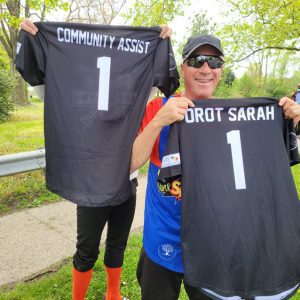
Jackie Shwecky of the Super Smash Bros. represents both the Community Assistance Fund and Orot Sarah.
The Community Assistance Fund is an unsung charity of our community and their support is personally solicited by Rabbi David Maslaton and Jackie.
Bet Yaakov Orot Sarah is a warm and caring school focused on growing, guiding, and nurturing our community’s girls from nursery to college.
Eat N Run Café – Mark Cohen of the Jokers represents Eat N Run Café. Eat N Run has become a go-to kosher eatery. A modern counter-serve café with a diverse menu, it is located on 2574 Coney Island Ave. in Brooklyn.
American Friends of Ariel University – AFAU supports Israel’s newest university, which is evolving into a major institution of research and higher education and is taking its place among the ranks of Israel’s most honored and respected universities.
Our communities are hurting. Our families have lost loved ones, many businesses are on the brink of bankruptcy, seniors and people with underlying health conditions are still trying to receive a vaccine close to their homes. High unemployment and unsafe streets have created a sense of hopelessness and cynicism over the ability of our state and city authorities to successfully guide us out of this crisis.
I am running for City Council to represent the great communities of Southern Brooklyn because I am convinced that public service starts with a sincere desire to help people.
My family and I immigrated to the United States from Belarus in 1993. The very next day after our arrival, I showed up at the JCH of Bensonhurst and asked to volunteer. For the last 28 years, I volunteered as Vice President of the Holocaust Memorial Committee, served as a board member of the Association of East European Jewry, Bensonhurst Business Club, and other important non-profits.
With the help of my mother-in-law, my wife and I have raised two beautiful children in Southern Brooklyn. I graduated Baruch College, City University of New York, with a bachelor’s in Business Administration and I have worked for over 20 years as a journalist for Russian language TV, radio, and newspapers. I also served as a community liaison for a U.S. Congressman and later for two City Comptrollers, representing them in Southern Brooklyn and helping local communities overcome the terrible consequences of Super Storm Sandy.
Since January 2020, I have been working as District Director of Operations for Councilman Mark Treyger. At the height of the COVID-19 pandemic, I hosted multiple food and mask distributions across Southern Brooklyn, helped hundreds of people who lost their jobs to obtain their unemployment benefits, and coordinated private donations of food and PPE to Coney Island Hospital. I also supported small business owners by bringing them masks and bottles of hand sanitizer, promoting them on social media, and helping to connect them with Small Business Services.
In 2012, I was honored to be elected to the volunteer position of Democratic District Leader in the 45th Assembly District. Together with my partners, I founded Bay Democrats, which quickly became a strong voice for local communities. Our club hosted annual Jewish Community Leadership Award ceremonies and Holocaust memorial events. We condemned BDS and the surge of anti-Semitic incidents in New York.
As District Leader representing a large segment of the Sephardic Community, I supported the important work of many local not-for-profit organizations. As your Councilman, I will fight to ensure that Sephardic Community Center, Sephardic Bikur Holim, Reach for the Stars, Harmony, The Morris I. Franco Cancer Center, and the Kings Highway Beautification Association are fully funded to meet the needs of the Community. Also, I believe that it is important for us to fight in City Council and in the state legislature to provide financial relief to yeshiva families. I will always support and protect our yeshivas.
Ronnie Tawil and Sam Sutton from the Sephardic Community Federation endorses Ari Kagan for City Council.
In 2018, I endorsed the election of a highly qualified jurist, Gina Levy Abadi, to the Brooklyn Civil Court, and I am supporting her candidacy this year for her appointment as a Kings County Supreme Court Justice. Together with my friends, I hosted Israel solidarity rallies and have always stood up against hate and anti-Semitism.
Over the years, I have continuously supported our brave police officers and I categorically oppose the “Defund NYPD” movement. Fighting for public safety would be my priority in the City Council. I strongly oppose the construction of a new “motel” at Coney Island Avenue and Avenue T that might be easily converted into a homeless shelter. I will strongly oppose any property tax or water rate increases for homeowners. Homeowners should not be overlooked during the post-pandemic recovery. I will push the Department of Parks to commence the long overdue renovation of the McDonald Park ASAP.
It would be my honor to receive your support and your vote on Tuesday June 22, during the Democratic primary for City Council. Together we will overcome this terrible pandemic and its after affects – it is personal to me. I will never abandon our fabulous Community and will serve you with dignity and perseverance.
Ari Kagan is a candidate for City Council in the 47th District (Coney Island, Gravesend, and Bensonhurst) and Democratic District Leader in the 45th Assembly District.
Hi! I’m Susan Zayat. You may know me from my insta page @Hungrymom. I started that page to share my recipes and my love for cooking. I have loved all kinds of cooking since I was a kid. Now nothing makes me happier than preparing food for my family and friends. I enjoy making a variety of dishes and presenting them in an interesting way, which enhances the enjoyment of any meal. I’m so excited to be sharing my recipes with you. We’ll do a different series every few months. We’re starting with dinner, because you can never have enough ideas to choose from for dinner.
I hope you enjoy!
Chicken with Onions
1 package of chicken cutlets
Corn flake crumbs
½ cup oil, divided
2 onions
Teriyaki sauce
Honey
1. Rinse the chicken cutlets in cool water then pat them dry with paper towels.
2. Prepare two plates (disposables are fine) one with ¼ cup oil, the second with about a cup of corn flake crumbs. Dip cutlets in oil and then in cornflake crumbs.
3. Put the cutlets on a tray sprayed with Pam (or your favorite neutral oil) and bake for 20 minutes at 350 degrees Fahrenheit.
4. Slice 2 onions very thin. Sauté them in ¼ cup of oil until they become translucent.
5. Once translucent, add 2 tbsp. teriyaki sauce and 1 tbsp honey. Sauté onions for another 10 minutes until they become caramelized.
6. Put the sautéed onions on the bottom of a baking dish.
7. Slice the cooked chicken and lay the slices on top of the onions. Make a mixture of 2 tbsp teriyaki sauce and 1 tbsp honey. Mix well and drizzle on top of the chicken.
8. Bake uncovered for another 10 minutes at 350 degrees Fahrenheit.
Vegetable Lo Mein:
1 box of spaghetti
2 tbsp oil
Red, yellow, and orange peppers, sliced
1 can of baby corn cut up into chunks
1 box of mushrooms, sliced
Handful of frozen broccoli
1 tsp salt
Garlic powder
Onion powder
Paprika
Mikee’s garlic stir fry and rib sauce
Low sodium soy sauce
This is my favorite way to make lo mein. This version is vegetarian, but you can add in cooked chicken or beef or serve the noodles plain with sliced steak on top.
1. Boil spaghetti according to package directions, drain, and set aside.
2. Add 2 tbsp oil to a skillet.
3. Sauté: sliced peppers, sliced mushrooms, and baby corn. Season with 1 tbsp salt, 3/4 tsp paprika, 1/2 tsp garlic powder, and a few shakes of onion powder.
4. Add In frozen broccoli and sauté for another 5-7 minutes.
5. Once the vegetables are sautéed add them to the cooked spaghetti.
6. Add in ¼ cup Mikee’s garlic stir fry and rib sauce and ¼ cup low sodium soy sauce.
7. Mix all together and adjust seasonings to taste.
Lemon Edamame
Shelled edamame beans
Oil
Lemon pepper
Lemon juice
Lemon zest from one lemon
I had edamame beans when we were away on vacation and knew right away, I needed to replicate that recipe. I love anything with lemon! These are now the only way my kids will eat edamame beans. Just seasoned with salt won’t do it for them anymore.
1. Boil the edamame beans in a pot of water for approximately 15-20 minutes.
2. Drain them well. Add them to a skillet with 2 tbsp of oil.
3. Mix them up to get them nice and toasty.
4. After 5 minutes add in 1/3 cup lemon juice, zest of a lemon, and a nice amount of lemon pepper, depending on how peppery your family likes it.
5. Mix thoroughly. Return pot to the stove for another 10 minutes tossing the edamame every few minutes to get that nice char on most of them.
Photo styled and photographed by Sarah Husney. Sarah Husney is a food photographer servicing NY & NJ. She has clients from the food businesses in the community upgrading their photos for Instagram and websites. Contact info: 917 626 2991 / @sarahhusney_foodphoto.
“Why am I an effective nurse? I treat everyone with dignity and respect. That’s what my parents modeled for us. There is no secret to success. I have Hashem on my side. Do the best you can, help whoever you can and be a good person.” ~~ Shany ~~
I am always elated to interview a woman from our community, to hear her life story and the passion in her voice when she describes her life purpose.
Please meet Shany Shaharabany, a family nurse practitioner and professor at the NYU Nursing School, who is on fire about helping people and saving lives. Let’s follow Shany on her journey from childhood to adulthood. In sharing her trajectory, I hope to convey her essence and her infectious energy and commitment to pikuach nefesh, preserving life.
Shany’s Roots
Shany Shaharabany, née Dagmy, was born in Flatbush to Stella and Shaul Dagmy, both Lebanese immigrants.
Shany is immensely proud of her parents and siblings. She is one of five children with three older brothers and a younger sister. “I was the first girl, the fourth child, the serious one. I wanted to be perfect for my mom and dad. I was on honor roll and won lots of awards. My parents worked hard to establish themselves in the States.”
The Dagmys were supportive of Shany’s goals and passions and they trusted her judgment. Her mother communicated that it was essential that Shany do something for herself and that being a woman and mother would not stand in her way. Shany attended Shulamith School for Girls from grade school through high school. She talked about her accomplished classmates who pursued professions and advanced degrees in diverse fields.
Shany was ten years old when she realized that the medical field was where her passion lay. Shany had a number of uncles and cousins who were doctors. Her mother’s cousin steered her towards nursing, saying that as an observant Jewish woman, she could grow and do so much as a nurse. As a teenager, Shany volunteered on Shabbat at Beth Israel Hospital visiting patients and she worked as a medical assistant in a doctor’s office.
The Dagmys taught their children to respect everyone regardless of their religion or their station in life. “They showed us that everyone has a soul and a heart. My parents kept in touch with our non-Jewish nanny and others. I am a good nurse because of their middot.”
Marriage, Family, and Career
Shany met her naseeb, Yosef Shaharabany, when she was eighteen. She met him through a shidduch arranged by mutual family friends. “Joseph is a gem. He is the best person on this planet. I only knew three people from Mill Basin and Joseph grew up there. We met in May, got engaged in June, and married in September. He is three years older and of Iraqi descent. He was super supportive about my education and raising a family. He stuck by me through all my schooling and nursing jobs, including the pandemic.”
While Shany filled me in about her life, I was in awe of her boundless strength, determination, and focus. Her family life, schooling, and career are deeply intertwined.
During the past 12 years, Shany got married, took her nursing pre-requisites, enrolled in nursing and graduate schools, gave birth to six children, and held five different nursing positions. She is emphatic that she could not have done it without the loving and limitless help of her husband, her mother, and her mother-in-law.
I was envious when Shany told me that she never worked on Fridays. Her nursing school classes did not fall out on Fridays. She drew the line with her employers about not coming in on erev Shabbat and only occasionally had to put in minimal clinical hours on a Friday.
Education
Shany graduated from Beth Israel Nursing School with an associate degree. Shany gave birth to her oldest son, now eleven, after spending her pregnancy on bed rest in her parents’ home, which was close by in Flatbush. Shany completed her first year of nursing classes before her son was born. Shany gave birth to her second child, a girl, on nursing school graduation day. Her two oldest are 15 months apart.
Shany learned that she would need a bachelor’s degree to get a nursing position in a hospital. She worked as a school nurse while studying online for her bachelor’s degree. After 14 months, Shany had her diploma and a third child, a boy.
Off to Work!
“I immediately called every hospital in Brooklyn. I was hired by Kingsbrook Jewish Medical Center and was a day shift staff nurse in the Cardiac Step-Down Unit for six years and worked three 12 hour shifts a week.”
Shany had three children as she began her nursing career. She felt very overwhelmed with a new job, a new home, and three kids under the age of five. “There were lots of tears in the beginning, but I got a good rhythm going and it became part of my life. Never working Fridays and having the unconditional assistance of my family were key.”
After her fourth child was born, a third boy, Shany worked part-time for a year and then continued full-time at Kingsbrook. A clinical resident encouraged Shany to go for an advanced license to become a nurse practitioner, saying that she had the right skillset. While Shany worked full time and attended graduate school for a family nurse practitioner master’s degree, she gave birth to twin boys.
After the twins’ birth, Shany accepted an offer as a surgical night nurse at Maimonides Hospital. Although she was highly regarded by her supervisor and had trained seven nurses, after 18 months, Shany decided to seek a position as a family nurse practitioner. She landed a job as a nurse practitioner at NYU Langone Hospital, working with the Director of the Comprehensive Epilepsy Center, Dr. Orrin Davinsky, a leading expert in the field of epilepsy. Shany was thrilled with NYU’s mission of finding a treatment balance that allows children and adults with epilepsy to lead full, high-quality lives.
Hatzalah paramedics who were going into patients homes to assess and care for COVID-19 patients’.Daniel Stok (center of the 3 men) was the Hatzalah member and nurse practitioner who worked closely with Shomrim to have Drs., PAs, NPs, RNs, and Hatzalah paramedics care for homebound Covid patients daily. The goal of this program was to help keep as many patients at home who were stable when the hospitals were at capacity.
And Then Covid Hit
Shany’s day-to-day changed dramatically when Coronavirus struck in March 2020, during Shany’s first year at NYU. She was assigned to a COVID step down unit for 12 weeks, working three to four shifts a week. Dedicated to her community, Shany also joined a Shomrim program that provided oxygen concentrators to homebound Covid patients. The goal was to help keep as many people as possible who were stable at home, when the hospitals were filled to capacity.
“For Pesach, I asked my rav, should I park far away [so the neighbors would not see me traveling by car], and he said, ‘No Shany, you are saving lives!” Josef was home for three months to help with the kids. He gave me a big hug as I came indoors and never asked what time I would be home. He knew we were saving neshamot and that’s why I became a nurse.”
I was honored to read an entry from Shany’s journal, describing a day in the life of a Covid patient provider. I do not think that someone who was not on the front-line can truly comprehend what taking care of a Covid patient involved. The stories were both harrowing and hopeful, terrifying and inspiring. What struck me most about Shany’s account was her tenacity. She kept going for 12-hour shifts, waking up at 4:00 a.m., getting to the hospital and then donning scrubs, getting a handoff from the night team, checking on her patients, reviewing labs, changing her PPE, doing rounds with her attending, getting updates from doctors, responding to red flags and codes, conversing with patients’ family members on the phone, and always praying! “The uncertainty was crippling. Never have I answered, “I’m not 100 percent sure how long it will take” or “I hope so,” so much in my career.” Shany’s chief resident explained: “We are in a war. Suit up, use ammunition if you need it, and call me if you need help.”
Shany never got to finish her cup of coffee or eat lunch. Before entering her house, she took a deep breath, asked Hashem for the strength to be positive, and said a quick prayer for her patients. Her kids would come running and ask about her day and she responded, “Better than yesterday.”
Speaking of her children, Shany calls them yummy. “They are so proud of me. They tell their teachers and classmates what I do and come to me when someone needs help. I want our kids to be happy and fulfilled. They don’t have to be doctors or lawyers. I respect their teachers, work with the PTA, and speak at their schools about nursing.”
Shany met her current supervisor, Yehuda Schonfeld, when she was working with Shomrim on the third night of Pesach. Her patient needed an EKG and the medic and nurse practitioner who walked in was Yehuda. He offered her a job after Pesach at Centers Urgent Care. Shany fell in love with the urgent care model.
“It’s like a family. They go above and beyond when it comes to patient care, caring with compassion. It doesn’t feel like work. I’m home a lot more, working a combination of six and twelve hours shifts in their various locations. I also enjoy teaching as an NYU nursing school professor.”
Hobbies and Simple Pleasures
Shany believes in self-care. She enjoys sitting on the couch on Shabbat with her husband and playing with their children.
Ellen Geller Kamaras, CPA/MBA, is an International Coach Federation (ICF) Associate Certified Coach. Her coaching specialties include life, career and dating coaching. Ellen works part-time as an entitlement specialist at Ohel Children’s Home and Family Services. She can be contacted at [email protected] (www.lifecoachellen.com).
With the summer approaching, we can use this time off from school to focus on raising children that are truly happy and satisfied with their lot in life. Happiness is available to all who want it.
If we look around us, we see children complaining about luxuries that our grandparents would have been nothing less than extremely grateful for.
Examples include:
“Uch, we are having chicken for dinner!” (Ask your grandparents how hard they worked to get a chicken from a farm to a slaughterhouse, to their tables.)
“Uch, I don’t want to go to the park. (Isn’t playing on a slide and swing a special activity?)
“Why did you buy me this coat? I wanted the other one.” (Aren’t you just lucky to have a nice warm cozy coat to wear to the bus stop?)
Recently, I even heard a teenager joking about how he needs motion sensors on his bedroom door in order to save him the hassle of telling Alexa to turn the lights on when he walks in.
Our ancestors would be shocked at the luxuries and amenities we live with today. Clearly Hashem wanted us to have the luxuries in our generation such as washing machines, chickens that we do not have to go to the farm to get, fast food, warm clothing we can buy in stores, etc. But we should never lose sight of the ways Hashem taught us to view these things.
The Source of Happiness
We all know that happiness comes from truly being happy with one’s lot in life. That means not looking at what others have, what others are doing, what dinner you “could’ve” and “should’ve” had.
We need to teach our children from a young age that happy people look at what they have, and miserable people look at what they do not have. We also must tell them that nobody owes them anything in life, that happy people know that and unfortunately many people walk around with a sense of entitlement. Talk to your children out loud about how lucky you feel to be able to breathe, to see, or to have any material items or conveniences or luxuries in life. Model, model, and then model some more.
Focus on Life’s Gifts – Not Entitlement
When our children talk to us like we owe them something, our response should be, “I know you would never mean it like this, and when you ask that way, it comes across like you think someone owes you something, and I know you don’t really think that. If you would like to ask me in a way that shows that you know that nobody owes you anything, you can ask me and I will tell you yes or no.” Notice that last part – “yes or no.” Children need to know that it’s not good for them to have everything they want in life.
It’s very healthy for our children to feel disappointed or frustrated. We do not need to jump in and fix anything. Just be there for your child and show a relaxed calm confidence when you decide to say no. It is one of the greatest gifts you can give your children.
It is my hope that we are all able to spend our summers focusing on the gifts we have and embracing the challenges as well, so we lead our children in the ways of gratitude and joy.
Practical Applications of Raising Your Children
Model that you are very happy with what you have. While it is normal to feel disappointed at times, show your children how you acknowledge your disappointments and move on.
Model for your children that you truly believe that if you do not have something right now, it means it would not be good for you to have it right now. We can always pray for a change of future events. However, in the present moment, if I do not have it, it means Hashem has determined that I do not need it.
Maury Litwack, Executive Director, Teach NYS & Teach NJ The 2021 elections in New York and New Jersey will shape both states and New York City for decades to come. Citizens will choose the New York City mayor, the New Jersey governor, and city and state legislators in both states. Yet, many in the community won’t vote. Some won’t even register to vote. Why?
I’ve heard plenty of people grumble and gripe that they don’t gain anything from voting and don’t lose anything from staying home. They complain that nothing changes no matter who is in office, so why bother?
If you feel this way or know someone who does, it’s time to recognize what’s really at stake.
Think about it this way. If you don’t pay your taxes, the IRS will charge you penalties, seize your assets, and freeze your passport. If you don’t stop at a red light, you will get a traffic ticket. None of us want those losses so we comply with the laws.
On the other hand, when you don’t vote, you don’t suffer a loss of money or property, so some people think it’s not worth the effort. However, that is not the case. There actually are big penalties associated with not voting. You lose an important voice, you lose your opportunity to change public policy, and you lose your civic power. Your identity becomes less visible in the civic process, and when your identity doesn’t count, neither do your interests, perspectives, or values. Multiply that invisibility by thousands in a community who are also choosing not to vote, and your losses are far higher than a $50 traffic ticket.
As a veteran of congressional and local campaigns and the Director of the Teach Coalition, which fights for over 200,000 yeshiva students in the region, I know firsthand what our communities stand to lose if we don’t vote. Silent communities don’t get funding for nonpublic schools. They don’t get government money to keep neighborhood synagogues safe. They don’t get updated roads, fairer taxes, or better education for their children and grandchildren.
On the other hand, when we do vote, elected officials can learn what we need, and they listen. Voting power has helped our team increase funding to yeshivot by more than $1 billion. That includes STEM education, security, support for families with children who have special needs, and healthy lunches.
Our votes influence how government officials allocate funds and implement laws that impact your family, your business, your community, and your children’s education. Do you want a say in those decisions or would you rather stay silent? New York City has a $90 billion budget. Do you want a say in how that money is allocated or prefer that other people get to choose?
Voting gets results. If you’re not yet registered to vote, we make it easy and fast. Our staff will help you when you register online here: https://teachcoalition.org/votenys/. If you are already registered, make sure to stay on top of the election and deadlines. Sign up for our updates and we’ll keep you posted. And if you’re ready to really step up, we can help you become a vote booster and lead a voting effort in your community: https://teachcoalition.org/join/.
Teach Coalition is calling on our community to help our voice be heard. When you vote you make a difference. By becoming a vote booster, you will take leadership in your community by encouraging your shul members and friends to get out and vote.
The choice has never been clearer. If you stay silent, our community loses. If you vote, our communities and our families can win – and win big.












 Lemon Edamame